(Xinhua/Ju Huanzong)
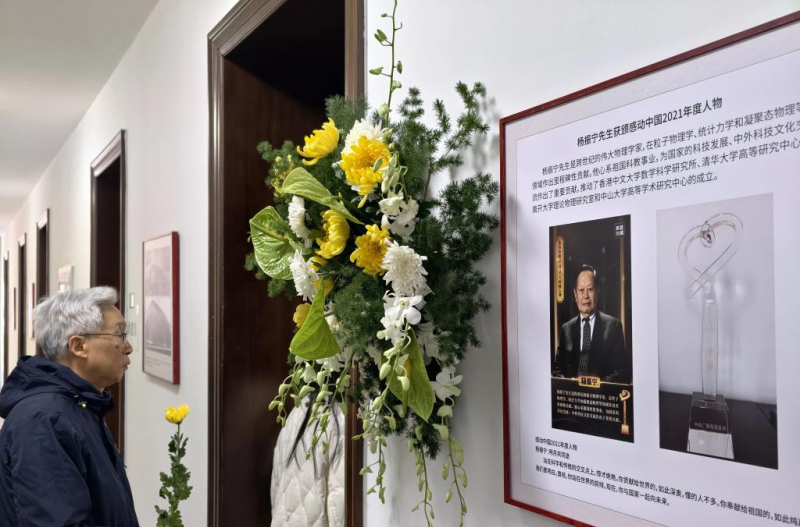
The announcement of the death of famous physicist Chen Ning Yang, Nobel Prize winner and academician of the Chinese Academy of Sciences (CAS), on Saturday caused a wave of emotion and tributes on social networks in China.
Considered one of the greatest physicists of the 20th century, Yang has been revered as a role model by generations of Chinese scientists. His achievements have significantly strengthened national confidence in national rejuvenation and scientific development.
Chinese netizens expressed deep sadness online, wishing Yang a peaceful rest and praising his contributions. “He is a scientific giant who proves that the Chinese are not inferior in cutting-edge science,” one comment read. Another netizen wrote: “Mr. Yang has played the role of an academic bridge between Chinese and Western civilizations.”
According to an obituary from Tsinghua University, Mr. Yang died Saturday in Beijing at the age of 103. He is described as “one of the greatest physicists of the 20th century, having made revolutionary contributions to the development of modern physics.”
The obituary points out that Mr. Yang made many breakthroughs in particle physics, quantum field theory, statistical physics and condensed matter physics, “profoundly shaping the development of these disciplines.”
Born in Hefei, in eastern China’s Anhui Province, in 1922, at a time when China was plagued by warlord conflicts, poverty and imperialist encroachment, Mr. Yang earned a master’s degree at Tsinghua University in the 1940s before moving to the United States, where he held various teaching positions.
He is best known for his work on parity laws, carried out with Tsung-Dao Lee, who proved that the law of conservation of parity, once considered absolute in physics, could be violated in the weak interaction. This groundbreaking work earned them the Nobel Prize in Physics in 1957.
Yang-Mills gauge theory, which he proposed with Robert Mills, laid the foundation for the later Standard Model of particle physics. This theory is considered one of the cornerstones of modern physics and one of the most important achievements of physics in the 20th century.
Renowned biophysicist Shi Yigong, an ASC academician, said in an article that MM. Yang and Lee inspired many generations of young Chinese to respect science and pursue excellence, thereby contributing to the emergence of many eminent figures in basic research.
In retrospect, Mr. Yang himself felt that perhaps his greatest contribution was “building the confidence of the Chinese people.”
In 1999, Mr. Yang was appointed professor at Tsinghua University in Beijing. Previously, he was appointed in 1997 as honorary director of the university’s newly established Center for Advanced Studies (now the Institute for Advanced Studies).
“Since returning to China, Mr. Yang has considered educating China’s brightest minds as his primary mission — a commitment to which he has devoted more time and energy than anything else,” said Zhu Bangfen, a condensed matter physicist, CSA academician and professor at Tsinghua, who had a close relationship with Mr. Yang.
To the staff and students of Tsinghua University, this eminent scientist was always energetic, humble and calm, with a clear mind. Students sometimes encountered him on campus and shared photos of these encounters on social media.
Even at age 82, he took to the podium to teach general physics to first-year students.
“He was a highly respected master scientist with a broad view and without prejudice. He always offered selfless support and encouragement to young researchers,” said Wang Xiaoyun, a cryptography expert and professor at the Tsinghua Institute for Advanced Study.
“What Mr. Yang hoped most was for more Chinese people to participate in world-class research and contribute to solving China’s practical problems with our own technologies,” Wang added.
According to the obituary, Mr. Yang devoted “tremendous efforts” to the advancement of core disciplines such as physics and the cultivation of talents at Tsinghua, thereby “making considerable contributions” that profoundly impacted the reform and development of China’s higher education. The document also calls him a “pioneer in building the bridge of academic exchanges between China and the United States.”
Mr. Yang’s century-long journey from young physics student at Tsinghua to Nobel Prize winner to dedicated educator in his homeland also reflects the trajectory of modern China, from the depths of modern-day crisis to the path of great revival.
His hometown, Hefei, is currently home to several national laboratories and large scientific facilities, including the Experimental Advanced Superconducting Tokamak (EAST), the “artificial sun” that explores the prospect of harnessing nuclear fusion for power generation.
Hefei residents also expressed their admiration for Mr. Yang, drawing inspiration from his patriotism.
“In his later years, Mr. Yang returned to China with an unwavering determination to contribute to the country’s scientific development. His dedication to science and love for the motherland will be passed on to younger generations of scientists,” said Kuang Guangli, academic director of the High Magnetic Field Laboratory of the Hefei Institute of Physical Sciences under the CSA.
At the age of 99, Mr. Yang donated his personal collection, which includes more than 2,000 books, manuscripts and letters, to Tsinghua University.
“What I hope to see preserved in the Tsinghua archives is not only my scientific work, but also the entire truth about the man Chen Ning Yang,” he said.



![[C Finance]Central Bank: The goal of keeping the RMB exchange rate basically stable will not change](https://beijingherald.com/wp-content/uploads/2025/01/C-FinanceCentral-Bank-The-goal-of-keeping-the-RMB-exchange-120x86.jpeg)