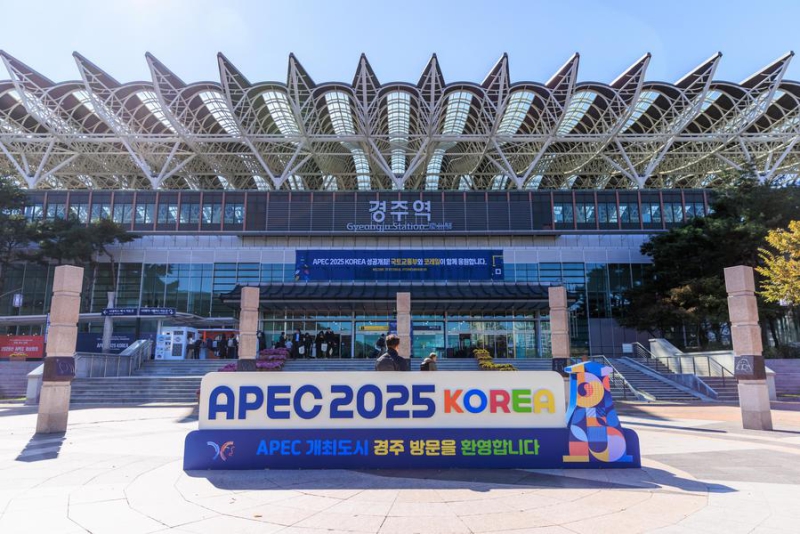
Photo of a publicity installation of the 32nd Asia-Pacific Economic Cooperation (APEC) Economic Leaders’ Meeting in Gyeongju, Republic of Korea, October 28, 2025. (Photo: Park Jintaek)
China’s push for greater opening-up and global collaboration was highlighted at the Asia-Pacific Economic Cooperation (APEC) economic leaders’ meeting in the Republic of Korea.
With its continued commitment to high-level opening-up and strong innovation capabilities, the world’s second-largest economy is well-positioned to drive the prosperous future of the Asia-Pacific region and maintain its role as an engine of global economic growth.
INCREASED OPENNESS
Nicknamed the “miracle of the Asia-Pacific”, the region has become a pole of global economic growth, a pillar of development stability and a hotbed of international cooperation.
China has long understood that its economic success is closely linked to the stability and growth of the entire region. As a result, it has consistently pursued a strategy of opening up and spurring innovation to strengthen its own economy, while providing a considerable boost to other regional economies.
“We should gradually expand the opening-up of the regulatory framework, uphold the multilateral trading system, promote the development of the international economic circuit, stimulate reform and development through opening-up, share development opportunities and realize common development with the rest of the world,” according to the proposals on the formulation of the 15th Five-Year Plan recently adopted at the fourth plenum of the 20th Central Committee of the Communist Party of China.
Over the past five years, China has ranked as the world’s largest trader in goods and second in services. It has attracted more than $700 billion in foreign investment, while its overseas investments have grown at an average annual rate of more than 5%. The country also shortened the negative list for foreign investments and extended its unilateral visa waiver policy to more countries.
In the first three quarters of this year, China’s imports and exports with other APEC economies increased 2 percent year-on-year, reaching 19.41 trillion yuan (about 2.74 trillion U.S. dollars), accounting for 57.8 percent of the country’s total import and export value, according to official data.
Today, China’s economic policies, particularly its high-level opening-up strategy, play a crucial role in boosting regional growth and prosperity. Efforts such as the Belt and Road Initiative (BRI) have strengthened connectivity between China and other economies through trade, logistics and digital infrastructure.
Through cooperation mechanisms such as the BRI, the Regional Comprehensive Economic Partnership (RCEP) and the China-ASEAN Free Trade Area 3.0, trade barriers in the region will be further reduced, and cooperation will also extend to emerging green, digital and artificial intelligence (AI) industries, said Liu Jing, chief China economist at HSBC Bank.
China’s rise to global economic power has been remarkable, and its door to the world will continue to open ever wider.
INNOVATION FOR ALL
China places great emphasis on innovation to grow its economy, and its prowess in high-tech industries such as AI, robotics and renewable energy has propelled it to the forefront of global technological advancements.
But China is not only boosting its own economy, it is also helping to accelerate growth across the Asia-Pacific region. As highlighted at the APEC meeting, the country aims to “collectively eliminate poverty and promote shared prosperity for all people in the Asia-Pacific region” and “deepen cooperation on open source technologies, while building an open and competitive ecosystem for innovation.”
According to Liu, a growing number of foreign-invested companies are establishing research and development centers in China, choosing the country as a hub for manufacturing and innovation. At the same time, more Chinese companies are expanding globally, setting up factories in regions close to end consumers, including many economies in the Asia-Pacific region.
HSBC predicted that China’s development in AI and robotics will have positive spillover effects through its trade and investment network. China’s technological progress and market advantages will continue to provide new growth drivers and ensure the stability of regional cooperation; APEC members will accelerate their own green transformation and digital upgrade through collaborations in the areas of industrial chain, capital and innovation, thereby promoting the progress of the entire Asia-Pacific region.
Mutual learning and collaboration have helped the Asia-Pacific region maintain its status as a global center of scientific and technological innovation, home to the world’s most active networks of people, finance, logistics and information, as well as some of the most important industrial chains, said Dai Erbiao, director of the Asian Growth Research Institute.
Dai believes that as host of the upcoming APEC Economic Leaders’ Meeting, China will advance regional cooperation by encouraging new industries in environmental protection as growth engines, promoting technological progress in life sciences and healthcare, supporting the healthy development of high-tech sectors such as AI, and strengthening mutual understanding among APEC members.



![[C Finance]Central Bank: The goal of keeping the RMB exchange rate basically stable will not change](https://beijingherald.com/wp-content/uploads/2025/01/C-FinanceCentral-Bank-The-goal-of-keeping-the-RMB-exchange-120x86.jpeg)