The rise of the Chinese aircraft manufacturer on the world stage looks less and less like a dream and more and more like a reality.
A C919 performs a demonstration flight over Victoria Harbor in Hong Kong, December 16, 2023.
China’s aviation industry is at a pivotal moment. For years, it focused on domestic demand. Today, the aircraft manufacturer COMAC (Commercial Aircraft Corporation of China) is aiming higher: the company aims to become an international competitor, to reshape the future of the skies and to increase China’s industrial and economic influence.
According to the Air Data News site, Air Cambodia (Cambodia) has secured an order for ten C909s, the largest for this aircraft outside China, becoming the fourth international operator after TransNusa (Indonesia), Lao Airlines (Laos) and Vietjet Air (Viet Nam). On the sidelines of the 10th Belt and Road Summit, held on September 10-11, 2025 in Hong Kong, Tony Fernandes, CEO of AirAsia, expressed the Malaysian airline’s ambition for COMAC’s flagship single-aisle aircraft: “We are in active discussions to become the first foreign airline to operate the C919. » This interest even goes beyond the borders of Asia. At a European aviation conference earlier this year, Michael O’Leary, CEO of Irish airline Ryanair, said: “If it was cheap enough, say 10% or 20% cheaper than an Airbus, then we would order it.” »

China Eastern Airlines flight MU6339 landed at Taoxian International Airport in Shenyang, marking the official arrival of the first domestic C919 aircraft in northeast China on March 30, 2025.
From C909 to C919
The history of COMAC began with the C909, a regional aircraft with a capacity of 78 to 90 passengers. Reliable on secondary routes in China and South-East Asia, it attracts with its ability to serve small airports, offering operational flexibility appreciated by airlines.
The C919 marks the second stage of the aircraft manufacturer. With its 174 seats and a range of 5,500 km, it targets short and medium-haul flights, the heart of global air transport. Beyond the technical specifications, it symbolizes China’s entry into the circle of manufacturers capable of manufacturing modern aircraft competitive with historic models.
According to aviation analysis firm Cirium, as of September 2025, the C919 was already showing significant activity within China’s three major carriers. Air China operated 530 flights, China Eastern Airlines operated 1,100 and China Southern Airlines 535. The airliner is accumulating tangible operational experience in its domestic market, an essential prerequisite for gaining trust internationally.
At the end of March 2025, COMAC had 1,317 firm orders, 155 purchase options and 185 devices delivered. Although the majority of deliveries still concern the C909, the gradual integration of the C919 into Chinese fleets, particularly at China Eastern, demonstrates growing confidence in domestically manufactured aircraft. It remains to be seen whether this credibility will be exported to the global market.

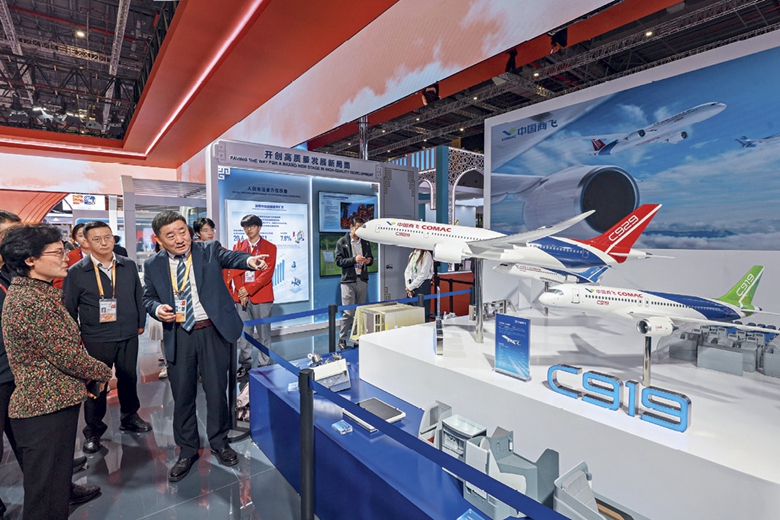
Visitors admire models of the C919 and C929 in Shanghai, November 5, 2024.
The ambitions of the long-haul C929
COMAC is also working on the C929, a wide-body twinjet with 280 to 320 seats, with a range of 11,250 km. This project, the aircraft manufacturer’s most ambitious to date, targets the long-haul flight market. Its success could demonstrate China’s ability to manufacture aircraft suitable for intercontinental operations, not just regional flights.
The C929 represents a litmus test for Chinese aeronautical ambitions. If successful, it would open access to the most lucrative segments of aviation, boost high-value manufacturing and encourage domestic innovation in materials and engineering. Skeptics, however, point out that long-haul planes face greater challenges, including international certification, maintenance networks and airlines’ reluctance to take a risk on unproven platforms.
COMAC’s strengths on the international scene
Several factors suggest real international potential for COMAC. Airlines in Asia, Africa and Latin America are expanding rapidly, but remain highly cost-sensitive. COMAC aircraft offer them a less expensive way to expand their fleet.
The C909 and C919 have already accumulated thousands of flights on Chinese territory. This operational reliability reassures both the regulatory authorities and the carriers who plan to adopt these devices.
Strategic initiatives like Belt and Road go beyond simple sales: they aim to create integrated ecosystems, combining trade, logistics and aviation partnerships, providing COMAC with a growing market and a solid foundation for expansion.
COMAC’s strategic vision
COMAC’s progress transcends the simple commercial balance sheet; they demonstrate the emergence of a serious player on the world aeronautical scene. The support of figures like Tony Fernandes and Michael O’Leary are testament to the credibility the company has gained.
COMAC’s success demonstrates that Chinese engineering can meet international standards and global demand, generate high value-added economic opportunities and position China in one of the most competitive sectors in the world.
With the C909 laying the foundation, the C919 proving itself in daily operations, and the C929 targeting the long-haul market by the end of the decade, COMAC’s rise to the global stage is looking less and less like a dream and more and more like a reality.
*ANTONIO ALVAREZ is a columnist at