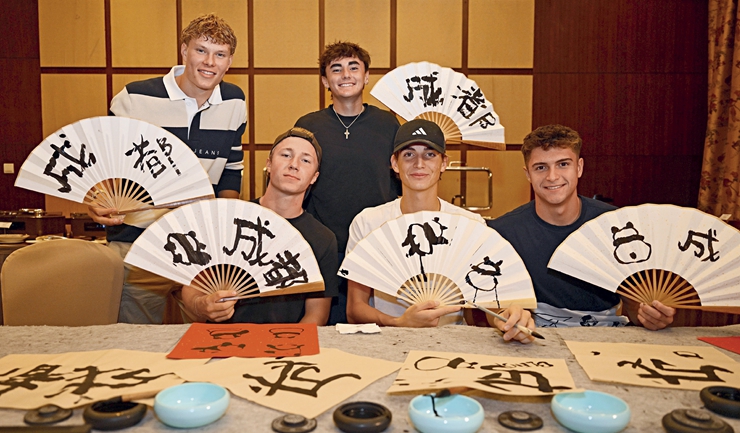
Young tennis players practice Chinese calligraphy on the sidelines of the 2025 ITF World Tennis Tour Junior World Final in Chengdu, Sichuan, October 19, 2025.
In a rapidly changing international landscape, marked by increasing unpredictability, relations between China and Europe are going through a pivotal adjustment phase. On both sides, a conviction is taking hold: only increased mutual understanding and appropriate management of differences can guarantee the stability and sustainability of bilateral relations. At the heart of this dynamic, exchanges between young people stand out as an irreplaceable lever.
Leaders of both parties have high hopes for young people. In 2014, at the College of Europe in Belgium, Chinese President Xi Jinping urged young Chinese-Europeans to “see the world with equality, respect and benevolence, and appreciate different civilizations with openness, tolerance and the spirit of mutual learning.” More recently, during his visit to Sichuan University, French President Emmanuel Macron echoed this vision: “This century is yours, you are the generation that will build it, live it and shape it. This century will only be habitable if we can understand each other on a global scale, be patient and build solutions for the future together. » These words from Chinese and French leaders reveal an essential consensus: young people are bridges to the future, and their interactions will profoundly shape the development of Sino-European relations.
How can we transform this consensus into lasting and effective actions?
First of all, immersion remains the most effective remedy against prejudice. By setting foot on Chinese soil, young Europeans are freeing themselves from media clichés to discover a tangible reality: practical mobile payment, a high-speed train network linking cities and countryside, an urban landscape combining modernity and tradition, as well as a confident and serene population. Likewise, young Chinese in Europe are imbuing themselves with unique know-how in town planning and heritage preservation. These field experiences dispel misunderstandings born from distance.
Then, information technologies offer a space for dialogue transcending borders. Thanks to social networks and intelligent translation tools, young Chinese-Europeans can now exchange with unprecedented ease, which allows for mutual “rediscovery” around common interests.
Most importantly, these exchanges must move from cultural perception to shared responsibility. True trust is built when we tackle global challenges together: ecological transition, digital governance or even public health. It is on these issues that young people can overcome divisions to collaborate.
By meeting, these young people realize that their aspirations – professional success, family fulfillment, desire for a more just and sustainable world – outweigh their differences. These human values constitute a solid basis for transcending cultural and institutional differences.
If exchanges between young people are not a “universal key” to solving all problems, they constitute a fundamental project looking to the future. When young people observe for themselves, engage in open dialogue, and build bridges of cooperation, they make China-EU relations more resilient and inclusive, injecting valuable force of stability into an uncertain world.



![[C Finance]Central Bank: The goal of keeping the RMB exchange rate basically stable will not change](https://beijingherald.com/wp-content/uploads/2025/01/C-FinanceCentral-Bank-The-goal-of-keeping-the-RMB-exchange-120x86.jpeg)