What if the future loomed in the native village? The winning bet of a young entrepreneur.
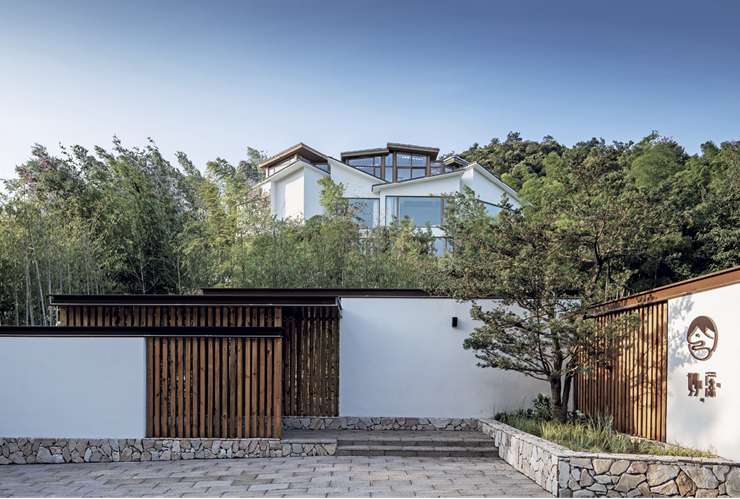
Wang Ying’s guest house retains some original features.
History is not written in comfort. It belongs to those who combine youth, conviction and courage. Progress comes from action, not from dreams. Sometimes, audacity does not consist of running towards the city, but of returning to the roots to revive them.
This is the story of Wang Ying, a young woman who could have stayed in the city, but chose to return to the quiet hills and bamboo forests of Longshan Village, Miaoxi Town, Huzhou (Zhejiang). His choice goes beyond his personal journey: it marks a turning point for the Chinese countryside, where talents are returning to invest.

Outdoor pool
The choice of return
A graduate of Gongshang University in Zhejiang, Wang Ying had a stable job. It had everything many young people look for: a good salary and urban excitement. However, one question obsessed her: what becomes of the village that saw her grow up when all the young people have left, leaving behind empty houses, a weakened culture and isolated elders?
The turning point came in 2017, during a stay in a small guest house in Viet Nam. The hospitality and atmosphere of the place remind him of his native region – the green hills and tea plantations. She is convinced: Longshan can offer the same authenticity, as long as someone invests in it.
In 2018, she resigned and returned to her village. If nature was intact, the village seemed frozen: silent businesses, deserted houses and rare opportunities. She could have turned back, but she decided to look to the future. Where others saw a decline, she saw a project to build.

Family room
A look towards tomorrow
Wang Ying did not see the gaps, but the potential of the village: its land, its memory and its rural conviviality that the cities could not reproduce. But resources are not enough; they require vision, method and will.
Old farms could become welcoming guest houses; the centuries-old tea culture lent itself to experiences for visitors; the villagers could find roles as host, artisan and storyteller.
Change, however, required more than ideas: it required patience, dialogue and persuasion. Wang Ying went door to door, listening to each villager to understand their expectations and learn more about their skills. From this dialogue was born a trust essential to collaboration.

Exterior view
The revival of the village
Among the abandoned houses, an old cracked building caught his attention. Many villagers walked past as if they were walking past a memory. Wang Ying stopped, imagining her rehabilitation in a guest house.
She brought together artisans and villagers to restore the building while respecting local techniques: repointed earthen walls, consolidated exposed beams, brightened and planted courtyards. The inspiration came from Lu Yu’s Tea Classic: the house is designed as an invitation to immersion, slowing down and a feeling of belonging.
When it opened in June 2019, there was no big talk, just early tea under the bamboo. Wang Ying shared the project on the social network RedNote. A slide, an infinity pool and ambient serenity. His publications generated such enthusiasm that reservations poured in even before the inauguration.
Today, city dwellers from Hangzhou, Shanghai and even Beijing come to seek calm. They participate in tea workshops, walk in bamboo forests and discover local crafts.
Prosperity did not take long to come, irrigating the entire community. Income from the guest house benefits the villagers, weavers, cooks, housekeepers and storytellers.
Elders pass on the art of bamboo weaving; village women run cooking or sewing workshops; even local vegetables are regaining their value. The work has brought dignity and laughter back into the classroom. Miaoxi is no longer a forgotten dot on the map, but a destination worth the trip, the investment and – for some – the return.

Wang Ying in his native village of Longshan
Agriculture as identity
If tourism has brought new energy to the village, agriculture remains its base. Tea, bamboo shoots and seasonal crops from Longshan, despite their abundance and quality, were previously sold for next to nothing to middlemen. Wang Ying transformed these harvests into branded products through careful packaging and enhanced quality control. Agriculture is no longer a mere subsistence; it has acquired aesthetic and economic value.
This renaissance has especially changed the lives of seniors. Emerging from inactivity, they became teachers or guardians of memory, paid for their expertise rather than simply solicited because of their age.
To date, cultural and tourism projects have created more than 50 permanent jobs and more than 3,000 flexible jobs in Longshan. The annual per capita income increased by more than 30,000 yuan. In 2024, the village’s collective income reached 1.38 million yuan. But beyond the figures, it is the newfound confidence that takes precedence: the village is no longer a dead end, but a horizon.
More than an individual story, Wang Ying’s journey sketches the future of the Chinese countryside: their modernity does not lie in an imitation of the city, but in the full expression of their identity. His story reminds us that progress does not always require leaving. When young people return to their roots, villages flourish and, with them, the nation prospers.
*ANTONY HARDI is a journalist at