While coastal areas are saturated, China is banking on high-tech floating farms on the high seas. It is laying the foundations for a new food model that is mobile, sustainable and resilient.
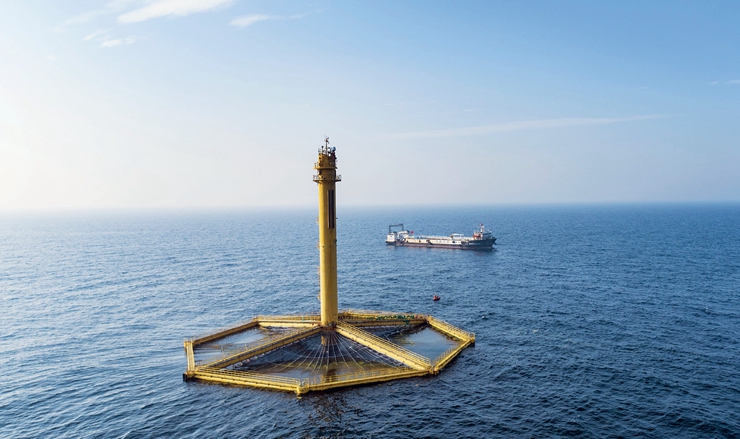
An aquaculture and processing vessel anchors at an offshore aquaculture area in Qingdao, Shandong.
If you’ve eaten fish recently, chances are it didn’t come from a typical coastal fish farm. Coastal areas, once full of promise, are today saturated, sometimes polluted and subject to increasingly strict environmental and climatic constraints. Population growth and global demand for marine proteins are increasing pressure on these limited areas. Faced with these challenges, the agri-food industry is exploring new horizons to feed the planet… and aquaculture farms in the open sea present themselves as a strategic and innovative solution.
China, the world leader in aquaculture for several decades, is committed to this transformation. With the Guoxin 1, it inaugurates the first intelligent aquaculture vessel of 100,000 tonnes, capable of raising fish on the high seas under strictly controlled conditions. Measuring nearly 250 m long and 45 m wide, with a displacement of more than 130,000 tonnes, it can weather storms and typhoons, while maintaining a stable aquatic environment for fish. Its 15 pools total nearly 90,000 m³ of sea water, the equivalent of several dozen Olympic swimming pools, and make it possible to raise different species such as yellow croaker, grouper or Atlantic salmon, with optimized growth cycles.
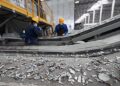
Recently, off the coast of Zhoushan, in Zhejiang province, the Guoxin 1 very concretely illustrated this rise in power. More than 46,000 yellow croakers were collected in a single operation. The fish, kept alive until the last moment, are transferred by suction to the processing deck, where they are immediately immersed in an ice slurry to preserve their quality.
The harvest is carried out in low light conditions, a parameter controlled to preserve the golden hue characteristic of the species. In around fifteen minutes, rapid cooling lowers the surface temperature of the fish to around 3°C, instantly freezing their freshness.
“This cooling phase is essential to ensure the quality of the product straight out of the water,” explains Sun Linlin, the ship’s production manager.
Since its launch, Guoxin 1 has illustrated China’s strategic role in food innovation. The country plans to deploy several similar vessels, with even larger models, to strengthen its food autonomy, secure its supply chains and export this technological model globally. This initiative is part of a long-term vision, where the high seas become an organized food production space, complementary to coastal areas and capable of feeding millions of people.

Official delivery of the intelligent ship Guoxin No. 1 2-2, with a capacity of 150,000 tons, in Qingdao (Shandong), November 15, 2025
The Guoxin 1, the intelligent ship
The Guoxin 1 is more than just a giant floating cage. It is designed as a complete farm on the water, integrating breeding, health monitoring, harvesting, processing and logistics, all in real time using automated systems.
The fish are introduced as juveniles, from specialized nurseries, which have already left the larval phase and resemble small adult fish.
“These small fish are ready to be transferred to the ship for deep-sea breeding,” said Wu Yimei, a juvenile specialist. On board, conditions of temperature, oxygen, salinity and water renewal are stabilized to promote regular growth, minimize stress and reduce mortality.
Each pond is equipped with intelligent sensors that constantly monitor environmental parameters and nutrition. Automated systems adjust the amount of food and water circulation to optimize fish growth and limit losses. But despite automation, human expertise remains central: technicians and engineers intervene daily to check the health of the fish, adjust the parameters and quickly resolve any problems. “These technologies make it possible to produce better and more efficiently, with maximum food safety,” explains Xu Hao, a researcher at the Research Institute of Fisheries Machinery and Instruments under the Chinese Academy of Fisheries Sciences.
The mobility of the ship is a strategic asset. It can move to avoid degraded water, harmful algae or unfavorable weather conditions. This flexibility reduces fish stress, ensures uniform growth and improves flesh quality. Harvesting takes place in precise cycles, with fish transported quickly to the port for processing, packaging and distribution, which guarantees freshness, traceability and food safety. This approach also makes it possible to reduce food waste and optimize volumes delivered to markets.
The sea, the farm of the future
Thanks to this ship, Chinese agri-food is gaining ground: the sea becomes a mobile and controlled farm, capable of feeding millions of people. But the Guoxin 1 goes well beyond simple production. It embodies a new way of thinking about food, where technology and nature work hand in hand to meet the needs of a growing world. By exploring deep waters and controlling breeding conditions, this vessel paves the way for more sustainable aquaculture, more resilient in the face of climatic hazards and pressures on coastal zones.
It also illustrates China’s strategic role in food innovation, placing agri-food at the heart of solutions for global food security. Each fish raised on board becomes the symbol of a more transparent, traceable and responsible sector, where product quality and integrity are no longer options, but a standard. Thanks to full traceability and production cycle planning, Guoxin 1 ensures stable volumes for national and international markets, while limiting food waste and maximizing product freshness.
More than a technical feat, the Guoxin 1 is a manifesto for the future of the sea as a living and sustainable resource. It demonstrates that it is possible to reconcile innovation, productivity and respect for the environment, by reducing pressure on saturated coastal areas and exploiting deep waters responsibly. This ship also illustrates the scale of the Chinese strategy: building a fleet of mobile farms capable of transforming food security on a national scale and offering an exportable model, inspiring other countries to rethink their aquaculture.
In short, the Guoxin 1 is not just a breeding tool. It is the symbol of a future where people and oceans collaborate intelligently, where each technological initiative contributes to feeding the planet sustainably, and where the sea becomes a true partner in global food supply. This vision lays the foundations for an aquaculture of the future, capable of responding to the challenges of population growth, climate change and food security, while preserving the balance of marine ecosystems.