From technical maintenance to local manufacturing, the cooperation between Siemens Energy and Yangpu has evolved with the Hainan Free Trade Port.
Hu Cheng tests the feedback signals from the control system of a Siemens gas turbine.
On the day of the launch of the Hainan Free Trade Port (PLEH) special customs operation, Danzhou’s Yangpu Economic Development Zone reached a historic milestone. Siemens Energy became the first foreign manufacturing company to make a concrete commitment to this new era by establishing Siemens Energy (Hainan) Co., Ltd. This initiative marked the start of the construction of a gas turbine assembly base and service center. About eight kilometers from the site, two Siemens V94.2 gas turbines, which had powered the island for thirty years, retired a month early, according to plan.
This succession symbolizes an industrial move upmarket and an opening spanning three decades. From maintenance service to local intelligent manufacturing, Siemens and Yangpu have jointly charted a synergistic development path.
From apprentice to expert
The Yangpu Economic Development Zone emerged in 1992 as China’s first territory developed by foreign investors under a free trade zone regime. The following year, the Yangpu Power Station, registered as a Hong Kong-owned company, had to respond to pressing energy demand despite a still embryonic network. To relieve this bottleneck, it installed two sets of Siemens V94.2 combined cycle gas turbines.
“At the time, it was the most advanced and powerful gas turbine in the country,” recalls Hu Cheng, chief engineer of the plant. In 1994, attracted by this project, he left Liaoning province for Yangpu, then a small fishing village.
As a key technician and translator, Hu Cheng oversaw the installation of the turbines and participated in their maintenance for decades. He remembers the constant expertise of the Siemens Energy team which provided rigorous technical support during each major intervention.
Although the Germans had long run operations, Hu Cheng worked to master key technologies by studying thousands of pages of manuals and observing every fine adjustment. With this technical background, he led his team to accomplish arduous tasks such as repairs in the engine room at nearly 50°C and emergency operations during the typhoon season. He also promoted a series of major technological upgrades such as converting from fuel oil to gas and reducing nitrogen emissions.
This increase in skills has consolidated the relationship between the two partners, leading in 2016 to a ten-year flexible service agreement to optimize the management of spare parts. In thirty years of service, these turbines with a total installed capacity of 440,000 kilowatts have generated more than 28.4 billion kilowatt hours. They supported up to 40% of the peak load of Hainan’s power grid and remained a pillar of stability despite seven major overhauls.
The rapid rise of more power enterprises in Yangpu and the vigorous development of clean energy such as wind and solar have gradually driven these turbines toward a natural end of cycle. In October 2025, after reaching their expected lifespan, they ceased to function.
“He’s like an old friend who has accomplished his mission. There is nostalgia, but above all pride: for thirty years, these two turbines have never failed and have never caused problems for the Hainan electricity network,” confides Hu Cheng. His journey alongside these machines allowed him to experience the transition of Yangpu, from an area with an electricity shortage to a modern and sustainable industrial hub.

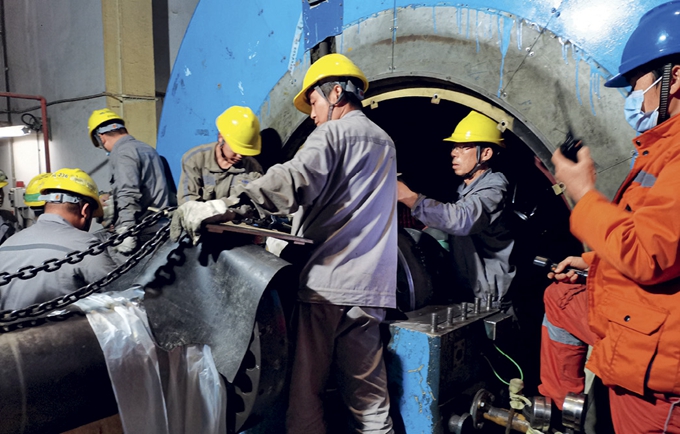
Installing a generator rotor
From supplier to co-builder
The release of the General Plan for the Construction of the Hainan Free Trade Port in 2020 propelled Yangpu to the status of a pilot area for institutional opening-up. The resulting reforms, notably customs reforms, create an environment conducive to commercial innovation.
Siemens Energy is focusing its localization strategy focused on China and the global market. This direction aligns perfectly with Hainan’s ambition to become a clean energy island and with national climate commitments. Yangpu’s industrial plans in manufacturing smart equipment have attracted the attention of Siemens Energy, which launched a new round of strategic discussions.
The lack of cutting-edge industrial infrastructure initially raised legitimate questions at Siemens Energy. Li Rui, deputy general director of Yangpu’s international energy development department, acknowledged that securing the supply chain for heavy turbines was a big challenge. What finally removed the company’s doubts were the continued improvement of the business environment in Hainan as well as the concrete benefits resulting from the special customs operation.
Hainan stands out for having China’s shortest negative list for access to foreign investment and pioneering measures in cross-border trade in services. By easing market access restrictions, the province has built a stable and transparent development environment for the global high-end manufacturing industry.
Lars Voelker, General Manager of Siemens Energy (Hainan) Co., Ltd., was able to see the efficiency of this administration from the first day of the customs operation. He obtained his company’s business license in just one business day, exemplifying what local players now call Yangpu speed.
The Siemens Energy gas turbine assembly base and service center is the first major foreign manufacturing project since the implementation of the new customs regime. Spanning almost 2.67 ha with a total construction area of more than 13,000 m2, the project, which is expected to be operational in 2027, will enable the local production of gas turbines. More than a production base, the project will serve as an integrated platform for technological innovation and offshore services.
This base will primarily target the markets of Hainan and Southeast Asia in the production of electricity from gas, offshore wind and green hydrogen. “This marks a new milestone in our cooperation,” says Joern Schmuecker, global senior vice president of Siemens Energy, highlighting the alignment with Hainan’s goals of building a high-level open economy hub.
“From commissioning the first turbine to deepening service cooperation to the implementation of this project, I have seen Siemens Energy move from a maintenance provider to a co-builder,” says Hu Cheng. This project not only provides an advanced technological ecosystem, it also propels Yangpu to the rank of a major industrial hub for the energy sector.
From industrial anchoring to talent rooting
The implementation of the project is only the beginning; the concentration of talents and the perfection of the industrial chain are the foundations for long-term development.
Siemens Energy’s facility in Yangpu has attracted several upstream companies such as Anhui Yingliu Group and ShenYang Instrument Transformer Co., Ltd. A high-precision manufacturing hub dedicated to high-end gas turbines is starting to take shape.
The first independent foreign university in China, the Hainan-Bielefeld University of Applied Sciences in Yangpu, will graduate its first graduates next year. Its training model directly responds to the industrial needs of PLEH and will provide tailor-made applied talents to companies.
In this industrial transformation, Hu Cheng has evolved from a field engineer to a skills expert, and now focuses on talent training.
In the training base established by the Yangpu Power Plant, it prepares teams to overcome future technical challenges and is committed to building a pipeline of versatile talents for the energy sector. “Our key technicians must become the central force in clean energy development. Just like these two old turbines, reliable and responsible, locally rooted,” says Hu Cheng.



![[C Finance]Central Bank: The goal of keeping the RMB exchange rate basically stable will not change](https://beijingherald.com/wp-content/uploads/2025/01/C-FinanceCentral-Bank-The-goal-of-keeping-the-RMB-exchange-120x86.jpeg)