Between humanoid robots serving the elderly and brain-machine interfaces, Wuhan is emerging as the new laboratory
Chinese smart economy.
Tourists visit China’s first 7S humanoid robot store in Wuhan, Hubei, February 25, 2026.
“By its appearance, its touch and the fluidity of its exchange, this humanoid robot defies our perceptions to the point of confusing itself with a human being. » This feat described by Huang Li, deputy to the National People’s Congress (NPC), is not the result of chance, but the emblem of Wuhan (Hubei), a Chinese industrial city undergoing rapid change. By including the digital and intelligent economy in its strategy, the metropolis has embarked on a frantic race towards brain-machine interfaces, seeking a new engine for its growth in this cutting-edge sector.
This quest for excellence is rooted in an industrial history lesson mentioned by Ma Xinqiang, also a NPC deputy and CEO of Huagong Tech. For him, it all started with a simple three-dollar screw. Once essential for fixing a laser, it has become the symbol of national awareness: key technologies cannot be bought, they are created internally.
As the 15th Five-Year Plan is rolled out, Wuhan finds itself at a crossroads, driven by this fierce desire for autonomy and progress. The question is no longer whether the city can project itself into the future, but by what levers it intends to impose itself technologically. Through the journey of two entrepreneurs, we attempt to provide some answers to this crucial question of our time.

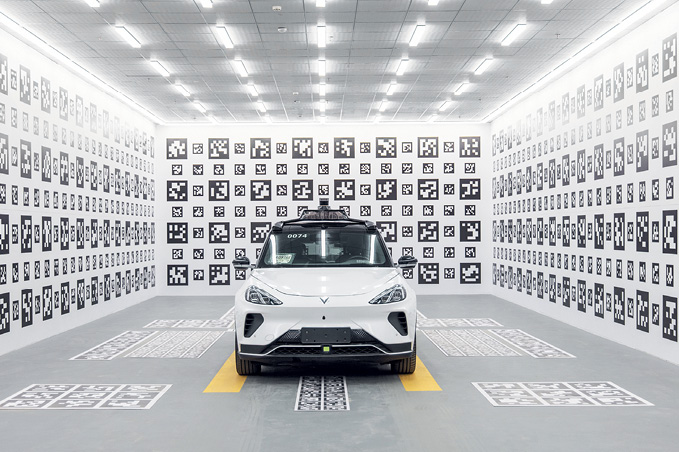
Apollo Moon, Baidu’s 5th generation of autonomous vehicles, being calibrated at Apollo Park in Wuhan (Hubei), September 5, 2023
Tireless efforts
If we wanted to give a concrete image of the rapid development of the industries of the future in Wuhan, and by extension in China, two figures would be enough to measure the scale: three dollars and 65,000 channels.
Twenty years ago, Ma Xinqiang had to practically beg his suppliers for a simple spare part. “At the time, high-end laser equipment came almost exclusively from abroad. Down to the smallest fixing screw, we were obliged to import it at a price of three dollars each. »
Always driven by this same determination, Huagong Tech has maintained, over the last two decades, a strategy resolutely focused on the future, with an average annual growth of its R&D investments greater than 20%. Thanks to this long-term vision, the company is now able to laser weld the body of an electric vehicle in just 43 seconds. A technological advance which forced foreign suppliers to reduce their prices by 40%, thus propelling the Chinese laser industry among the world leaders.
If Ma Xinqiang embodies the resilience of Wuhan, Huang Li represents, for his part, the visionary capacity to anticipate the disruptions of tomorrow.
After having established his company among the international leaders in the field of infrared, Huang Li was not content with his achievements, turning his gaze towards horizons then unexplored. Five years ago, when the brain-machine interface was still unknown to many, he already laid the groundwork for the Wuhan Zhonghua Brain-Computer Interface Fusion Technology Development Co., Ltd. For Huang Li, technological anticipation is not a bet, but a direct response to the state’s strategic priorities.
The news he brought back from the Two Sessions confirms this ambition: his 65,000-channel brain-machine interface chip ranks among the most efficient in the world, while clinical trials on 2,048 channels are progressing steadily. This technology worthy of science fiction is becoming a tangible reality to treat the incurable.
From the vulnerability symbolized by a screw worth a few dollars to the decisive breakthrough of thousands of neural channels, these two entrepreneurs from Wuhan define what the industries of the future truly are. Far from being an abstract concept, they are akin to a real marathon requiring forward-looking vision, strategic consistency and tireless efforts.

Humanoid robots from the Hubei Humanoid Robotics Innovation Center at the China 5G + Industrial Internet Conference in Wuhan, Hubei, November 22, 2025
The secret of synergy
If companies act as scouts on the front line, the city of Wuhan stands out as the essential base camp for their logistical support. Where does the confidence with which the metropolis aims to become a major hub of the digital and smart economy come from? For Ma Xinqiang, the answer lies in extraordinary industrial synergy.
Wuhan, the world’s leading production base for optical fibers and cables and birthplace of Dongfeng Motor, is proudly nicknamed the “Optical Valley” and the “Automobile Valley” of China. The meeting of these two industrial sectors has triggered a real chemical reaction: on-board optical fibers offer the autonomous vehicle a transmission rate of around 10 Gbit/s, while cutting-edge chips provide the intelligent car with an ever more efficient brain.
This synergy constitutes Wuhan’s unique advantage. It differs both from cities which owe their growth to the Internet economy alone or from purely manufacturing centers. The barriers between the digital economy and the real economy are disappearing in favor of what Huang Li describes as a new “form of industry”, born from the superposition between fundamental technologies and emerging algorithms.
His company Wuhan Zhenyou Technology is focused on dispelling the coldness of humanoid robots. By developing highly flexible joints and biomimetic skin coupled with the multimodal perception of AI, the company is enabling robots to leave the factory and enter homes. These machines then become life assistants capable of offering a warm presence to elderly people.
This is the secret of Wuhan’s success: its ability to link high technology to the vast industrial system and the real needs of the population.
The favorable atmosphere
The industries of the future offer fascinating prospects, but invariably face a triple challenge: long R&D cycles, colossal investments and uncertain short-term profitability. While cities everywhere are jockeying for pole position, how does Wuhan manage to convince entrepreneurs like Huang Li to commit their resources to technologies that still seem like a gamble? The answer lies both in the mechanisms deployed and the posture adopted by the municipality.
“Institutional innovation is not a simple aesthetic addition, but the key to breaking out of the rut,” emphasizes Ma Xinqiang. To make the company a true economic player, the management team must be given full autonomy in its operational decisions.
This logic of rupture now extends to local authorities. In 2026, Wuhan unveiled a new action plan for the digital economy, which explicitly provides for the establishment of increased investment and risk-sharing mechanisms for the industries of the future. An observation shared by Huang Li: “The very essence of innovation is not fearing failure. Funds cannot simply seek short-term returns without risk; it is necessary to establish an error tolerance mechanism. »
The major advantage of private companies lies in their courage to experiment: a one in ten chance of success can be enough to revolutionize an entire sector. This spirit of risk-taking can only flourish with the joint support of patient capital and “lenient” policies.
The human dimension
We must certainly climb to the heights of technology, but it must ultimately find its anchor in humans.
At the economic press conference on March 6, Zheng Shanjie, head of the National Development and Reform Commission, highlighted two age categories: “very old people” and “very young children.” Over the next five years, China plans to accelerate the upgrading of retirement facility equipment and provide each prefecture-level city with at least one integrated child care center. This orientation perfectly fits with the idea of “technology for good” defended by Huang Li.
Why, then, invest massively in humanoid robots? Why strive to perfect bionic skin or the emotional understanding of machines? Huang Li’s answer is unequivocal: a truly revolutionary product always ends up entering homes. He hopes his robots can play a role in intelligent services for the elderly and medical rehabilitation, taking over where humans reach their limits or struggle to act.
Discussing the industries of the future is therefore not just about aligning GDP figures or celebrating a sector worth 200 billion yuan. It is, above all, defining the face of the support we will benefit from in our old age and defining the technological environment in which our children will grow up.
Under the 15th Five-Year Plan, China has clearly identified its strategic priorities, from brain-machine interface to embodied AI and quantum technologies. The example of Wuhan undoubtedly offers the most vivid illustration of the place China occupies in this global technological race.