The book series Xi Jinping: The Governance of China allows African countries to explore their own development paths.
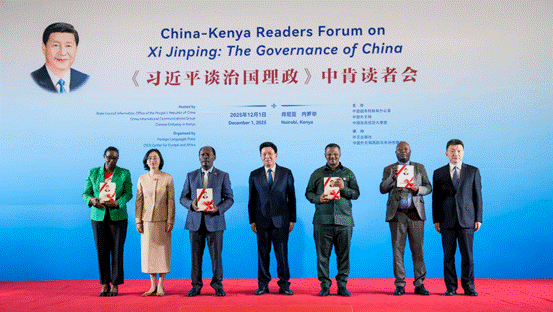
The China-Kenya Readers’ Forum on Xi Jinping: China’s Governance in Nairobi, capital of Kenya, December 1, 2025
Faced with the collective emergence of countries in the Global South and as awareness of their autonomous development continues to grow, China’s development path and governance experience are attracting growing interest from the international community, particularly African countries. Recently, at the Xi Jinping: Governance of China series reader forums held in Kenya and South Africa, the meaning of modernization with Chinese characteristics was explored in detail, sparking in-depth discussions and broad consensus among African policymakers and scholars.
Go beyond a single development model
In international discourse, there is a long-standing narrative that simplistically equates “modernization” and “Westernization.” In just a few decades, China has accomplished a process of rapid industrialization while maintaining long-term social stability, an achievement that offers countries around the world, particularly those in the Global South, a different perspective.
Hassan Omar Hassan, secretary-general of the Kenya United Democratic Alliance, noted that many African countries had attempted to replicate Western democratic and economic models, but had often found themselves caught in political turbulence and slowing development. He believes that the series Xi Jinping: The Governance of China reveals a fundamental truth: there is no fixed development model and we must rely on national specificities.
This idea found an echo in South Africa. Cedric Frolick, Speaker of the National Assembly of South Africa, noted that modernization with Chinese characteristics represents a completely new model, which rejects the colonization and plunder common in the process of Western modernization, prioritizes peaceful development and shares opportunities with the world. This offers countries in the Global South a new vision of prospering without sacrificing their sovereignty, and modernizing without abandoning their traditions.
Paul Tembe, a sinologist and founding director of the South African think tank SELE Encounters, points out that the Chinese experience is rooted in a five-thousand-year-old civilization. Just as the Ubuntu spirit in South Africa emphasizes community, he notes that the biggest lesson from the Chinese experience lies in cultural trust. “We have to solve our problems with our own philosophies,” he believes.

Kenyan readers view copies of Xi Jinping: The Governance of China.
Rule of the people and national governance
Once the correct development direction is determined, effective governance is essential to achieve the goals. Participants extracted several key elements of the Chinese governance system from Xi Jinping: The Governance of China.
The first fundamental principle is that of the primacy of the people. William Kabogo Gitaū, Kenyan Cabinet Secretary in charge of the Ministry of Information, Communications and Digital Economy, quotes President Xi Jinping, who remarked that “the people’s aspirations for a better life are our goal of struggle”, emphasizing that this fits perfectly with Kenya’s vision, which strives to improve the well-being of citizens and empower the most disadvantaged sections of society.
Kenyan MP Beatrice Elachi also points out that Chinese policy focuses on solving concrete problems related to people’s daily lives, and that its pragmatic approach is a model that African parties could adopt.
The second element is continued political courage towards self-reform. Kirtan Bhana, director of the Diplomatic Society of South Africa, is particularly impressed by the anti-corruption discussions in the book. He cites the phrase “Displease a few thousand people, but don’t betray 1.4 billion people” to emphasize the determination to place national interests above personal interests. This endogenous corrective capacity, where the Party implements reforms within itself, is essential to maintaining China’s vitality and dynamism.
The third element is foresight and continuity of strategic planning. Cedric Floreck considers that China’s five-year plans are a fundamental element of effective governance. He believes that they ensure the stable implementation of long-term national strategies, thereby avoiding policy interruptions caused by electoral cycles and ensuring the achievement of long-term goals. This governance capacity is a valuable model for many African countries.
Poverty reduction and green development
China’s development concepts are eventually translated into practical results. Among these, victory in the fight against poverty and the advancement of the green transition are like practical manuals particularly followed by African participants.
Thembinkosi Josopu, a board member of the National Development Agency of South Africa, visited China to study poverty reduction projects. He was particularly struck by the concept of targeting. “China has abandoned the large-scale watering method and is using big data to accurately identify poor populations, analyze the causes of poverty, and then develop policies tailored to households and individuals. It is a scientific, complete and traceable system. He believes that China’s multidimensional assistance experiences, covering industry, education, and health, provide considerable practical value for African countries in their fight against poverty.
Maropene Ramokgopa, Minister in the Presidency for Planning, Monitoring and Evaluation of South Africa, notes that South Africa is actively borrowing Chinese practices in state enterprise reform, green transition and technological innovation. These concrete experiences provide African countries with direct examples that they can observe and learn from.

Xi Jinping: The Governance of China series presentation stand
An international practice of peaceful development
China’s governance philosophy is not limited to the country, it also extends to its international relations. Forum participants largely agreed that China’s path of peaceful development, as well as cooperation initiatives like the Belt and Road Initiative (BRI), offer a new model of international development cooperation.
The ICR is considered an example of this philosophy. Hassan Omar Hassan cites the Mombasa-Nairobi railway project in this regard, noting that the Mombasa-Nairobi standard gauge railway line is also an economic corridor which has significantly reduced logistics costs, created jobs and aligned with the Kenya National Development Plan, embodying the principle of “consultation, synergy and sharing”.
Beatrice Elachi mentioned several Sino-Kenyan cooperation projects, particularly in agricultural technologies and the construction of industrial parks, to emphasize that this cooperation directly benefits the lives of ordinary people. These tangible results, “palpable and visible to the naked eye”, contrast sharply with the vain promises of certain Western countries which often remain without follow-up.
From Nairobi to Johannesburg, these forums show that African countries are adopting a more pragmatic and dialectical attitude towards China’s development experience. It focuses not only on learning specific methods of effective governance and economic development, but also on recognizing the principles of peace, equality, cooperation and mutual benefit in international relations. Discussions on modernization with Chinese characteristics thus offer African countries a rich source of intellectual inspiration and practical reference to explore their own paths to sustainable development.