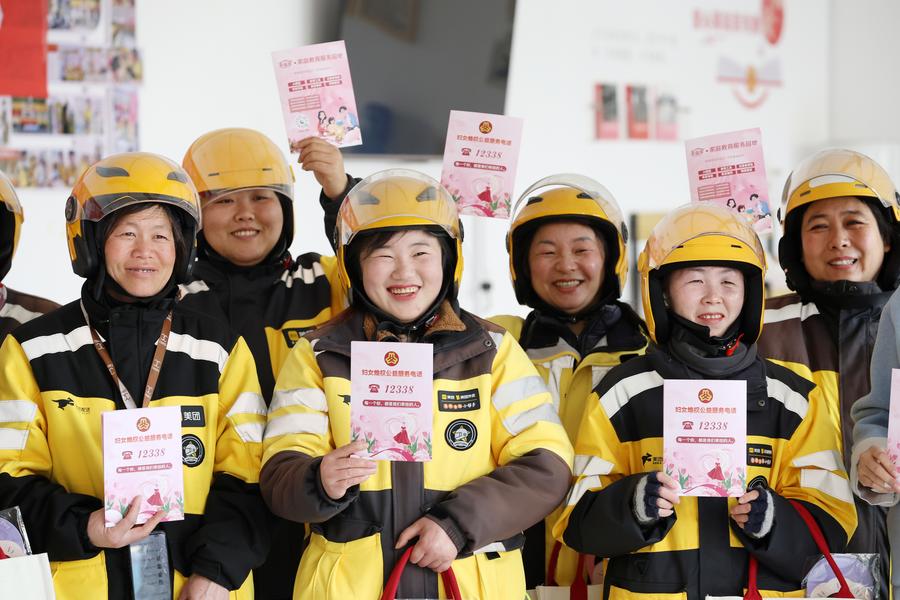
Delivery girls present a manual on protecting women’s rights in Tancheng District of Linyi City, east China’s Shandong Province, March 7, 2025. (Xinhua/Zhang Chunlei)
Without the ferment of women, no great social revolution can succeed, states Karl Marx. Chinese women are fighting to make their contribution to gender equality and women’s empowerment internationally.
The 2025 World Women’s Summit, held in Beijing on Monday, aims to revive the spirit of the Fourth World Conference on Women in Beijing in 1995, which had a profound impact on the global women’s movement.
In the field of scientific research, gender imbalance has persisted for a long time. China has always strived to promote the equitable advancement of women scientists.
Chinese professor Tu Youyou, winner of the 2015 Nobel Prize in Physiology or Medicine, discovered a new treatment for malaria based on traditional Chinese medicine and managed to save millions of lives.
Wang Yaping was not only China’s first “space teacher”, but also became the country’s first female astronaut to perform extravehicular activities.
Chinese women now represent 45.8% of scientific and technical professionals, and account for 50.76% of all higher education students in the country, including 50.01% of postgraduate students, according to a white paper on women’s development published on September 19.
This echoes the old Chinese proverb that “women hold up half the sky.” This belief has long guided China’s efforts to expand the role of women in public life, the workforce and education.
On the international stage, Chinese Juncao technology has provided employment opportunities for women in more than 100 countries, including less developed ones, such as Fiji and Papua New Guinea. In Africa, China has implemented digital literacy and health education projects for girls.
In addition, China has trained more than 200,000 female professionals from more than 180 countries and regions, provided more than 100 specialized training programs for women and children in the South, and established the Global Center for Women’s Digital Empowerment, according to the white paper.
Alifa Chin, a 12-year-old girl from Bangladesh, has a special affection for China. Her mother suffered life-threatening complications during her delivery. Female military doctors serving aboard the Chinese hospital ship Peace Ark, while visiting Bangladesh, intervened to save the mother and child.
Her father expressed his gratitude by naming his daughter Chin, from the Bengali word for “China”. Inspired by the doctors who saved her, Chin hopes to study medicine in China and save lives in turn.
From conception to implementation, China continues to inject new impetus into the global struggle for gender equality and the full development of women, giving rise to a Chinese vision and proposals for the progress of women, thus demonstrating the responsibility of a major country in this matter.