When curiosity, creativity and science meet, a generation of young Chinese innovators is born capable of transforming everyday life and pushing the boundaries of what is possible.
All over China, young engineers, researchers, designers and entrepreneurs are imagining, testing and building. From a workshop to a laboratory, from a screen to an object, from an abstract idea to a concrete application, they transform each intuition into a real project. With them, the borders are erased. Whether it is artificial intelligence (AI), robotics, cultural design or intelligent manufacturing, the same method emerges: starting from a simple idea and transforming it, step by step, into an innovation capable of impacting the world.
Pop Mart: the genius of objects
Wang Ning did not create a brand; he started a movement. Born in 1987 in Henan, he grew up in a modest environment and spent a lot of time in his parents’ shop. By seeing customers from all walks of life pass by, he develops an instinctive sense of trends and consumer desires.
In 2010, at the age of 23, he opened a small gadget store – Pop Mart – in Beijing. This neighborhood business quickly transforms into an observation laboratory. Wang Ning notes that mystery boxes, with their surprise and rarity, trigger a real addiction. He then understands that surprise and rarity can become the heart of a commercial strategy.
The decisive turning point came in 2016 with the launch of Molly, a figurine created by Hong Kong designer Kenny Wong. Each character is thought of as a small universe, endowed with its own identity and intended to create an emotional experience. The success was immediate, sales exploded on Tmall, customers rushed to obtain their series and the characters became cult. Very quickly, icons like Labubu, Dimoo or Crybaby established themselves in Chinese, even international, pop culture, and sometimes fetched high prices on the collection market.
Pop Mart is growing rapidly with hundreds of stores, vending machines and overseas boutiques. In 2020, the company went public in Hong Kong, with a valuation of several billion dollars. Wang Ning, founder and CEO of Pop Mart International Group, transformed a simple object into a global cultural phenomenon, demonstrating that innovation lies not only in technology, but also in the ability to create experiences and communities.
Unitree Robotics: robots on the move
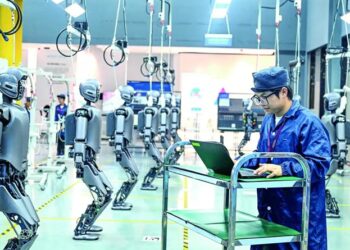
Wang Xingxing, founder and CEO of Unitree Robotics, brought robots into our lives without making them too inflexible or too expensive.
In January 2025, when dozens of robots danced in perfect synchronization on a widely-watched TV show in China, Unitree Robotics shined. But Wang Xingxing is not just looking for spectacle. Above all, he sees more down-to-earth uses of “robots which help in everyday life, at home, in industry or in agriculture”.
Unitree Robotics claims two-thirds of the robot dog market and says its humanoid is the best-selling in the world. What is striking is the combo: affordable, robust and easy to use machines. The result is spectacular: the brand is enjoying great success outside China, with 50% of its turnover abroad.
His philosophy? Structural minimalism. “The fewer parts a product has, the easier it is to manufacture, and the stronger and more durable it is. » This obsession comes from his first robot, built on a tiny budget during his first year of university.
Wang Xingxing also emphasizes the link between AI and robotics: AI can be intelligent, but without a robot, it remains virtual. “For AI to truly be put to use and help solve humanity’s real-world problems, we need robotics. This is why I think AI and robotics are inseparable. »
DJI: the sky at your fingertips
Frank Wang, who dreamed of flying, ended up “giving the sky” to the general public. Passionate about miniature helicopters since childhood, he built his first model in his bedroom. Like many first attempts, the adventure ends with a crash. But rather than being discouraged, he decided to invent a drone that was easy to pilot, accessible to everyone, and no longer just to the initiated.
In 2006, he founded DJI in Shenzhen (Guangdong) with a simple idea: to make air flight commonplace. More than just a machine manufacturer, the company designs an integral experience. Stabilized cameras, intuitive software, precise controls: every detail is thought out so that aerial photography becomes natural, almost
automatic.
With the arrival of the Phantom and then Mavic ranges, DJI is carrying out a real revolution, transforming a niche tool into an everyday companion. Drones are no longer reserved for professionals, they are becoming creative instruments for videographers, influencers, journalists, but also tools for agriculture, research or rescue.
Today, DJI is the world leader in civil drones. Frank Wang, for his part, cultivates his singularity. Far from the image of the conventional boss, this extremely demanding perfectionist has made obsession with detail his trademark. Because ultimately, DJI doesn’t just sell machines, the company offers a new look at the planet, an invitation to rediscover the beauty of the world seen from above.
These trajectories show that innovation in China is above all human. Whether it is a toy that has become a social phenomenon, a domestic robot or a consumer drone, each success proves that a vision driven by perseverance can transform society.
These young innovators are designing a future that is more open, connected and attentive to daily needs. Without imposing a single model, they remind us that innovation is not limited to what is new, but to what creates meaning, connection and lasting perspectives. With audacity and creativity, they do not just invent products: they shape the future.