Faced with global fragmentation, Macron’s visit to China tests the emergence of a civilizational axis capable of reinventing cooperation and world order.
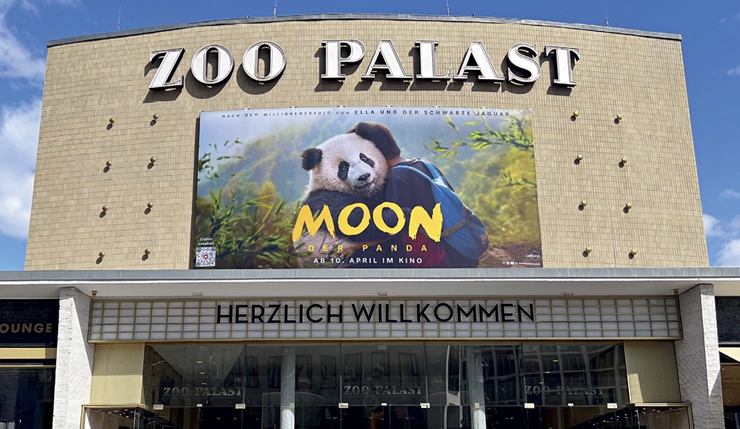
Poster for the Sino-French film Moon The Panda at Zoo Palast, an iconic cinema in Berlin, April 6, 2025
Last December, French President Emmanuel Macron made his fourth state visit to China, against a backdrop of severe global turbulence. Globalization is fragmenting, and unilateral impulses are reappearing with disconcerting force. In this unstable environment, cooperation between Europe and China – and not just between France and China – takes on renewed importance. As the world’s largest integrated market and leading emerging economy, Europe and China have both the material clout and normative responsibility to shape a more balanced, predictable and inclusive international order.
Macron’s visit therefore goes beyond the simple management of a bilateral relationship, including its frictions. It tests the capacity of two civilizational entities – Europe, with its pluralistic humanism, and China, with its historic attachment to harmony, universal order and collective responsibility – to translate long-standing affinities into strategic cooperation. The cultural affinities between the two parties, nourished by intellectual exchanges, artistic dialogues and mutual curiosity, have long given their relationship a dimension that goes beyond diplomatic pragmatism. Both share a universalist instinct: the conviction that civilization involves obligations beyond borders, that the world order must be based on reason rather than force, and that great powers must justify their position by their contribution, not by their domination.
These affinities matter because they constitute the cultural grammar that allows political alignment: they condition the way in which each actor conceives responsibility, power and the international system.
This cultural foundation finds political expression in deeper strategic affinities. Both Europe and China reject the dogma of bloc politics; both are wary of hegemonic projects that demand alignment on ideological rather than pragmatic grounds; both believe that a stable century must be multipolar – not because multipolarity is fashionable, but because a diversified distribution of power is the only way to support cooperation in a world structured by interdependence. Their commitment to multipolarity is inseparable from their demand for renewed multilateralism.

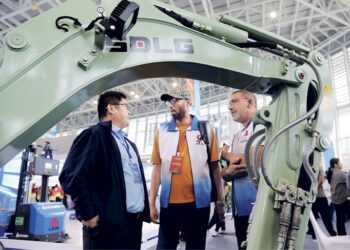
Mao Qingyun (r.), principal researcher of the SVOM satellite jointly developed by China and France, presents Sino-French cooperation, in Shanghai, April 23, 2025.
The world does not need fragmentation but renovation: a multilateral system that reflects the realities of the 21st century, integrates the voice of the Global South and restores confidence in the possibility of collective action. In this sense, the Europe-China relationship is not only transactional; it is structural. It expresses the shared refusal of a zero-sum logic and the common conviction that global governance must be modernized rather than abandoned.
For more than six decades, Sino-French cooperation has embodied certain elements of this vision, but its effectiveness now depends on its ability to go beyond a purely national framework. Since the establishment of diplomatic relations in 1964, cooperation has flourished in the fields of culture, space exploration, nuclear energy, agriculture and science. These sectors, backed by a large-scale commercial relationship, have generated mutual benefits and accumulated institutional capital. However, they reveal the limits of bilateralism. The scale and complexity of contemporary challenges – from climate transformation to technological governance – require the involvement not only of France, but of the European Union as a collective actor, capable of combining industrial capacities, regulatory authority and normative influence. On a European scale, the relationship could then be systemic and prospective.
The green transition is the most urgent and promising area for structured cooperation. China’s unprecedented deployment of renewable technologies, combined with Europe’s regulatory leadership and engineering expertise, creates a natural complementarity. Collaboration in renewable energy, hydrogen, sustainable mobility and circular economy systems could accelerate global transitions while demonstrating that environmental transformation is compatible with economic competitiveness. This cooperation echoes the universalist commitments that both parties claim: the recognition that climate responsibility transcends geopolitical rivalries, and that the credibility of climate governance rests on concrete and replicable solutions, rather than on simple diplomatic symbolism. In a world where climate negotiations are becoming increasingly confrontational, Europe and China have the capacity to show that sustainability and sovereignty are not necessarily incompatible.
Another decisive frontier is artificial intelligence (AI). Both Europe and China have strong research ecosystems, advanced industrial players, and complex debates about ethics, dignity, and risk. As AI risks becoming the structural fault line in a new technological Cold War, Europe and China are almost alone in being able to offer a middle path. Rather than letting high-tech drift into a race for dominance, they can promote an ecosystem based on innovation, security, equity and inclusive governance. Such cooperation would send a strong signal: technological power should not be synonymous with geopolitical intimidation, but can be put at the service of universal human interests. In an area where standards will shape destiny, Europe and China have the responsibility to define the rules rather than accept those imposed by competition.
Expanding cooperation to these strategic areas highlights deeper convergence. Europe and China reject decoupling as an economic or civilizational project. They oppose the nihilistic idea that interdependence is a vulnerability rather than an asset. They understand that economic fragmentation will not stabilize the world, but will intensify competition, distrust and insecurity. Their decision to remain open, to negotiate rather than isolate, reflects a realism based on interdependence rather than ideology.
The timing of Macron’s visit was therefore crucial. China is seeking stable, high-quality external partnerships to support its modernization and deepening opening-up, while Europe is focused on translating the vocabulary of “strategic autonomy” into concrete policies, amid economic turmoil and geopolitical uncertainties. Both players need predictability in global affairs just as volatility becomes structural. Although they differ in their analysis of the Russian-Ukrainian conflict, they converge on a fundamental imperative: diplomacy, de-escalation and normalization of international relations. Their cooperation thus responds not only to national interests, but to universal interests.
This universalist dimension is essential. The multilateral system is being put to the test by geopolitical segmentation, geo-economic fragmentation, insufficient climate financing, the fragility of food and energy security, as well as the worsening inequalities between a vulnerable global South and a secure global North. Multilateral institutions do not fail because multilateralism is obsolete, but because their architecture has not been adapted to the distribution of power and the urgency of contemporary challenges. Europe and China, influential but not hegemonic actors, can contribute to modernizing this architecture – not to impose a new order, but to restore the possibility of shared governance.
Macron’s visit comes at a time when the world is seeking stability, when unilateralism sows uncertainty and when the narrative of rivalry tends to overshadow any prospect of cooperation. In this context, the symbolic significance of this visit will resonate beyond Paris and Beijing, because it represents a choice: to engage rather than withdraw, to affirm universalism rather than nationalism, to build order rather than suffer disorder. Europe and China will not always agree, but their common aspiration – a multipolar, inclusive and dialogical world – remains intellectually coherent and strategically necessary.
*DAVID GOSSET is a specialist in international relations and sinologist. He is the founder of the China-Europe-America Global Initiative.