More than a port, Hainan is a laboratory that redefines the frontiers of tomorrow’s services.
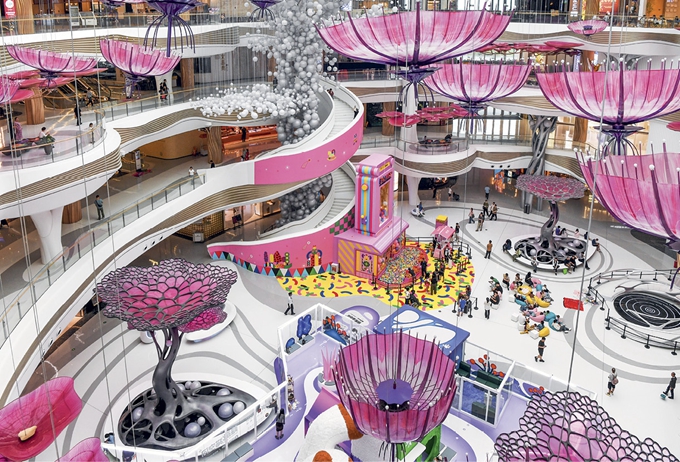
The cdf Haikou International Duty-Free Shopping Complex, November 1, 2025
December 18, 2025 marks a turning point for Saud Khan. This Pakistani doctor collected his work and residence permits at the Yangpu Government Service Center in Danzhou (Hainan). Arriving three months earlier for medical training at the Central Hospital of Western Hainan, the practitioner was seduced by the dynamism of the island, to the point of deciding to build his career there.
Hainan Island is home to the world’s largest free trade port. The case of Dr Khan perfectly illustrates this change: holding a medical license in Pakistan, he benefited from the mechanism for recognizing the skills of foreign doctors specific to the Free Trade Port of Hainan (PLEH), thus exempting himself from the Chinese national examination. Once his contract is signed, his qualifications will be recognized, allowing him to obtain legal authorization to practice.
This administrative gateway perfectly illustrates how Hainan aligns its medical services sector with high-level international economic and trade rules.
“PLEH is a true laboratory for institutional innovation,” analyzes Dun Zhigang, researcher at the Chongyang Institute for Financial Studies at Renmin University of China. “Its role is critical: it is no longer just a question of boosting cross-border trade in services, but of adopting high-level international rules, or even helping to define them. »
An asset for trade in services
According to the Hainan Provincial Department of Commerce, total trade in services in Hainan jumped 23.4 percent in the first ten months of 2025, reaching 56.05 billion yuan. Growth three times higher than the national average. The official launch of island-wide special customs operations on December 18, 2025, “reinvented the logic of cost and efficiency of the province’s trade in services,” underlines Mr. Dun.
Now, 38 new product categories benefit from bonded maintenance, with suppliers and customers abroad. Hainan has become the only region in China capable of offering bonded maintenance services for engines. CRRC International Vehicle Industry (Hainan) Co. Ltd. has already obtained its first order from Germany.
Tax attractiveness completes the system. Today, 74% of imported products are exempt from customs duties, covering almost all production equipment and raw materials. “Thanks to this customs exemption policy, imported spare parts cost nothing in taxes, while components purchased on the mainland benefit from tax refunds,” explains Zhang Zirui, marketing director of the company.
PLEH also offers the most favorable visa-free entry policy in the country. With a visa exemption regime for nationals of 86 countries, the island is boosting its cross-border tourism. During the first month of this new customs regime, 87,000 foreign visitors took advantage of this facility, representing 93% of international arrivals.
At the Sanya International Friendship Hospital for Traditional Chinese Medicine (TCM) and Rehabilitation, foreign visitors show keen interest in acupuncture, cupping and massage. The hospital was established by Sanya TCM Hospital. In 2025, the facility treated 10,749 foreigners, generating revenue of 5.83 million yuan. Yuan Ailin, deputy director of Sanya TCM Hospital, said the combined effect of the policies will attract an increasing flow of patients.

A couple poses in front of the stone sculpture depicting the character “love” in Luhuitou Park in Sanya, December 18, 2025.
The Hainan model
According to Dun, alignment with international rules for trade in services is reflected in practical issues such as equal access of foreign-invested companies to licenses, the discriminatory technical barriers they face, the free and secure flow of data across borders, as well as the movement of people and the recognition of professional qualifications with ease. Dr Khan’s journey illustrates the island’s ability to attract international experts through the recognition of professional qualifications and simplified installation procedures.
In 2025, Dun & Bradstreet, an American business information provider, launched its Longyicha information service application in Haikou (Hainan). “Previously, Chinese companies had difficulty accessing information on foreign companies, while foreign institutions struggled to obtain reliable data on Chinese companies,” said Wu Qingji, general manager of Fullsing Internet Industrial Park in Haikou, adding that Longyicha has a promising market.
Foreign providers of such data services must obtain a value-added telecommunications operating license. To date, 13 foreign-invested companies, including Dun & Bradstreet, have obtained this permit. In February 2025, Hainan issued the Hainan Free Trade Port Data Export Management List (Negative List) (2024 Edition), the first of its kind in the country, specifying that unlisted data can flow freely across borders. This provided the regulatory basis for the launch of Longyicha, meeting both domestic and international compliance requirements.
The international medical tourism pilot zone of Boao Lecheng is described as an exceptional enclave. Unlike the traditional “pre-registration” process, innovative drugs and medical devices already approved abroad but not yet registered in China can be introduced to Lecheng through a special approval regime and used directly in the clinic.
Supported by a clinical data application pilot program, the data collected can be used for national regulatory approval. To date, this mechanism has accelerated the market entry of 21 imported drugs and devices, including three included in China’s national health insurance reimbursement scheme. This approach brought the “Hainan solution” to the reform of the global medical product supervision framework. It has stimulated strong growth in cross-border medical consumption. On January 15 alone, Lecheng received more than 2,000 foreign patients, an increase of 49% year-on-year.
These cases offer concrete, on-the-ground illustrations of what is known as the “Hainan model”.
A resistance test area
Dun said that by expanding cross-border trade in services, Hainan serves as a key hub connecting domestic and international markets. It functions as both a “stress test zone” for high-level international economic and trade rules and a “potential incubator” for the global standards on trade in services of tomorrow.
Dun noted that given China’s vast territory and regional diversity, implementing the highest level of opening-up nationwide in one step would carry risks. In sensitive areas such as cross-border service delivery, Hainan can act first by aligning with the rules of agreements such as the Comprehensive and Progressive Agreement for Trans-Pacific Partnership. If the tests prove conclusive, the experience can be reproduced elsewhere; otherwise, the risks will have been controlled.
*ZHANG SHASHA is a journalist at Beijing Information.