The development of the Hainan Free Trade Port is not a matter of competition with Hong Kong or Singapore, but of strategic complementarity.
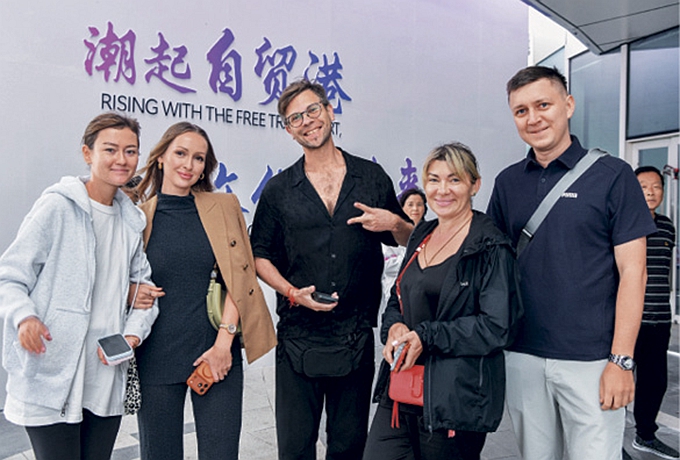
Foreign tourists at the Sanya International Cultural Industries Exhibition, December 26, 2025
Since the implementation of the special customs operation on the whole of Hainan, a question has been burning on the lips of observers: could the island replace Hong Kong or Singapore? The concern seems legitimate. At 35,400 km2, it dwarfs its neighbors in size and enjoys massive political support from the Chinese mainland.
However, the reality is more subtle. It is not a question of replacing, but of supplementing. Hong Kong bases its power on its common law system, its financial system of free movement, as well as its unique function as a bridge connecting the Chinese mainland to global financial markets. Singapore, for its part, is the logistics hub of Southeast Asia.
Hainan plays on another ground. Its priority sectors are clearly defined: tourism, modern services, tropical agriculture and high-tech industries (aerospace, marine biotechnologies, varietal selection). The island does not seek to compete with Hong Kong in the financial sector or with Singapore in maritime transhipment. It focuses on services linked to quality of life such as international education and excellent health care.
 The most profound difference in positioning lies in functional and institutional design. The Singapore Freeport is a platform open to the whole world, whose services are aimed at all international capital wishing to penetrate the South-East Asian and even global markets. Hong Kong has long played the role of a “super connector” for capital flows. As for the Hainan Free Trade Port, it serves as a laboratory for China’s “dual circulation” strategy (domestic and international). This complementarity avoids head-on competition and opens a vast space for cooperation between Hainan and these two large established free ports.
Hainan draws on China’s vast domestic market of 1.4 billion people, more than 400 million of whom are middle class, an asset no other free port can match. In terms of taxation, the corporate tax is 15%, a rate lower than the 17% in Singapore and the 16.5% in Hong Kong, thus placing itself at the highest level of international competitiveness. The policy of exemption from customs duties, import VAT and consumption taxes for the vast majority of goods gives Hainan the potential to become the world’s largest duty-free sales market. In addition, Hainan is the only Chinese province whose maritime area under jurisdiction exceeds the land area, which offers unprecedented prospects for the development of its maritime economy.

Sanya Phoenix International Airport, December 24, 2025
This clear positioning has made it possible to build a real bridge of cooperation between Hainan, Hong Kong and Singapore. Regarding Hainan-Hong Kong cooperation, the two governments have established a regular coordination mechanism, focusing on promoting collaborations in areas such as tourism, medical care, education and green finance. Cooperation with Singapore has also borne its first fruits: Singaporean flagship companies such as Temasek and Capitaland have launched logistics park and smart city projects in Hainan, thus transposing their experience in precision management there. These partnerships are based on a simple balance: Hong Kong and Singapore provide their best practices, specialized services and international networks, while Hainan offers policy testing grounds, market access opportunities and new space for growth.
The establishment of the special customs operation in Hainan, which embodies the most successful form of China’s opening, sends an unequivocal message to the international community: China is no longer just a beneficiary of globalization, it is becoming an engine in its own right. This ambition does not seek to destabilize the existing economic and commercial order, but aims, through the creative transformation and innovative development of existing models, to propose a new paradigm of mutually beneficial cooperation, whatever the system or stage of development of the economies concerned.
*GAO PEINING is a columnist at China.org.cn.