(Xinhua/Ding Haitao)
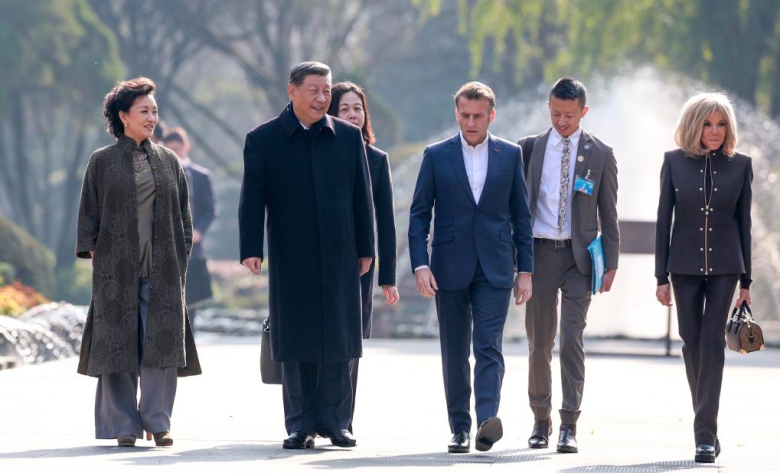
From December 3 to 5, 2025, French President Emmanuel Macron made his fourth state visit to China, in response to that of Chinese President Xi Jinping in France in 2024. In an international context marked by upheavals and tensions, relations between the two countries, as well as between China and Europe, are at a key moment of their redefinition. Through his actions, Mr. Macron has clearly conveyed to Europe and the world the stable, resilient and unique character of the comprehensive strategic partnership between China and France, the scope of which now goes beyond bilateral issues alone, highlighting its global strategic importance.
Consolidate strategic trust and initial commitment
In 1964, France was the first major Western country to establish ambassadorial-level diplomatic relations with China in a Cold War setting, highlighting the distinct historical nature of Sino-French bilateral relations.
Over the past sixty years, China and France have continued to strengthen their strategic coordination, deepen their economic and commercial cooperation and consolidate their human exchanges, gradually transforming their relations into a model between great powers based on the sharing of responsibilities and the interdependence of interests.
Due to international upheavals, geopolitical conflicts, changes in the balance of power and the rise of protectionism in recent years, China-France and China-Europe relations have faced increasing challenges. Certain irrational voices have been raised in Europe, considering China as a “competitor” or even a “systemic rival”, calling for a “reduction of risks” vis-à-vis China, in a context where ideology is increasingly disrupting bilateral relations.
The year 2025 marked both the 50th anniversary of the establishment of diplomatic relations between China and the European Union (EU) and the start of a new sexagesimal cycle for Sino-French relations. It is therefore essential to stick to the spirit of establishing diplomatic relations between China and France to anchor the future trajectory of healthy and stable development of their bilateral relations. It will also help inject stability and predictability into a world that sorely needs it.
During the meeting between the heads of state of the two countries, four priorities for the future of bilateral relations were jointly defined, among which strengthening mutual political trust takes the first place. The two sides stressed that regardless of developments in the international environment, they must always demonstrate independence, autonomy and strategic vision, and understand and support each other on issues concerning their core interests and major concerns. This is precisely how a new contemporary meaning is given to the spirit of the establishment of diplomatic relations based on “independence and autonomy, as well as mutual understanding”.
Independence and autonomy constitute the strategic basis which makes it possible to neither yield to any power nor become the appendage of any large country; mutual understanding is the foundation of mutual trust, based on respect for the vital interests of each person and their development choices. Only by sticking to this path can China and France overcome the narrow logic of geopolitical games and avoid “model rivalries” dominated by ideology, so as to jointly promote the reform and improvement of the global governance system.
Today, unilateralism, the politics of might and resurgences of militarism pose serious challenges to the international system centered on the United Nations and the international order based on law. As permanent members of the United Nations Security Council, China and France are two major forces in preserving the world order established after World War II. They carry a particular mission in the defense of multilateralism and the prevention of a return of the world to confrontation by blocs.
Explore new avenues of cooperation
The history of Sino-French relations is also a history of cooperation based on common development and mutual success. France has been a witness and actor in the great process of reform and opening up in China; while the constantly expanding Chinese market and its dynamic development potential have provided a strong impetus to the growth of European integration, including for France.
In a context where globalization encounters headwinds and where speeches advocating “decoupling” and “disruption of supply chains” are heard, economic and commercial cooperation between China and France demonstrates strong resilience. In the first ten months of 2025, the bilateral trade volume reached 68.75 billion dollars, and the cumulative mutual investment exceeded 27 billion dollars, which in itself constitutes the best proof of the logic of the market and the choices made by businesses.
It is, however, undeniable that the “risk reduction” strategy implemented by the EU since 2023, as well as a series of measures such as the strengthening of trade defense instruments, the intensification of investment controls and the establishment of the Foreign Subsidies Regulation, have seriously disrupted the environment for bilateral economic and commercial cooperation, introducing a dimension of uncertainty.
Recently, the European Commission once again issued a document aimed at strengthening its economic security strategy, marking a further shift in its trade policy from liberalism to a logic of geo-economics, and adding new factors of instability to the global trade system, which should be free and open.
At this crucial moment, the leaders of China and France jointly issued a clear and strong signal for cooperation, while setting out priorities for expanding pragmatic cooperation. This not only constitutes a “stabilizer” for economic and commercial cooperation between China, France and the EU, but also an effective counterweight to the so-called “risk reduction” strategy.
The directions for future cooperation outlined by the two parties reflect a combination of heritage and innovation: on the one hand, it is a question of consolidating and further exploiting the potential in the traditional fields of excellence of aeronautics, aerospace and nuclear power; on the other, the two countries intend to develop cooperation in emerging sectors such as the green economy, the digital economy, biomedicine and artificial intelligence, thus opening new avenues of collaboration.
To address mutual concerns, the two sides also affirmed their desire to promote balanced development of bilateral economic and trade relations, expand investments in both directions, and guarantee businesses in both countries a fair, transparent, non-discriminatory and predictable business environment. This commitment directly responds to the main expectations of companies and will undoubtedly strengthen their valuable confidence.
The Recommendations for Developing the 15th Five-Year Plan for Economic and Social Development, adopted at the Fourth Plenary Session of the 20th CPC Central Committee, present to the world the image of a stable, open and innovative China. They clearly define a development direction focused on high quality and a high level of openness, while accelerating the transition to new sectors such as the green economy, digital technology and biomedicine. China and France, as well as China and the EU, will be able to take advantage of this to build a new model of mutually beneficial cooperation at an even higher level.
Strengthen mutual understanding through human exchanges
The resilience and vitality of Sino-French relations over the past sixty years come not only from the state’s strategic orientation, but also from the mutual attraction between the two peoples and the deep ties passed down from generation to generation. France was the first country to organize Cross Cultural Years with China, the first to create reciprocal cultural centers, and the first major Western country to launch youth exchanges with China. Today, whether it is the high-level official mechanism dedicated to human exchanges, city twinning, educational exchanges, tourist flows, sports cooperation or even “panda ambassadors”, the channels of exchange and cooperation between the two peoples continue to expand.
However, deeply rooted conceptions of “Western centrism” still constitute, to a certain extent, an obstacle to an objective and rational perception of contemporary China by Western societies. In an international context marked by intensifying geopolitical conflicts and the rise of populism, these cognitive biases can easily be exploited and amplified, thereby eroding the public opinion base that supports relations between the two countries.
It is precisely for this reason that the leaders of the two countries have made promoting people-to-people exchanges a priority of cooperation, which is of major strategic significance for the long-term sustainable development of China-French relations. Based on the success of the 2024 Year of Cultural Tourism, the two sides pledge to further deepen exchanges and cooperation in the fields of culture, education, science and technology, as well as at the local government level, and decided to launch a new phase of cooperation for the protection of giant pandas. These initiatives will inject a powerful new dynamic into Sino-French people-to-people exchanges and encourage an increasing number of people, especially younger generations, to get involved in the cause of friendship between China and France.
*JIN LING is vice director and researcher at the Institute of European Studies of the Chinese Academy of Social Sciences.