Combining tradition and modernity, Songyang’s tea industry is attracting a new generation of entrepreneurs who are revitalizing local culture and boosting the economy.
Relaxing time in a teahouse on Songyang Old Street
From the time of the Three Kingdoms (220-280), the scent of tea already permeated the lands of Songyang, in Lishui (Zhejiang). Today, the district is home to 153,200 mu (1 mu = 1/15 ha) of ecological tea plantations. One in three inhabitants makes a living from this sector, whose industrial chain now exceeds 13.5 billion yuan.
This thriving industry attracts a growing number of young people who return to their region to do business. From manual roasting workshops to trendy tasting rooms, including live-stream studios, this new generation is reinventing ancestral know-how to adapt them to the contemporary world.
Craftsmanship at your fingertips
In the cobbled streets of Songyang, while the morning mist has not yet dissipated, a delicate scent of tea escapes from a century-old house. Yang Junjie, a tea artisan born in the 1980s, is busy in front of the stove. His hands move quickly over the hot iron wok, swirling tender green tea leaves between his fingers.
“Today, there are more and more tea lovers; the value of craftsmanship is being rediscovered,” says Mr. Yang. Faced with a growing demand for quality and authenticity, hand-roasted tea – appreciated for its unique flavor and its cultural dimension – often sells three to five times more expensive than mechanically processed tea. “Last year, a customer from Shanghai drove 600 km to buy my tea, saying that industrial tea lacked character. »
“To roast tea, you have to feel the temperature with your heart. » Growing up alongside his grandfather, Mr. Yang learned this art from childhood. After his military service in 2009, he went to Hangzhou (Zhejiang) to learn Longjing tea roasting techniques, often training for more than ten hours a day.
“The hand-roasted leaves are dense and heavy to the touch, and their aroma and taste are inimitable. » He takes a handful of freshly roasted “Songyang Silver Monkey”: the leaves blossom in his palm, their silver downs sparkling, evoking the silhouette of an agile monkey. Today, his Jiuchen tea workshop is renowned and receives orders from all over China, generating around 10,000 yuan in sales every month.
To pass on this know-how, Mr. Yang patiently trains apprentices, emphasizing wrist flexibility and regularity of pressure. Inspired by his example, many young people are now turning to this ancestral art.

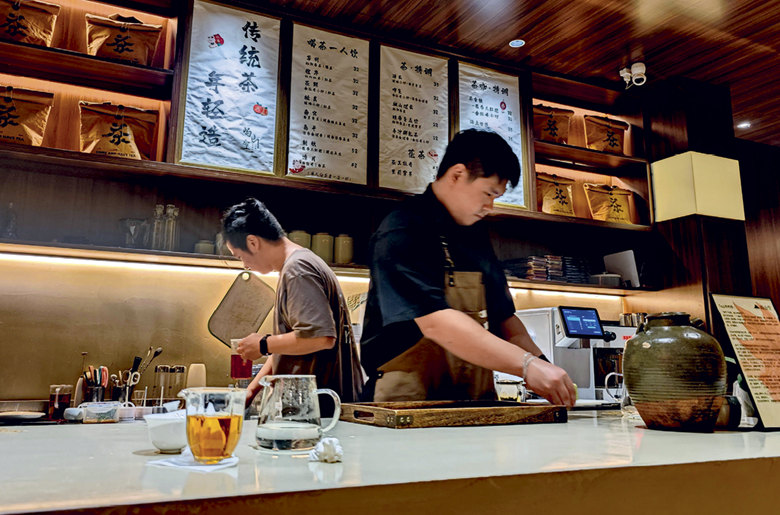
Yushankong Tea House is a popular destination for young people at the junction between Songyang Old and New Town. (PHOTOS: YU JIE)
The flavors of innovation
At the junction between Songyang Old and New Town, Yushankong Tea House has become a popular place for young people. Its slogan “Traditional tea, young creation” sums up the ambition of its founder, Pan Hongri, also born in the 1980s.
After studying luxury management in France, Ms. Pan led a hectic professional career. In 2022, she left her well-paid job in Hangzhou to return home, determined to reinterpret tea culture in her own way.
“When I was little, the elders always served icing sugar tea to the guests during Chinese New Year,” she recalls. This traditional sweet drink from Songyang is the source of its inspiration. But to appeal to young people, she knew that something new was needed.
She began experimenting, bringing bags of tea home to test new blends, with friends and relatives as tasters. After many trials, Ms. Pan boldly innovated, using Songyang fragrant tea and “Songyang Silver Monkey” as bases, then infusing fruit or adding cream, coffee or cocktails. His most popular creation, “Clouds on the Lonely Mountain,” won the gold medal in a provincial tea competition for the perfect balance of tea and fruit aroma.
At Yushankong, modern tea utensils sit alongside antique tables. The young people who go there not only appreciate these creations, they also have a social experience. “We are not just selling tea, but an art of living,” says Ms. Pan.
Last year, she organized an exhibition combining luxury brands and rural products from Songyang: a Gucci handbag next to the “Silver Monkey of Songyang,” a Balenciaga outfit next to dried mountain bamboo shoots. “Rediscovering the beauty of local products through the prism of global luxury is fascinating,” she rejoices. Today, she has sold more than 2,000 gift boxes made up of local agricultural products.
“Traditional tea culture needs a youthful expression,” says Pan. With two tea houses in Lishui and Hangzhou, it plans to expand its range of creative drinks and launch into e-commerce so that the flavor of Songyang tea travels even further.
Live broadcast of tea culture
The Southern Zhejiang Tea Market in Songyang, China’s largest green tea market, is bathed in tea fragrance all day long. Here, tea shops line the streets, tea producers and merchants come and go, and daily transactions reach 185 tonnes.
This excitement has opened up new business opportunities for local farmers and traders. In 2017, Wang Yipeng quit his job in the city to return to Songyang, becoming one of the first young people to venture into e-commerce. At first, his parents didn’t understand why a university graduate would come home to sell tea. But he was convinced that the tea industry in Songyang had a promising future.
He assembled a team of sixteen people and traveled to tea plantations to consult with experienced growers, filming every step of the process, from picking to roasting. His brand, “Wang Dapeng Tea Farmer,” has more than 700,000 subscribers thanks to educational videos posted on social networks such as Douyin and RedNote. It sells nearly 500 kg of tea per day, generating an annual turnover of 30 to 40 million yuan.
Today, Songyang has more than 700 e-commerce companies, more than half of which specialize in tea trading. E-commerce has become a key driver of the transformation and upscaling of local industry. To date, the district has developed 1,650 online tea shops, with sales exceeding 5 billion yuan in 2024.
E-commerce has not only expanded the market for Songyang tea, but also created many jobs. More and more young people are returning to their native regions to start their own businesses, increasing their income through live-streaming. Songyang is actively adjusting its tea industrial strategy by adopting a new vision: nationwide sourcing and marketing, supported by a comprehensive logistics system.
“We not only sell tea, but also a cultural emotion of Songyang,” says Wang Yipeng. This land, steeped in a centuries-old tea culture, has regained new vitality thanks to the return of these young people.