China’s four global initiatives form a coherent framework to respond to global challenges and build a common future.
Visitors admire velvet embroidery at the France 2025 International Cultural Heritage Exhibition in Paris, October 23, 2025.
In a world marked by profound changes, Chinese diplomacy has just reached a decisive step. On September 1, 2025, Chinese President Xi Jinping officially introduced the Global Governance Initiative. This historic proposal completes a global architecture already composed of the Global Development Initiative, the Global Security Initiative and the Global Civilization Initiative. Together, these four initiatives constitute a comprehensive strategic framework for shaping a community with a shared future for humanity, in full coherence with the United Nations Charter.
Faced with a global reality fragmented by unilateralism and geopolitical tensions, these proposals offer a constructive alternative. They invite us to overcome divisions to favor equitable cooperation, capable of bridging the growing gap between the North and the South.
A call for shared development
For China, development is the cure for global structural crises. The Global Development Initiative places the needs of humanity at the top of its priorities. In perfect synergy with the United Nations 2030 Agenda for Sustainable Development, it aims to break the cycle of dependence.
Global development has suffered major setbacks in recent years. Only about 35% of the 2030 Agenda goals are on track to be achieved. Extreme poverty is on the rise for the first time in twenty years, 2.6 billion people do not have access to the Internet and climate financing for developing countries remains insufficient. This picture is clouded by the multiplication of conflicts and the use of unilateral sanctions which paralyze food supply chains.
Faced with this emergency, China is prioritizing on-the-ground actions, strengthening skills and technological innovation. For example, the China-Africa Agricultural Technology Demonstration Center has increased agricultural yields by 30% to 60% for more than a million farmers, illustrating the tangible benefits of development partnerships. Likewise, the China-Laos railway opened up Laos, generating more than 100,000 jobs and reducing logistics costs by more than 30%. In Latin America, joint technological innovation centers with Brazil are accelerating the transition to clean energy while preserving local ecosystems.
Guided by the “six principles” of international cooperation, this initiative aims for balanced, coordinated and inclusive growth to ensure that no country is left behind.

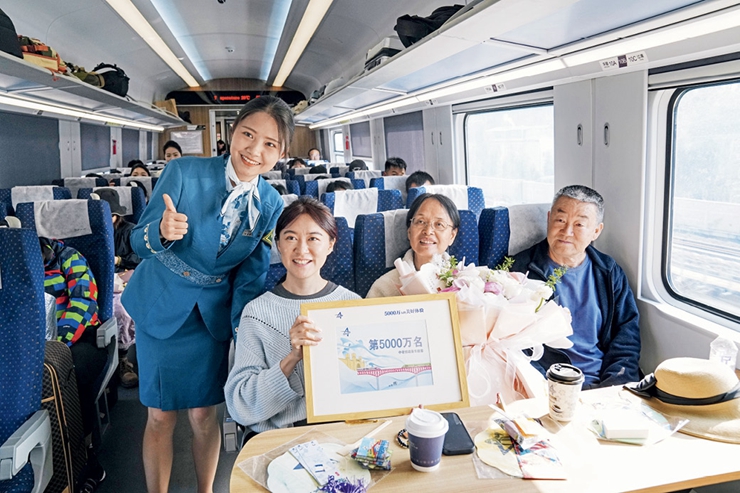
The 50 millionth passenger of the China-Laos Railway receives a commemorative certificate on March 28, 2025.
Towards lasting peace and security
If development constitutes the foundation of progress, peace and security are the essential ramparts. Faced with the growing instability of the international scene, the Global Security Initiative, launched in 2022, provides a strategic response to the current turbulence. Persistent conflicts, hegemonic ambitions and unilateral security policies have undermined global stability, illustrating the failure of approaches based solely on force and confrontation.
This initiative aims to eradicate the root causes of conflicts by responding to the legitimate security concerns of each nation. It systematically favors dialogue to resolve tensions and strengthens the effectiveness of United Nations peacekeeping missions. In addition to this diplomatic effort, it encourages direct international cooperation to fight terrorism, drug trafficking and major health crises.
Regionally, China has relied on platforms such as the Shanghai Cooperation Organization (SCO) to maintain stability and build trust. By promoting multilateralism and inclusive dialogue, the initiative offers a viable path to global peace where cooperation trumps coercion.
Respect for the diversity of civilizations
Faced with theories of the clash of civilizations, the Initiative for Global Civilization, launched in 2023, stands out as a constructive alternative. It places cultural diversity, empathy and dialogue at the heart of international relations, based on the principle that each culture holds distinct wisdom, values and perspectives, essential to meeting the challenges of our time.
China’s commitment is reflected in concrete actions. Platforms such as the Asian Civilizations Dialogue Conference, the Liangzhu Forum and the World Classics Conference promote in-depth exchanges. Furthermore, the establishment by the UN of the International Day of Dialogue between Civilizations, under Chinese leadership, institutionalizes this celebration of diversity. Thanks to educational, cultural and heritage cooperation with more than a hundred countries, China demonstrates that modernization can rhyme with the preservation of the common heritage of humanity.
By advocating mutual learning and rejecting cultural arrogance, this initiative helps create a global environment where differences are not sources of conflict but opportunities for collaboration. It offers a vision where coexistence and mutual enrichment are the pillars of human progress.

Foreign customers negotiate the purchase of winter sports equipment at the Yiwu International Trade Market, Zhejiang, January 7, 2026.
For effective global governance
The Global Governance Initiative, launched in 2025, addresses power imbalances. As emerging challenges, from digital governance to seabed management, require unprecedented coordination, she advocates inclusive responses.
It is based on sovereign equality, multilateralism and the collective development of international rules. Its particularity lies in its people-centered approach, indexing the effectiveness of global governance on the concrete improvement of social well-being, particularly in terms of employment, education and health.
On the ground, this commitment is translated into concrete measures: China is advancing the reforms of major multilateral institutions, strengthening South-South cooperation, promoting the International Organization for Mediation and supporting the central role of the United Nations in maintaining international peace and security. In the area of digital governance, it offers frameworks on artificial intelligence, data security and cross-border digital flows, so that technological innovation benefits all countries and not just a privileged minority. Through these actions, China shows that development, security, civilization and governance are interdependent pillars of a sustainable world order.
Global recognition of China’s role
These four global initiatives led by China outline a coherent, visionary and pragmatic roadmap to build a world of shared prosperity, peace and mutual understanding. Faced with exacerbation of conflicts and global social divisions, these pillars provide a framework for concerted action. They reaffirm that a future of peace and mutual understanding is only possible through a collective commitment towards fairer and more equitable global governance.
*ZAMIR AHMED AWAN is founding president of the Global Silk Route Research Alliance.
This article was first published on People’s Daily Online.