Faced with tensions, Chinese and European youth are establishing themselves as the essential driving force to overcome ideological divides.
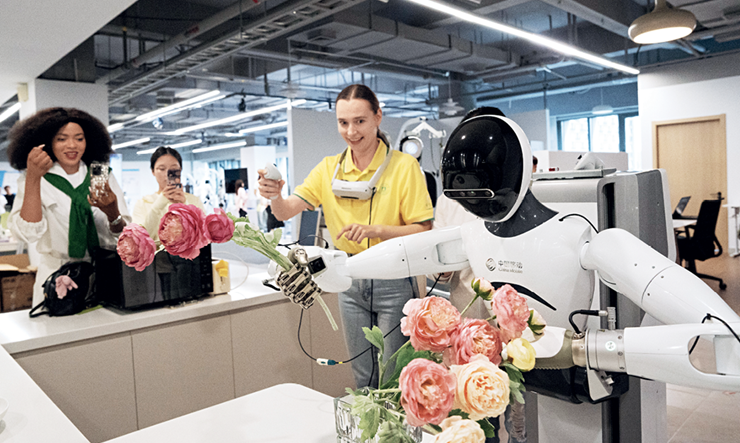
An Uzbek student uses a robot to make a flower arrangement in Hangzhou, Zhejiang, May 10, 2025.
Bilateral relations between China and Europe are among the most important on the world stage. Their dynamics influence not only the development of the two parties, but also the global configuration. In recent years, under the combined effect of geopolitical rivalries, trade frictions and divergent visions, Sino-European relations have been going through a period of complex challenges. In this context, human and cultural exchanges, in particular interactions between young people, play a fundamentally constructive role.
In July 2025, Chinese President Xi Jinping emphasized in his message to the World Youth Peace Conference that the future of peace lies with young people. Endowed with incomparable vitality and creativity, young people are the future guarantors of Sino-European friendship, already embodying a key force for overcoming differences and strengthening mutual understanding. It is now essential to fully unleash their potential so that they move from the status of simple “witnesses” of Sino-European relations to that of active “builders” of this common future.

Inauguration of an exhibition of more than 70 creations by young Chinese and French designers at the Ming gallery in Suzhou (Jiangsu), October 17, 2025
Break through the barriers
In the era of globalization, interactions between young people in China and Europe continue to face significant obstacles, creating a “trade deficit” that fuels bilateral misunderstandings.
These challenges come first from what we could call an “information bubble”. The stories disseminated by some Western media tend to reduce China to a simplistic and politicized image. This has the effect of maintaining a stereotypical and dated perception among many young Europeans, hindering any true understanding of the country. Conversely, some young Chinese, witnessing the rapid growth of their country, risk underestimating Europe’s institutional resilience, cultural richness and technological innovation capabilities.
Furthermore, concrete “impediments to connections” persist. The slow recovery of international air traffic after the pandemic, combined with the rearrangements of air routes caused by the Ukrainian crisis, has resulted in insufficient flight frequency and prohibitive travel costs. This situation objectively limits the possibilities of staying there for young people with modest budgets.
Finally, a deeper challenge lies in the cultural and psychological “gap.” There are objective differences between the two parties regarding the perception of human rights, the relationship between the individual and the collective or even governance models. A lack of inclusive mentality and sharp intercultural skills could lead young people to view “difference” as “opposition”, paralyzing constructive dialogue.

Young foreigners discover the preparation of tanghulu (caramelized hawthorn berry skewer) in Licang district in Qingdao (Shandong), February 11, 2025.
The triple mission
Faced with obstacles, young people are not helpless. On the contrary, it is precisely their age that gives them the courage to break conventions and the potential to reshape relationships. In the context of Sino-European relations, young people emerge as a force playing three fundamental roles.
First, that of ice breaker. Compared to their elders, young people are less prisoners of Cold War mentality and ideological frameworks. They can adopt a “depoliticized” perspective, essential for defusing opposition. Whether it is e-sport, fashion, gastronomy or travel, Chinese and Europeans have a vast common language through their lifestyles. By leading “bottom-up” interactions between people, they breathe human warmth into the “political ice”. Their desire to correct their perceptions comes through field experience: immersion in the Chinese countryside and cities or in European communities and campuses is enough to make prejudices disappear.
Then, that of digital connector. The world is interconnected and young people are its pioneers. On social networks, they share creative and daily ideas, reducing psychological distance through frequent exchanges. The success of European vloggers in China and Chinese vloggers in Europe bears witness to this.
Finally, they assert themselves as innovators. Faced with global issues such as climate change, the preservation of biodiversity and public health, young Chinese and Europeans share the same sense of urgency and responsibility. Beyond intergovernmental negotiations, they favor concrete actions via NGOs and scientific collaborations. This cooperation “focused on specific issues” transcends borders and forges a solid community of values.

Chinese Real Madrid fans Rebecca Feng (L) and Alex Lee (R) pose before flying to Kazakhstan to watch a Champions League match at Beijing Daxing International Airport on September 29, 2025.
Three paths to the future
To transform the potential of youth into a concrete driving force, Sino-European exchanges cannot be limited to simple tourist visits. They must extend to broader areas. The urgency is to act on three fronts.
It is imperative to focus on the green transition and sustainable development, in order to forge the greatest common denominator of values. Climate change represents the strongest area of convergence between China and Europe, and one of the major issues for the younger generation. The European “Green Deal” and China’s dual carbon targets are highly consistent. Universities, research centers and young entrepreneurs can launch competitions, R&D projects and joint entrepreneurial initiatives in the renewable energy, circular economy or green construction sectors. At the same time, the authorities can organize the joint participation of young Chinese and Europeans in ecological protection projects: study missions on desertification in China or operations to clean up marine plastics in Europe. These concrete practices make it possible to exchange technologies and ideas, and to build common themes in the co-construction of the global village.
It is crucial to deepen the digital and innovative economy, in order to forge new links of convergence of interests. Faced with current issues such as the development of artificial intelligence, data confidentiality or algorithmic bias, young researchers and professionals must intensify their dialogue. Young users and developers can bring new perspectives to define digital rules consistent with the common interest of humanity. By combining Europe’s strengths in fundamental research and industrial design with China’s strengths in commercial applications and digital model innovation, it is possible to create a Sino-European alliance for innovation and youth entrepreneurship. To facilitate this meeting between technology and the market, the organization of digital competitions and other similar events is essential, which would allow young people to share the economic benefits of cooperation.
Finally, we must encourage the mutual enrichment of cultures to sustainably consolidate trust. True understanding comes from respect and appreciation of the cultural identity specific to each civilization. Educational cooperation must go beyond simple language training and include more exchange programs in disciplines such as philosophy, history or the arts. Through cultural forums, young Chinese and Europeans can discuss substantial issues such as social governance, the relationship between tradition and modernity, or globalization and local roots. We can also stimulate their interest through innovative means, for example, the use of virtual reality technologies to allow young Europeans to “virtually visit” historic Chinese cities. It is this fusion of technology and culture that most directly affects the younger generation.
The future of Sino-European relations depends not only on agreements on paper, but also on the resonance between minds. Although the real barriers that hinder exchanges between young people remain visible, the youth force, eager for understanding and determined to cooperate, is gaining power. When young people understand each other face-to-face and meet on the ground, the popular basis of China-Europe relations can only be solidified.
Not only observers of Sino-European relations, young people are also the actors who define their future. Only through denser interactions, more pragmatic cooperation and deeper empathy can young people from China and Europe consolidate the bridge of friendship, sustainably advance the China-Europe comprehensive strategic partnership, and make indispensable contributions to building a community with a shared future for humanity.
*CHEN SIYANG is a researcher at the Institute of European Studies of the Chinese Academy of Social Sciences.
Meetings between young Chinese and Europeans 2025
China-Europe Youth Dialogue on Global Governance
On July 11, the 1st China-Europe Youth Dialogue on Global Governance was held in Budapest, Hungary. Focused on the theme “Consensus and Cooperation in the Age of Transformations”, this meeting brought together 56 exceptional young people from more than 20 universities in China, Hungary, Germany, France and Italy to discuss the future of global governance.
China-Europe Young Leaders Camp
From July 17 to 20, young people from 22 European countries gathered in Shanghai to participate in the China-Europe Young Leaders Camp, under the theme of ecological transition and sustainable development.
China-EU Young Scientist Exchange Program
The China-EU Young Scientist Exchange Program, under the auspices of the Chinese Ministry of Science and Technology, was officially launched on July 25 in Beijing. The initiative aims to promote exchanges between young scientists from both sides, laying a solid foundation for scientific collaboration between China and Europe.
“Future makers” international exchange program
From September 18 to 25, the international exchange program “Future makers” launched an innovation tour in Beijing. Jointly organized by the Beijing NGO Association for International Exchanges and the German Zhongguancun Innovation Center, the event invited 25 young Europeans from six countries, including Germany and Austria. The objective was to discover in depth the charm of Beijing, both technologically and culturally.
China-Europe Youth Dialogue 2025
On November 17, the China-Europe Youth Dialogue 2025: China-Europe Relations for the Next 50 Years was held in Beijing. More than a hundred representatives from China and 30 European countries exchanged their views on themes such as the global landscape, China-Europe relations and human exchanges.
Dialogue between young Chinese and European politicians
On December 1, the Dialogue between Chinese and European Young Politicians was held in Beijing. More than 40 Chinese and international delegates took part in frank and in-depth discussions on the theme “Forging a more strategic and forward-looking relationship between China and the EU: the responsibility of young politicians.”



![[C Finance]Central Bank: The goal of keeping the RMB exchange rate basically stable will not change](https://beijingherald.com/wp-content/uploads/2025/01/C-FinanceCentral-Bank-The-goal-of-keeping-the-RMB-exchange-120x86.jpeg)