Thanks to its technical innovations, optimized logistics and the opportunities offered by the status of Hainan Free Trade Port, Wenchang is establishing itself as a major aerospace hub.
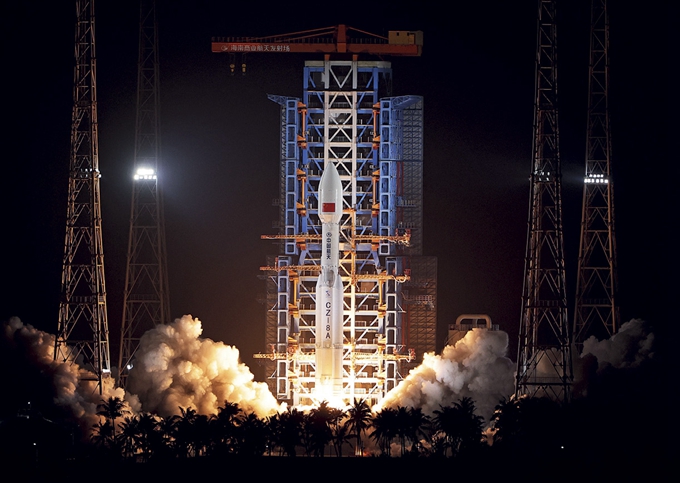
Launch of the Long March-8A rocket at the Hainan Commercial Space Launch Site on January 13, 2026
On January 13, 2026 at 11 p.m., excitement reigned at launch area No. 1 of the Hainan commercial space launch site. With a deafening roar, the Long March-8A rocket rose from the ground to place its satellites into orbit with precision.
This success perfectly illustrates the rise in power of China’s first commercial space launch site. Since its inauguration in 2024, the complex has carried out eleven successful missions in less than fourteen months, a record pace which testifies to its dynamism.
How did Wenchang manage to transform itself from a coastal city into a commercial space stronghold in such a short time? And to what extent will the Hainan special customs operation accelerate this rise?
An effective solution
To deploy on a large scale, commercial aerospace needs launch bases that are both efficient and economical. Located on the 19th parallel north, the Hainan commercial space launch site responds to this challenge with a resolutely market-oriented approach.
“Our mission is to provide commercial launch services fully tailored to demand,” says Xu Xikai, deputy director of the development and planning department of Hainan International Commercial Space Launch Company. It specifies that any company, public or private, can access a standardized launch, as long as its technology is ready.
Efficiency and profitability are the key words to establish yourself in this sector. To achieve this, the site has focused on innovation from its design. “On launch zone No. 1, for example, we replaced the traditional diversion trench with a diversion cone – a first in China which made it possible to drastically reduce construction costs,” says Mr. Xu. Launch zone No. 2, for its part, will have a versatile cylindrical platform capable of accommodating more than twenty types of rockets. This flexibility optimizes the use of infrastructure and spreads expenses over a greater number of launches.
Beyond the technique, process optimization has reduced the delays between two shots. “The site already has a rate of two launches in five days,” he specifies. This operational density makes it possible to chain contracts and smooth fixed costs, thus establishing a virtuous circle.
Finally, the relocation of the supply chain constitutes a major lever of competitiveness. The establishment of companies like JOVO now makes it possible to source critical materials directly from the launch pad, thus eliminating the additional costs and hazards of long-distance transport. From assembly to propellant filling, the site now offers integrated services at the heart of a rapidly expanding industrial cluster.

Transferring a rocket to the Hainan Commercial Space Launch Site before launch (PHOTO PROVIDED BY COMMUNICATION DEPARTMENT OF THE CPC HAINAN PROVINCE COMMITTEE)
A strategic choice
Why are commercial space leaders rushing to Wenchang? The journey of iSpace is, in this respect, revealing. As of 2021, its CEO Peng Xiaobo saw in this establishment “both the starting point towards space and a home port which allows you to return there”.
The choice of Hainan is based on a rigorous analysis, combining geographical assets and political opportunities. “Here, we benefit from a unique launch profile,” notes He Guanghui, co-founder of the company. The low latitude improves the effectiveness of launchers, while trajectories above the sea make operations safer. For companies like ours that rely on reusable rockets, this framework provides an ideal operational field for maritime recovery. »
Indeed, reusability is an essential lever for breaking down price barriers. Peng Xiaobo estimates that reusing the first stage of a rocket would reduce launch costs by five compared to conventional models.
Today, iSpace is realizing its “factory on the launch pad” objective, considerably reducing its logistics costs. With the commissioning of its own recovery vessel, the company completes its business cycle – launch, recovery, inspection, reuse – at an accelerated pace.

The Hainan Commercial Space Launch Site (DUAN WEI) Control Center
A key dividend
According to China Aerospace Science and Technology Corporation (CASC), the Chinese commercial aerospace market could cross the 1,000 billion yuan mark by 2030. In this perspective, the special customs operation of Hainan asserts itself as the major political lever for Wenchang.
According to Fan Ruixiang, academician and expert of CASC Group, the development of the Hainan Free Trade Port provides a historic opportunity. According to him, the Hainan commercial space launch site must exploit the synergy between its geographical advantages and the tax advantages of the port to become a true space incubator, capable of propelling Chinese space services internationally.
This synergy results firstly in increased efficiency and reduced costs across the entire industrial chain. The free trade port status allows Hainan to exempt imports of advanced equipment and precision components from customs duties. Coupled with a preferential rate of 15% on corporate and income tax, the policy eases the financial burden of this capital-intensive industry, thereby attracting global technologies and talents.
Finally, this framework promotes the opening of new outlets for the exploitation of data. For Li Zhongbao, chief engineer of the CASC group, the special customs operation will accelerate the cross-border circulation of innovation flows. Secure and regulated data exchange, consistent with the Free Trade Port Policy, will unlock the immense potential of downstream industries, such as big data from satellite remote sensing.