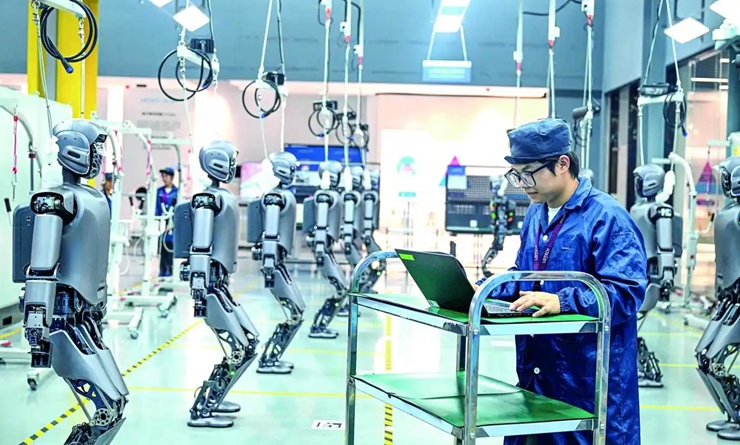
Between industrial strengths and technological challenges, China is building an ecosystem of the future open to global cooperation.
(PHOTO: Xinhua)
China’s 15th Five-Year Plan (2026-2030) marks a strategic turning point by abandoning the simple quest for growth in favor of building autonomous and technologically sovereign ecosystems. The emphasis is now placed on the development of “industries of the future”, pillars of national renewal and vector of global cooperation.
According to China’s Ministry of Industry and Information Technology (MITI), the national framework for the development of future industries is structured around nine key sectors: the “manufacturing” sector includes humanoid robots, intelligent bionics and 3D printing; the “information” sector includes quantum technologies, 6G and brain-machine interfaces; the “materials” sector includes metamaterials, smart materials and high-performance nanomaterials; the “energy” sector includes nuclear fusion, hydrogen energy and solid-state batteries; the “space” sector includes commercial aerospace, satellite internet and deep space exploration; the “health” sector includes gene therapy, synthetic biology and regenerative medicine; the “environment” sector includes carbon capture and storage and climate engineering; the “intelligence” sector includes general artificial intelligence (AI) and embodied AI; and the cutting-edge interdisciplinary sector encompasses dynamic areas like the Metaverse.
We will examine the strengths and challenges of this approach, how China is working to address various challenges to achieve its national development strategies, and the opportunities these efforts provide for international partners and global cooperation.
Strengths and challenges of the Chinese approach to the industries of the future
The industries of the future approach has major advantages, but also faces significant structural challenges.
China’s main advantage lies not only in its technological breakthroughs, but in the coherence and depth of its industrial ecosystem. Its ability to compress the cycles between design, prototyping and massive deployment creates a ripple effect, or “flywheel”, unique in the world. This industrial density, coupled with a concentration of suppliers and direct feedback loops between producers and users, transforms industrial modernization into a cumulative process. This synergy is evident in renewable energy and now AI, where China’s strength in hardware manufacturing provides a unique foundation for embodied AI and robotics.
The Chinese approach also favors the rapid integration of technologies into real-world workflows. When it comes to AI, for example, the focus is no longer just on racing for cutting-edge models, but on creating scalable platforms and deploying AI agents in manufacturing, logistics and content creation. At the same time, the rise of models such as “Robotic as a service” (RaaS) is democratizing access to these tools, already positioning China at the top of forecasts for humanoid robot installations. This pragmatic approach focused on application and monetization creates a virtuous cycle of investment and real data generation.
Despite these advantages, China faces several major challenges. The first is structural: an imbalance between robust production capacity and domestic demand which remains to be consolidated. The 15th Five-Year Plan actively promotes reforms to boost domestic consumption, but export markets continue to play a key regulatory role, with implications for trade relations.
Furthermore, the evolution and restrictions of the external technological environment also constrain the development strategy, particularly in the high-technology sector. While significant progress has been made, room for improvement remains in targeted areas such as advanced semiconductors, EDA software and specialty materials – precisely the segments targeted by some export control measures.
Added to these obstacles are obstacles linked to data quality and gaps in standardization. For example, in data-intensive fields like AI and smart manufacturing, the gap between capturing raw data and creating actionable industrial datasets remains a major bottleneck. At the same time, building unified standards and cross-sector data sharing mechanisms requires complex institutional coordination that goes beyond the simple framework of financial investment.
Finally, although political support is robust, the transition from basic research to commercial viability – the famous “valley of death” – is perilous. Proposals for “laboratory companies” (hybrid R&D entities) aim to close this gap, but success is not guaranteed. This transition to market discipline will be painful but necessary.
Solutions with Chinese characteristics
Here we’ll look at tactics to address challenges specific to the semiconductor and biomedicine industries.
In the semiconductor sector, policy solutions aim to overcome fragmentation and external technological restrictions through national-level coordination and strategic reorientation. The ambition to build a “Chinese ASML” is pushing the main industrial leaders to call for a major initiative unifying the resources of companies and research institutes. The goal is to create an “integrator champion” capable of unifying funding and talents to overcome obstacles in EUV lithography, EDA software and advanced silicon wafers during the 15th Five-Year Plan period.
Scholars recommend moving from a “catch-up” mode focused on key technologies under foreign dependence to an “active” development strategy. This involves prioritizing breakthroughs in AI and high-performance computing chips while pursuing parallel development paths: the optimization of traditional silicon technologies on the one hand, and the adoption of new architectures such as advanced packaging and open standards ecosystems (e.g., RISC-V, Chiplet) on the other.
In the meantime, China is strengthening supply chain integration through structures like the “Big Fund,” which connects design, manufacturing and materials. This so-called “dual-track” approach aims to build national autonomy while expanding technical cooperation with countries of the Global South via the “Digital Silk Road” to create buffer zones outside of Western-dominated systems.
Biomanufacturing policies aimed at bridging the “valley of death” emphasize the removal of technical obstacles in the pre-industrialization phase, since more than 90% of laboratory achievements fail to be commercialized. In 2025, MITI and the National Development and Reform Commission (NDRC) launched a program to create a national network of specialized testing centers. The aim is to establish more than 20 platforms by 2027 to serve more than 200 companies and incubate more than 400 products, covering sectors ranging from biopharmaceuticals to bio-based chemical compounds.
Opportunities for global cooperation
Multinationals can take advantage of opening new sectors and integrate into China’s mature supply chains. The government announced pilot programs expanding market access for value-added telecommunications, biotechnology and foreign hospital services. Shanghai released 26 new measures to support multinationals’ R&D centers, encouraging their involvement in state-led research and strengthening their ties with local universities to speed up the bringing of innovations to market. Foreign manufacturing companies are specifically guided to build high-level research platforms for key industrial chains especially in the fields of integrated circuits and AI.
As for developing partner countries, China is actively building cooperation platforms. Through the Innovation Center of the BRICS Partnership on the New Industrial Revolution, China launched the “Golden Egret” excellence scholarship, which has already trained 30 professionals from 22 countries, with a new program on smart manufacturing to be launched in 2026.
Three areas where mutual benefits are most tangible stand out. First, China offers its “ultra-large-scale market” and broad application scenarios. Newly opened sectors, characterized by high technological density, allow foreign capital to introduce international standards and practices. This contribution catalyzes the upscaling of the national industry, while providing lucrative opportunities for sophisticated international service providers.
Second, China’s productive efficiency, particularly in renewable energies (solar, wind, batteries), allows its partners to provide technologies accessible on a global scale. Already supplying 70% of the world’s photovoltaic components and 60% of wind energy equipment, China illustrates this synergy through its cooperation with Latin America. The alliance of Chinese expertise in AI with the abundant renewable resources of Brazil or Chile creates complementary partnerships, optimizing energy efficiency while providing vast testing grounds for Chinese innovation.
Third, China aims to co-create the standards of tomorrow rather than simply adapting to existing rules. Through initiatives such as the “Digital Silk Road” and BRICS instances, AI governance partnerships, 6G standards alignment and digital infrastructure interoperability represent opportunities to jointly shape future technology frameworks. The “open source + local deployment” model of Chinese AI platforms (e.g., DeepSeek, Qwen) allows global developers to build on these foundations while maintaining data security.
*JOSEF GREGORY MAHONEY is professor of politics and international relations and director of the Center for Ecological Civilization at the East China Normal University (ECNU) in Shanghai.