The Two Sessions shed light on how the Chinese leadership intends to translate its long-term strategic vision into concrete political actions.
Ambassadors stationed in China read the Activity Report of the Standing Committee of the NPC, during the second plenary meeting of the fourth session of the 14th NPC at the Great Hall of the People in Beijing, March 9, 2026. (PHOTO : YU JIE)
Every year, the world’s attention turns to China during the Two Sessions – the annual meetings of the National People’s Congress (NPC) and the National Committee of the Chinese People’s Political Consultative Conference (CPPCC). In 2026, these meetings took place at a pivotal moment: they inaugurated the 15th Five-Year Plan (2026-2030) and set the political course ahead of the 21st Congress of the Chinese Communist Party scheduled for 2027.
In a world shaped by technological acceleration, geopolitical tensions and economic fragmentation, the decisions taken in Beijing in March 2026 will have repercussions far beyond China’s borders.
The NPC, the supreme organ of state power, is responsible for legislation, the approval of major political guidelines, the examination of the national budget and the appointment of senior state leaders.
By bringing together representatives of political parties, mass organizations, ethnic groups and key sectors of society, the CPPCC promotes dialogue, consensus building and political deliberation, without having legislative powers.
The Two Sessions of 2026 took place in a demanding external environment. The global economy is undergoing a profound structural transformation, propelled by the rise of artificial intelligence, green technologies, digital infrastructure and advanced manufacturing. At the same time, the exacerbation of strategic competition, the reconfiguration of supply chains and technological “decoupling” are profoundly reshaping international economic relations.

A panda robot interacts with a foreign visitor during the 2026 Global Home Appliances and Electronics Exhibition (AWE 2026) in Shanghai, March 12, 2026.
In this context marked by rapid technological changes, the margin for error is limited. A political miscalculation can have lasting consequences, particularly in terms of innovation ecosystems, industrial modernization, energy transition or demographic adaptation. For China, which aims to climb the global value chain while preserving its social stability and economic resilience, strategic coherence is not an option, but a necessity. In 2025, its GDP grew by 5% to cross the $20 trillion mark – a figure equivalent to the sum of the economies of Germany, Japan, India, the United Kingdom and Italy.
At the heart of the challenges of 2026 is the launch of the 15th Five-Year Plan. A true keystone of the Chinese governance model, this instrument defines medium-term orientations while providing flexibility of adjustment and regional differentiation.
Its importance goes far beyond the simple economic dimension. It serves as a unifying framework, aligning national priorities with their provincial implementation, coordinating public and private sector expectations, and providing society as a whole with a common roadmap. In these times of uncertainty and transition, such cohesion constitutes a major strategic advantage.
Modernization is the common thread of this planning process. The Chinese leadership has repeatedly emphasized that modernization is not judged solely by the rate of growth, but by the quality, sustainability and balance of development.
The new plan deepens commitments to high-quality development, technological autonomy, green transformation and strengthened social protection systems, while addressing challenges related to aging, productivity constraints and regional disparities.

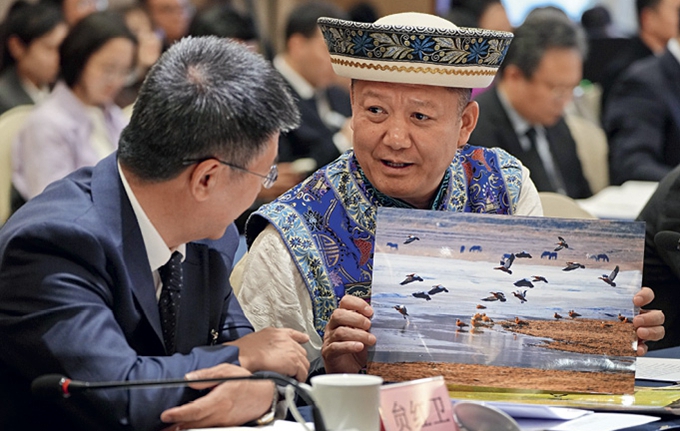
NPC Deputy Wang Guodong (R) presents progress in preserving biodiversity in Tu Autonomous County Huzhu (Qinghai), during a deliberation of the Qinghai delegation during the fourth session of the 14th NPC, March 6, 2026. (PHOTO: YU JIE)
Several major directions of the 15th Five-Year Plan have emerged clearly.
First, innovation remains central. Science and technology are seen not only as engines of growth, but also as pillars of national security and long-term competitiveness. Investments in fundamental research, talent training and strategic emerging industries are growing.
Second, economic resilience is emphasized. This involves stimulating domestic demand – one of the most crucial challenges of the coming years –, strengthening the security of supply chains and subtle management of the balance between openness and risk prevention. The construction of a “modern industrial system” already occupies a preponderant place.
Third, green and low-carbon development continues to guide political choices. Climate commitments and environmental imperatives make the energy transition, resource efficiency and the protection of ecosystems essential components of the plan.
Fourth, social cohesion remains a major concern, particularly in a country with 1.4 billion inhabitants. Stable employment, income distribution, public services and demographic adaptation are essential to ensure sustainable development and preserve social harmony.
The priorities set out during the Two Sessions shed light on how the Chinese leadership intends to translate its long-term strategic vision into concrete political actions, while preserving the continuity of the system and adapting to national and international developments.
China’s governance framework places primary importance on long-term goals. The targets set for 2035 and beyond – including achieving socialist modernization, achieving global leadership in innovation and significantly improving the population’s living standards – serve as essential benchmarks for medium-term planning.
In this sense, 2026 is a pivotal year. It links the conclusion of the 14th Five-Year Plan (2021-2025) and the more distant horizon of the mid-century goals. Decisions made at this time will shape China’s development trajectory for years to come.
This is why global attention was focused on Beijing in early March. Investors, policymakers, academics and governments have been closely scrutinizing the Two Sessions for signals about China’s economic direction, its strategy in the face of technological competition and its vision of modernization in a changing world.
More than an annual political ritual, the Two Sessions of 2026 have opened a new strategic cycle where China intends to navigate uncertainty through planning discipline, institutional cohesion and a long-term vision.
(The original article was published in
*DAVID GOSSET is a French specialist in international relations, sinologist, and founder of the China-Europe-America Global Initiative.



![[C Finance]Central Bank: The goal of keeping the RMB exchange rate basically stable will not change](https://beijingherald.com/wp-content/uploads/2025/01/C-FinanceCentral-Bank-The-goal-of-keeping-the-RMB-exchange-120x86.jpeg)