By setting the rules for the industries of the future, China no longer just wants to innovate, it wants to inspire the regulatory frameworks for tomorrow’s economy.
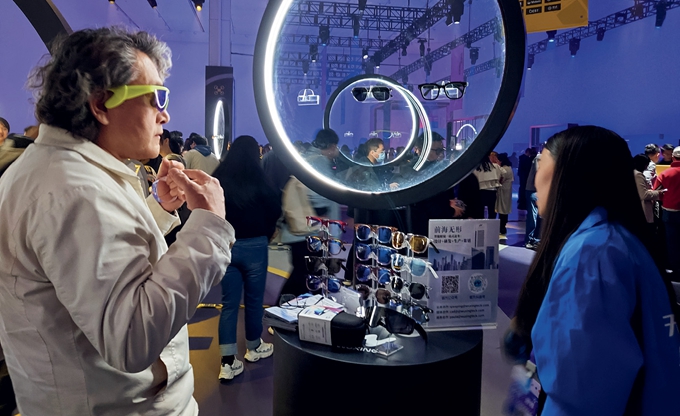
A visitor views smart glasses equipped with the Qwen language model at the Alibaba Cloud Smart Hardware Exhibition in Shenzhen, Guangdong, January 8, 2026.
At the annual sessions of the National People’s Congress (NPC) and the National Committee of the Chinese People’s Political Consultative Conference (CPPCC), China unveiled the priorities of its 15th Five-Year Plan (2026-2030), emphasizing massive investment in disruptive technologies: embodied AI, 6G, quantum and brain-machine interfaces.
Beyond planning, what are the strategic issues behind these choices? Does China have the infrastructure necessary to transform these innovations into economic engines? To understand how these technologies will disrupt our daily lives, we interviewed Pu Songtao, an expert in future industries at the China Electronic Information Industry Development Research Center.
A new positioning
According to Pu Songtao, the promotion of industries of the future as new engines of growth within the framework of the 15th Five-Year Plan is the result of a coherent and continuously deepening policy. From 2020, China showed its desire to structure these sectors. If the 14th Five-Year Plan (2021-2025) formalized forward planning, the 15th Five-Year Plan period should be marked by major advances on two fronts.
First, this development reflects a shift from the strategic plan to systemic implementation. While the previous plan outlined the macroeconomic framework, the 15th Five-Year Plan focuses on operational deployment. This pace is perfectly consistent with the objective laws governing the industrialization of technologies and also responds to the imperative of cultivating new quality productive forces. The fundamental objective is to remove obstacles to the transformation of technological results into industrial applications.
Second, the industries of the future are now officially integrated into the heart of the modern industrial system. Mr. Pu interprets this new configuration through the model of industrial pillars: traditional industries constitute the “base” stabilizing the general economy; emerging industries represent a “growth pole”; and the industries of the future form the “engine of tomorrow”, guaranteeing a long-term competitive advantage. The parallel progression of these three pillars means that the industries of the future will no longer be mere technological reserves, but acquire strategic importance equal to traditional and emerging industries.
Technological innovation is emerging as the new engine of Chinese growth. If the industries of the future still remain at the exploratory stage and will not offer immediate massive returns, their development during the 15th Five-Year Plan is a long-term bet. The objective is clear: to transform this growth potential into an advantage. However, their development remains crucial to guarantee the independence and competitiveness of the country.

A spherical robot at the Digital China Summit, in Fuzhou (Fujian), April 29, 2025
Development challenges
The transition from planning to realizing China’s future industries builds on the solid foundations accumulated during the 14th Five-Year Plan period in several key dimensions.
On the political level, a support system articulated around the principle of “strategic management of the State, targeted sectoral measures and local pioneering experiments” has emerged. This system links the national strategic design and ministerial directives to the establishment of pilot zones, notably Beijing and Shanghai.
In terms of innovation, major breakthroughs have been made in quantum technologies and brain-machine interfaces. Between 2020 and 2024, China ranked first in the world for five consecutive years in quantum patent applications, laying the technical foundation for its industrialization.
At the same time, the leading role of businesses has been strengthened with increased participation of market players. The State Assets Administration and Supervision Commission of China’s State Council has launched a specific action to deploy industries of the future. Large state-owned enterprises and technology companies have formed innovation consortia, accelerating the formation of an innovation ecosystem involving businesses, universities, research institutes and users.
Furthermore, industrial scale and talent pools have seen steady growth. The biomanufacturing industry is worth around 1 trillion yuan, while the embodied AI market represented around 27% of the global total in 2025. Finally, the creation of future technology schools and interdisciplinary training guarantees a strong skills pool.
However, the development of the industries of the future today faces two major challenges. On the one hand, it is necessary to explore diversified technological avenues to remove scientific obstacles. The uncertainty of trajectories requires plural exploration in order to distribute technological risks. The answer lies in suitable financing mechanisms, the pooling of risks and the establishment of a “right to make mistakes”.
On the other hand, it is appropriate to prioritize the development of emblematic application scenarios and viable economic models to ensure the commercial feasibility of industries. A sustainable economic model constitutes the bridge between technology and the market, like AI which has been able to establish a virtuous circle thanks to models such as Software as a Service (SaaS) or API calls.

DUCO, collaborative robot from Siasun, at the Shanghai International Automobile Manufacturing Technologies and Materials Exhibition, July 10, 2025
Securing development through rules
Asked about ways to guarantee stable and healthy development of the industries of the future, Pu Songtao believes that market rules act as both a “track” and a “guardrail”. On the one hand, they guide the allocation of resources in order to prevent disorder; on the other, they draw the ethical and security limits necessary to protect against systemic risks.
Thus, market regulation is of crucial importance. Clear and stable rules provide market participants with a predictable outlook, enhance investor confidence and reduce uncertainties, thereby promoting a smooth transition and healthy growth of the sector.
More importantly, early implementation of mature regulations could strengthen China’s influence in setting global standards. Like the “Brussels effect” generated by the European Union’s General Data Protection Regulation, China could promote its own regulatory frameworks internationally, thus increasing its negotiating power and promoting the adoption of its standards as global references.
Light up future life
According to Mr. Pu, the impact of the industries of the future on our daily lives unfolds at two complementary levels.
On the one hand, innovations like general AI and embodied AI are concretely transforming our lives by boosting professional efficiency and personalizing healthcare. On the other hand, more discreet but structural sectors, such as commercial aerospace and nuclear fusion, are preparing a profound revolution in communications and energy infrastructures.
Ultimately, the industries of the future will move from the status of “strategic reserves” to that of “essential drivers”, thus becoming the cradle of new economic growth. This is precisely why their staggered deployment is key for China to maintain sustainable industrial vitality.