The economy of emotions is experiencing unprecedented growth in China, but this dynamic requires a certain sobriety
so as not to sink into excess.
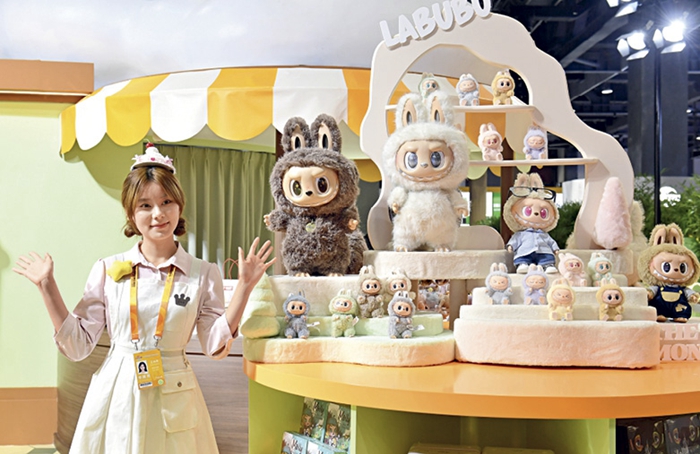
Pop Mart booth at the China International Fair for Trade in Services, September 10, 2025
Previously mocked and considered superfluous, products such as “anti-stress” mini-banana trees, mystery boxes and even AI virtual companions are now attracting young consumers. This trend reveals consumption dictated by emotions rather than practical needs.
Pay to feel good
Ms. Gao, born in the late 1990s, embodies this new generation adept at emotional consumption. His office, strewn with small comforting objects, constitutes a true sanctuary against stress. “These little companions offer me an escape from my anxiety,” she confides. Her budget last year reflects this quest for balance: between concerts, dance and fitness classes, and her visits to the Lama Temple (Yonghegong) in Beijing to pray and acquire lucky rosaries, she no longer hesitates to invest in her mental well-being. For many young Chinese, emotional spending now equals, or even surpasses, the purchase of basic necessities.
A street vendor in Jingdezhen (Jiangxi) has become a local star with his formula: “six yuan for a chicken cutlet, with 60 yuan of emotion and 600 yuan of service”. Customers queue for hours just to chat with him. The 2025 Youth Lifestyle Report, published by Seashell Finance and the Consumer Market Big Data Lab under China’s Ministry of Commerce, confirms that 56% of respondents are willing to pay for products that support them emotionally.
Ding Ying, professor of marketing at the Business School of Renmin University of China, distinguishes between two types of emotional spending: purchasing for pleasure (mystery boxes, therapeutic products, meditation classes) and the need for social connection (conviviality, cultural trips). Unlike traditional consumption focused on utility, current purchasing choices are dictated by the aesthetics of packaging, brand image and association with familiar worlds (characters, franchises). Some business models have even left practicality aside to focus on emotional value.
Although emotional consumption responds to fundamental and timeless human needs, it is today taking on an unprecedented dimension in China. With the era of material abundance, the priority has shifted from need to want, thus redefining the standards of quality of life. As Ding Ying observes, today’s consumers, especially Generation Z, prioritize self-expression and the richness of their inner experience.

The Grand Canal Music Festival in Beijing attracts crowds on October 6, 2025.
Sell the experience
In the fall of 2025, Tong Pengfei, a sugarcane farmer in Qingshen District (Sichuan), became famous overnight by turning simple picking into a game of organized “pilferage”. This fun activity has attracted thousands of visitors every day, some of whom have traveled thousands of kilometers to rediscover the adrenaline of childhood games or digital entertainment. In just ten days, this “pay theft” concept increased sugarcane sales by nearly 50,000 yuan. To capitalize on this enthusiasm, local authorities offered participants free entry to surrounding tourist sites, transforming simple day trips into extended immersive stays.
In recent years, the success of emotional marketing has boosted local tourism. In today’s cultural tourism, competitiveness is less about resources and more about the ability to create experiences that resonate deeply with consumers.
According to Xu Hong, dean of the School of Tourism and Service Management at Nankai University, under the pressure of a hectic pace of life, people crave emotional consumption to recharge and assert themselves. While the digital world facilitates convenient shopping, it also saturates daily life with superficial virtual interactions. “Offline immersive experiences then appear as a form of emotional healing by reestablishing concrete and tangible human connections. »
The major challenge, however, remains to transform a viral phenomenon on social networks into lasting success. In 2023, Zibo, a previously featureless industrial city in Shandong province, has become a national sensation thanks to its renowned barbecue, attracting tourists from all over the country. Faced with this influx, local authorities reacted quickly to streamline transport, regulate prices and strengthen security. At the same time, retailers have been able to perpetuate this craze by injecting a cultural dimension into their offering, thus transforming a simple fashion phenomenon into lasting success. Xu Hong points out that while emotional appeal can arouse consumer interest, sustainable growth depends on quality.
Emotional consumption propels new economic formats around existing activities: “murder mystery” role-playing games, escape rooms, concerts, or even xiangsheng (traditional Chinese comic dialogues). Companies are competing for the means of consumer emotional liberation.
“In the future, the value of a product will increasingly be judged by the emotional impact it provides. In a market saturated with similar goods, the competitive advantage will belong to those who know how to forge a distinctive emotional identity, capable of creating attachment and sparking repeat purchases,” believes Xu Hong.
Spend reasonably
The 15th Five-Year Plan (2026-2030) and the 2025 Central Economic Work Conference have included “stimulating consumption” among the priorities of the coming years. As the consumer market undergoes an accelerated transformation, fueled by the rise of emotional spending, it is imperative to guarantee consumer rights and ensure stable and healthy development of the sector.
Ding Ying points out that emotional consumption often does not involve tangible objects, making it difficult to price. Combined with consumers’ lower price sensitivity, this characteristic increases the risk of impulsive purchases. Competent authorities must conduct research into quality standards, pricing mechanisms and conditions of access to this market, in order to establish appropriate regulations, in particular for virtual products and services. The objective is to promote a healthy consumption environment, where well-being does not become a pretext for economic abuse.
She also emphasizes the importance of guiding consumers towards reasoned spending. “Only the creation of authentic and stable social bonds, by substituting the lasting satisfaction of endorphins for the ephemeral peaks of dopamine, allows true long-term emotional regulation. This particularly applies to children and adolescents. We must encourage them to embrace the AI era, while reminding them that human beings belong in the real world. Occasional pleasures cannot in any way replace the fundamental pillars of a balanced life. »