Human rights are not abstract concepts, they must concretely improve the well-being of populations.
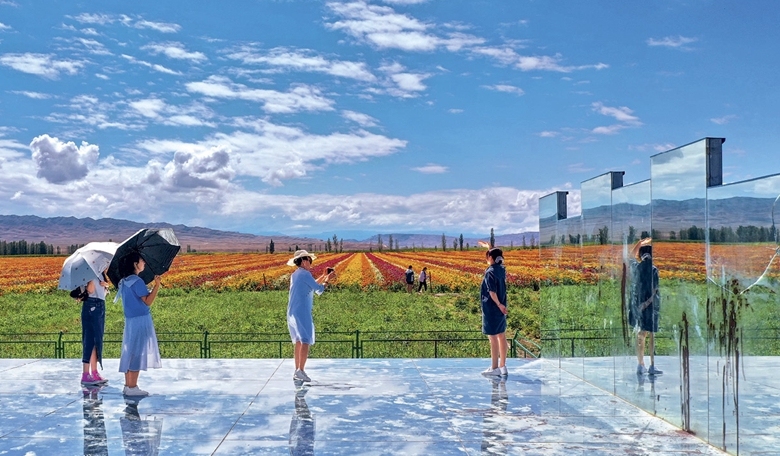
Tourists in the village of Baiyanghe (Xinjiang), August 13, 2023
Human rights are among the greatest achievements of human civilization. Shaped by their history, their culture, their social realities and their level of development, different countries often implement them in unique ways. Under the leadership of the Chinese Communist Party (CCP), China’s practices reflect this diversity and have given birth to the “development path of human rights with Chinese characteristics.”
Fundamental rights
At the heart of the Chinese concept, the right to subsistence and the right to development constitute fundamental and primordial human rights. The CCP has always maintained that without food, housing, education, health care, and opportunities for personal development, other rights risk remaining mere concepts. Therefore, improving living standards and promoting inclusive social development are at the center of China’s human rights policy.
This philosophy is deeply rooted in Chinese national realities. Since its founding in 1949, the People’s Republic of China has had to face immense challenges in terms of survival and development. In the decades since, and especially since the implementation of the reform and opening-up policy in 1978, China has relentlessly followed a development-oriented strategy, aiming to lay the economic and social milestones necessary for the protection and expansion of human rights.
One of the most convincing examples is the fight against extreme poverty. Since 1978, according to current criteria, China has enabled 770 million rural people to escape extreme poverty. While poverty remains a global scourge and the gap between rich and poor is widening, China has achieved, 10 years ahead of schedule, the poverty reduction targets set by the United Nations 2030 Agenda.
This achievement is not only an economic success, but also a major step forward for human rights. Access to education, health care, decent housing, clean water, transport and employment has improved significantly in previously disadvantaged regions. Millions of families have thus been able to fully integrate into society and realize their aspirations with dignity.
The Chinese way thus demonstrates that human rights must not be simple abstract concepts, but translate into concrete improvements on a daily basis. From increasing life expectancy to expanding access to education, from improving health coverage and social protection to raising living standards, China’s development strategy always aims to anchor human rights in reality.

Preparing zongzi ahead of the Dragon Boat Festival in Tangxi village (Jiangxi), June 20, 2023
People-centered governance
Another important feature of Chinese human rights philosophy is the active involvement of the people in governance and decision-making. China describes this approach as “whole-process people’s democracy”: a concept aimed at combining democratic participation and effective governance.
According to the CCP, democracy is not limited to periodic elections. It must be exercised throughout the political cycle: from consultation to decision-making, including management, implementation and control. The ultimate test is whether citizens are truly able to participate in public affairs and whether governance effectively responds to the fundamental needs and interests of the population.
To this end, multiple channels of participation have been put in place: popular assemblies at different levels, political consultation mechanisms, self-management at grassroots levels, public hearings, online consultation platforms, as well as broad participation in the drafting of laws and the development of public policies.
Human rights protection encompasses a wide range of areas in China, including social welfare, medical coverage, workers’ rights, access to education and services for seniors. One of the largest social security systems in the world was created, covering more than a billion people.
Furthermore, the Chinese approach emphasizes the essential balance between individual interests and collective well-being. Rights and duties are inseparable, social harmony, national stability and the general interest constituting the basis for lasting protection of human rights. While trajectories vary from one political system to another, the Chinese model seeks to harmoniously integrate democratic participation, effective governance and social development.
This human-centered philosophy has become a basic principle that “development is for the people, by the people and for the benefit of the people.” In this sense, human rights are not simple legal concepts, but concrete outcomes that enhance people’s feelings of satisfaction, happiness and security.
Expanded dimension
The Chinese philosophy of human rights evolves with national and international changes. In recent years, environmental protection and international cooperation in this area have become increasingly important pillars of Chinese discourse on human rights.
Ecological civilization represents one of the most significant developments in this regard. Chinese President Xi Jinping has repeatedly emphasized that a healthy environment is essential for human well-being and sustainable development. Clean air, clean water, fertile land, biodiversity and a healthy living environment are considered inseparable components of quality of life and human rights.
Over the last decade, China has implemented significant environmental protection measures, such as the fight against pollution, large-scale reforestation, the deployment of renewable energies, and the establishment of ecological red lines. Added to this are its commitments to the objectives of peaking carbon emissions and carbon neutrality. These efforts illustrate the belief that environmental rights are closely linked to human flourishing.
The concept of ecological civilization illustrates that the human rights framework in China goes beyond traditional debates to fully encompass economic, social, cultural and environmental dimensions, reaffirming the desire to guarantee a sustainable future for future generations.
This philosophy of human rights also has an international scope. China actively promotes the building of a community with a shared future for mankind, emphasizing mutual respect, development cooperation and mutually beneficial exchanges among nations.
In this context, South-South cooperation has established itself as a major platform for promoting the right to development. Through cooperation mechanisms such as the Belt and Road Initiative, China provides support to developing countries in sectors such as infrastructure, technology, agriculture, health and education. This approach allows partner countries to strengthen their own development capacities and improve the living conditions of their populations.
China maintains that international cooperation should focus on tangible development results and respect each country’s right to choose its own path. This position reaffirms a long-held belief: there is no single model applicable to all countries. Each nation has the right to explore the approaches best suited to its historical traditions, cultural values and development imperatives.
China’s experiences and practices provide valuable perspectives for global human rights governance. They highlight the role of development as a foundation of human dignity, the importance of effective governance to protect the general interest, the value of ecological sustainability and the scope of international cooperation for shared prosperity. If trajectories differ, the quest for a better life for all remains a common aspiration and a responsibility shared by all of humanity.
*ZAMIR AHMED AWAN is founding president of the Global Silk Route Research Alliance.



![[C Finance]Central Bank: The goal of keeping the RMB exchange rate basically stable will not change](https://beijingherald.com/wp-content/uploads/2025/01/C-FinanceCentral-Bank-The-goal-of-keeping-the-RMB-exchange-120x86.jpeg)