From the epic of the 1930s to the engines of the Long March 7A rocket, China is weaving a link between its historical heritage and its technological future.
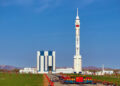
A modified version of the Long March-7 rocket, carrying a new test satellite dedicated to communications technologies, takes off from the Wenchang space launch site (Hainan) on June 23, 2026.
In Wenchang (Hainan), all eyes were turned to the sky. On June 23, 2026, when the countdown reached zero, a Long March 7A rocket rose with a deafening roar, carried by a column of flame. The roar of its engines spread across the South China Sea like distant thunder.
Among the spectators present, space enthusiasts, local residents and engineers, I remained silent in front of this almost solemn scene. There was nothing ordinary about this launch. It marked the meeting point between two eras: on the one hand, the 90 years that have passed since the completion of the historic Long March; on the other, the space ambitions of modern China. A name once associated with a national event then took on a new dimension, turned towards the stars.
The year 2026 marks the 90th anniversary of the completion of the Long March (1934-1936), the iconic epic of the Red Army of Chinese workers and peasants. Over nearly 12,500 km, across more than a dozen provinces, its fighters crossed snow-capped mountains, swamps and turbulent rivers, in extreme conditions.
This march has become a symbol of perseverance, sacrifice and willpower in the face of obstacles. For the Chinese, it represents much more than a historic event: it embodies the idea that great goals require time, unity and constant determination. It is in this spirit that China chose, in 1970, to name its first space launcher “Long March”. This name thus anchored the quest for scientific and technological autonomy of the modern country in the memory of the struggle waged for its survival in the 1930s.
Today, the Long March rocket family has completed more than 500 launches, placing China among the only three countries in the world capable of autonomously carrying out human spaceflight and lunar exploration missions. The Long March 7A plays an essential role in China’s high-orbit and deep-space missions, notably enabling the launch of heavy satellites from the Wenchang space center.
As I watched this rocket disappear into the sky over Hainan, I understood that I was not just witnessing a technological feat. I saw the link between two eras: the Long March of mud and trials, and that of metal and stars.

Zunyi Conference site in Honghuagang District in Zunyi, Guizhou, January 7, 2025
Hainan, between land, sea and space
This continuity between past and future appears with particular force in Hainan. Until four decades ago, the island was among the most isolated regions of China. Its economy was based primarily on agriculture and fishing, and travel to the mainland was long and difficult.
Today, Hainan occupies a strategic place in China’s opening to the world. The start of the establishment of the Hainan Free Trade Port in 2020 marked a new stage in its development, with policies aimed at promoting international trade, investment and exchanges. Massive public investment followed: the Hainan Circular High-Speed Rail, completed in 2015, reduced travel time around the island to just 3.5 hours; the island’s two main airports together welcomed 45 million passengers in 2025; while 5G coverage now exceeds 95% in all administrative villages.
The island also hosts the Boao Forum for Asia, launched in 2001, which has become an important platform for economic and political dialogue. Every year, more than 2,000 politicians, business leaders, academics and representatives of international organizations meet there to discuss major regional and global issues. The contrast is striking: an island once on the fringes of the international scene now hosts both a world-class space center and a major multilateral forum. Two symbols of the same ambition: to progress technologically while opening up to the world.
Beyond these symbols of modernity, the most vivid memory I have of Hainan comes neither from a conference center nor from a space launch pad. It is located on the small island of Xidao.
Far from the hustle and bustle of big cities and the rapid pace of technological innovation, I spoke with several residents whose lives remain deeply linked to the ocean. Their stories spoke of generations of fishermen, the patience needed to wait for the right tide and the pride of belonging to a community that has preserved its traditions. Listening to them, I wondered if true modernization did not lie precisely in this balance between progress and the preservation of identity.
A resident told me about the transformations he had seen during his life. He remembered a less connected island, where travel was difficult. Today, he observes with admiration the improvement of infrastructure, communications and the emergence of tourism which seeks to promote natural resources while respecting local identity.

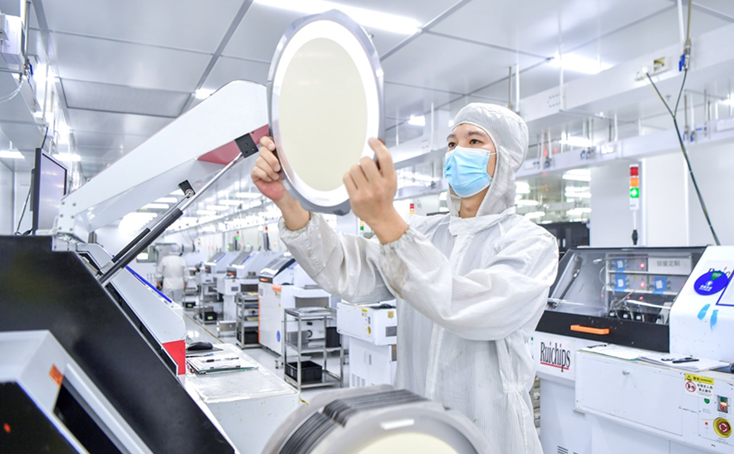
An employee conducts tests on a transistor at an electronic components company in Haikou Integrated Free Trade Zone, Hainan, May 23, 2026.
The Long March continues
Hainan’s transformation reflects a broader evolution in China. Infrastructure – notably the high-speed rail network, which today constitutes the largest in the world with more than 50,000 km, but also roads, bridges, ports and digital networks – has brought isolated territories closer to economic centers.
In 2025, 99.9% of Chinese villages were served by paved roads, compared to 35% in 2000. These projects are part of the “common prosperity” strategy, which aims to promote equitable sharing of the fruits of growth between regions, the country’s 56 ethnic groups and different income categories. To support this effort, hundreds of thousands of Chinese Communist Party members and technical professionals are sent to disadvantaged villages to tailor projects to local needs. In a country of 1.4 billion inhabitants, reducing inequality is an immense challenge. The government has made it a priority in its five-year plans, favoring stability and inclusive growth in the long term.
As my plane left Hainan, I looked out the window at the island’s lush green forests, coastlines and roads that defined the landscape. I thought about the “two” Long Marches that are shaping contemporary China. The first embodied a difficult crossing to ensure the survival of the nation. The second represented (1) a decades-long march toward scientific, technological, and economic progress. The landscapes may have moved from snow-capped mountains to orbital trajectories, but the spirit remains the same: great achievements require perseverance, coordination and a long-term vision.
Ninety years after the completion of the historic Long March, its spirit continues to inspire new journeys: towards the stars, towards development and towards a future where progress seeks to respect both history and the planet. Because, for nations as for individuals, it is not only the destinations reached that define a journey, but the way in which we advance on the path.
*MARTA MONTORO is executive president of the Spanish think tank Cátedra China.