A new chapter is opening for Sino-African trade under the sign of zero tariff.
A first batch of corn fodder imported from South Africa docks at the port of Machong (Guangdong), May 4, 2023
May 1, 2026 marks the entry into force of a measure intended to fundamentally reshape economic relations between China and Africa: the application of a policy of zero tariff treatment to all imports from the 53 African countries that have established diplomatic relations with China. This opening-up initiative, which Wang Yi, Chinese Minister of Foreign Affairs, compared to an “arithmetic operation”, is now moving from concept to reality.
Through the “subtraction” of tariff barriers, China intends to encourage the “addition” of trade, trigger a real multiplier effect in terms of social benefits and expand the opportunities offered by the immensity of its market. Behind these mathematical operations lies both a strategic response to the uncertainties of the international context and a decisive step forward towards the realization of the notion of a community with a shared future for humanity, particularly in Sino-African relations.
Unilateral opening
China’s decision to unilaterally expand its opening takes on its full meaning in a context of renewed trade protectionism and increased recourse to tariff weapons by certain major powers. According to data from the General Administration of Customs of China, the Sino-African trade volume reached $348 billion in 2025, up 17.7% year-on-year, setting a new all-time high. China remains, for the 16th consecutive year, the leading trading partner of the African continent.
In this context, the total exemption from customs duties means that emblematic products (coffees from Ethiopia and Kenya, dried peppers from Uganda and even fruits from South Africa) will be able to access the Chinese market at more competitive prices. This measure will benefit African exporters and enrich the offer on the Chinese market, responding to a growing demand for diversified and quality products.
This policy sends a strong signal: that of a commitment to trade stability and multilateralism. As uncertainty dominates global trade, China is choosing to offer African economies valuable visibility.
As Zhao Yongsheng, a researcher at the Research Institute for Global Value Chains and director of the French Economy Research Center at the University of International Business and Economics, points out, the concrete and shared benefits generated by zero tariff treatment are precisely the materialization of the China-Africa community of shared future in the new era. In his eyes, this policy illustrates a strategic approach that favors long-term gains and mutual benefit, rather than short-term calculations.
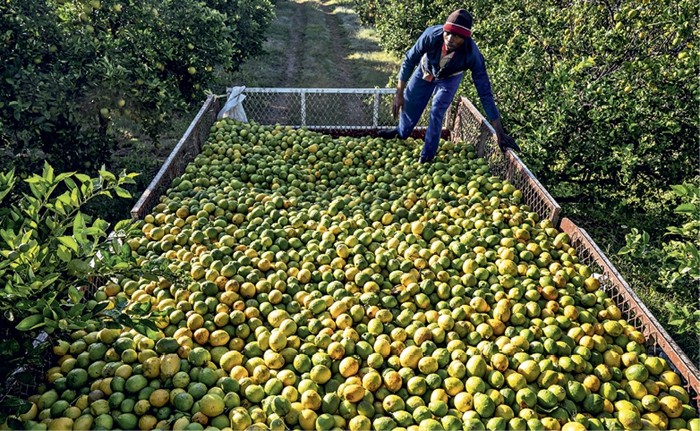
A worker works on a citrus farm in the North West province, South Africa, May 24, 2023.
In-depth and structured cooperation
However, zero tariff treatment is only one lever among others. The case of a Kenyan flower, picked in Nairobi and delivered to Shanghai in less than 20 hours, illustrates the combined effect of trade facilitation policies, optimized logistics corridors and accelerated customs procedures.
Concrete initiatives also demonstrate this dynamic. During an economic forum dedicated to new opportunities linked to “zero tariffs” held in Brazzaville (Republic of Congo), companies from the two countries concluded agreements aimed at structuring transnational value chains. The model providing for the R&D stage in China associated with the use of African raw materials for marketing on the Chinese market is gradually taking shape, supported by “green corridor” and rapid customs clearance systems.
The most structuring impact of this policy lies in its ripple effect on industrial chains. By facilitating access to the Chinese market, it encourages Chinese companies to invest in Africa, to develop processing capacities there and to promote technology transfer. The objective is clear: to help African economies move beyond their traditional role as suppliers of raw materials to move up the ranks of global value chains.
This ambition was welcomed by Denis Christel Sassou Nguesso, Minister of International Cooperation and the Promotion of Public/Private Partnership of the Republic of Congo, who believes that “zero tariffs” will help increase the added value of African agricultural and industrial products. By combining market opening, investment and technology transfer, China is responding to African aspirations in terms of industrialization.

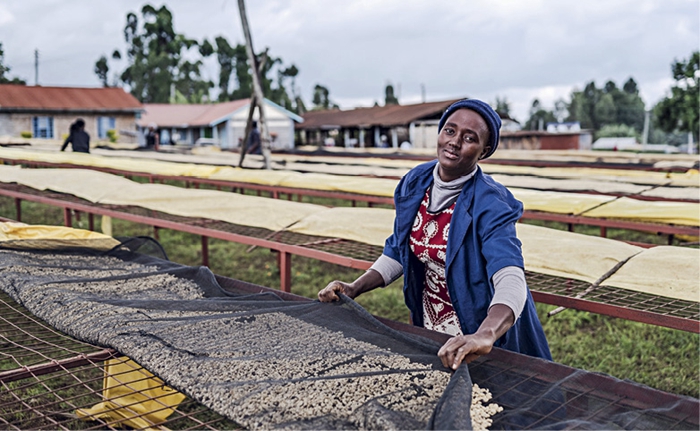
A worker dries coffee beans at a processing factory in Kirinyaga, Kenya, December 18, 2024.
Community of shared future
The most profound impact of this policy lies in its capacity to transform an abstract concept, that of the community with a shared future for humanity, into a tangible reality.
Drinking coffee made from African beans or tasting South African wines in China, or even allowing young Africans to find stable employment in local companies supported by Chinese investments: Sino-African cooperation is part of people’s daily lives.
According to Mr. Zhao, the multiplier effect of this policy is deployed at several levels: in the short term, it stimulates employment and income in Africa; in the medium term, it strengthens industrial capacities through investments and technology transfer; in the long term, it favors the emergence of a class of African consumers, likely to become a driver of demand for Chinese products. This is a virtuous circle that goes beyond the simple logic of commercial exchange.
As Mr. Wang points out, this development is part of a long history. From visits to Africa by former Chinese Premier Zhou Enlai to the sacrifices of Chinese engineers during the construction of the Tanzania-Zambia railway, the Sino-African relationship has weathered the tests of time and international ups and downs. Today, zero tariff treatment extends this heritage by translating it into concrete development opportunities.