“The modernization of any nation flows in the bed of its own civilization. » Giray Fidan, Turkish sinologist, draws this conclusion from his observations on China.
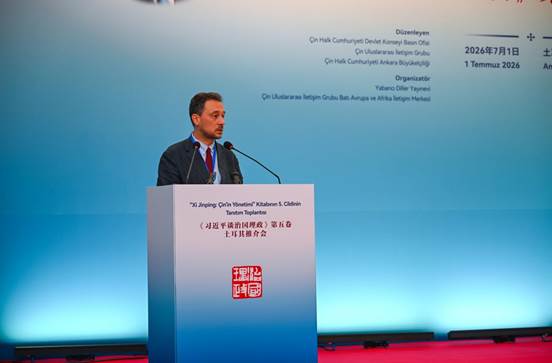
Giray Fidan delivers a speech at an event promoting the fifth volume of Xi Jinping: China’s Governance in Türkiye.
In China, legend has it that Ma Liang’s magic paintbrush brings everything he draws to life. This story crossed borders to find its way into a Turkish comic strip, awakening in a twelve-year-old boy the dream of a distant China. This teenager was Giray Fidan. Years later, he exchanged the brush for the translator’s pen, making it his mission to build a bridge between Chinese and Turkish civilizations.
Today, Giray Fidan is the director of the Oriental Languages Department at Hacı Bayram Veli University in Ankara. For more than twenty years, he has devoted himself to Sinology and literary translation, transposing the works of Confucius, Sun Tzu, Cao Xueqin and Lao She from Chinese into Turkish. On its shelves, on one side the original texts yellowed by time, on the other the Turkish translations which thicken over the years. Beyond books, his knowledge of China was gradually nourished by the country’s contemporary realities.
Chinese wisdom in the waters and mountains
At a promotional event for the fifth volume of Xi Jinping: The Governance of China in Ankara, Giray Fidan said he was impressed by China’s development in recent years, emphasizing that environmental cleanliness had ceased to be the prerogative of a few cities and extended to the entire territory.
Beyond improving the living environment, he sees in President Xi Jinping’s phrase, “Clear waters and green mountains are worth their weight in gold”, an echo of the traditional Chinese conception of the relationship with nature. He evokes Taoism and its principle of “Dao following nature”, or the warnings of Mencius against fishing with too fine mesh and cutting wood out of season. All these lessons converge towards the same requirement: collect with moderation and use resources in moderation. For Giray Fidan, ecological civilization, proposed by Mr. Xi, is a “creative and innovative reinvention” of this ancient philosophy.
The Chinese, he recalls, have never considered nature as an object to be tamed, but as a living organism with which we must live in harmony. In his eyes, the strength of the phrase “Clear waters and green mountains are worth their weight in gold” lies in its ability to provide a clear answer to a global dilemma: the possibility of reconciling economic growth and environmental protection.
“In other words, nature cannot be sacrificed on the altar of development at all costs, because it constitutes in itself the most precious of riches. » Giray Fidan believes that, faced with environmental challenges, humanity would benefit from rediscovering the wisdom of measurement and harmony brought by ancient civilizations, beyond just technological and commercial responses.

Giray Fidan in front of Lao She’s former residence in Qingdao (Shandong) (PHOTO PROVIDED BY GIRAY FIDAN)
A Chinese response in a cup of coffee
Another striking change struck the sinologist: the meteoric rise of coffee. “China is historically the country of tea. A few years ago, it was difficult to find good coffee there. Today, signs are everywhere. » This observation is eloquent: a society so deeply rooted in tea culture, but capable of adopting and democratizing coffee in such a short time, demonstrates remarkable serenity – far from any identity withdrawal or any blind imitation. It reveals a China which, while remaining faithful to its soul, opens up to the world with confidence.
“The Yi Jing says: “Through change, one finds the path; through the path, one finds duration.” » Giray Fidan sees it as a profound reflection on the way in which a civilization in full modernization deals with foreign influences and its own tradition.
He then evokes a key concept proposed by Mr. Xi: the “two combinations”. If the first unites Marxism with the concrete realities of the country, the “second combination” seals a profound fusion between Marxist principles and the best of traditional Chinese culture. For Giray Fidan, this approach is part of a long historical quest: “From the debate at the end of the Qing dynasty on “Chinese culture as a foundation, Western culture as a means of action”, to the precept of “drawing from the past to serve the present, drawing from abroad to serve China”, Chinese intellectuals have never stopped looking for a path to modernization. »
In his eyes, this “second combination” restores tradition to its rightful place: that of a living root and not a burden. “The modernization of any nation must flow within the bed of its own civilization, and this approach is China’s unique response to this requirement. »


Covers of The Art of War (l.) and The Dream in the Red Pavilion (r.), in their Turkish versions translated by Giray Fidan (PHOTO PROVIDED BY GIRAY FIDAN)
From Ma Liang’s magic brush to the translator’s pen
It all started in Beijing. It was during his doctorate at the University of Languages and Cultures in Beijing that Giray Fidan tried his hand at translating the Analects of Confucius.
Back in Turkey, noting that Chinese classics were often translated into Turkish from English versions or other intermediate languages, at the cost of distancing themselves from the original text, he decided to work exclusively from Chinese. In collaboration with Professor Pulat Otkan, he signed the first Turkish version of The Art of War directly from the classic text. In twelve years, the work has been reprinted 31 times, proof of the true enthusiasm for the ancient wisdom of China.
Today, Giray Fidan is tackling the monumental Dream in the Red Pavilion, a work that he considers to be the ultimate test of his career as a sinologist. In 2023, the publication of the first volume in Turkish was quickly followed by a reprint, which reinforced his approach.
For contemporary works, he favors texts with universal emotions which offer an authentic mirror of society. His translation of Ordinary World (2), a novel by the Chinese writer Lu Yao, allowed Turkish-speaking readers to identify with the destiny of the simple people of the Loess plateau who struggle to improve their lot, sharing the same attachment to their native land and the same desire to surpass themselves. “The strongest bridge between civilizations remains the book,” he likes to point out.
From a young boy fascinated by Ma Liang’s magic brush to a sinologist awarded the China Special Book Prize – Youth Prize, Giray Fidan’s journey illustrates, better than any speech, the depth of exchanges between China and the world. Even today, leaning over his table, he continues, through his pen, to connect ancient China to Turkish readers eager to understand it.