China is stepping up support for industries of the future through high-quality development and international cooperation.
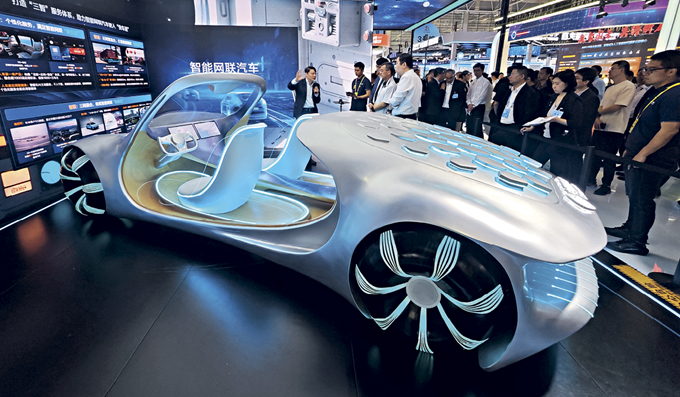
A connected and autonomous vehicle attracts visitors to the Digital China Summit in Fuzhou, Fujian, April 28, 2025.
As the Chinese economy enters a new phase of high-quality development, the “industries of the future” are emerging as a major strategic axis. Faced with the need to transform its traditional growth model, the development of these industries constitutes the essential engine of the country’s economic restructuring, while reaffirming its desire to deepen mutually beneficial partnerships and share the fruits of its innovation.
According to this year’s Government Work Report, China will develop cutting-edge fields such as future energy, quantum technologies, embodied artificial intelligence (AI), brain-machine interfaces and 6G technology. Why does China attach such importance to these industries? What are the main challenges to overcome for their deployment? And to what extent will this new engine contribute to global development?
Growing demands
Positioning industries of the future as the main growth engine reflects China’s analysis of national transformation imperatives and global technology trends.
First, this strategy responds to the quest for new levers of sustainable growth. Faced with diminishing marginal returns in traditional industries, it has become essential to open new paths through disruptive innovations. The synergistic development of emerging and future industries over the next decade is predicted to generate an economic volume comparable to that of China’s current high-tech industries.
These technologies have a major multiplier effect: AI is capable of redefining traditional manufacturing, while biotechnology offers more environmentally friendly production solutions. Their deployment will unlock growth potential far greater than their intrinsic value.
Furthermore, this choice constitutes an active response to the global technological race. The industries of the future are the main lever of competitiveness of the next technological revolution, for which the great powers are accelerating their strategic deployments. The United States relies on a mature innovation ecosystem, the European Union focuses on ecological transition and Japan consolidates its strengths in materials and production. For China, the development of industries of the future is an essential choice to align with the latest global developments and respond to global challenges, such as climate change and energy security.
History shows us that technological advances lacking inclusiveness can worsen global development imbalances. That’s why China is putting accessibility at the heart of its planning: from quantum communications to ensure digital security in developing countries, to biomanufacturing driving green industrialization in resource-constrained countries, to low-cost brain-machine interfaces for people with disabilities around the world. These ambitions illustrate China’s commitment to transforming technological breakthroughs into global public goods.

A foreign visitor discovers how to capture individual brain electrical signals through brain-machine interfaces at the HICOOL 2025 Global Entrepreneur Summit in Beijing from October 16 to 18, 2025.
Challenges to overcome
Moving from blueprint to concrete productivity requires overcoming the obstacles inherent to the development of these cutting-edge industries.
The main challenge lies in strengthening innovation capacities to multiply technological breakthroughs. While China’s R&D investments are among the highest in the world, the country has yet to complete its transition from follower to leader. Faced with the uncertainties of the industries of the future, the research ecosystem must take advantage of its strengths in terms of resource concentration and demonstrate patience in the face of the risks of failure. At the same time, it is essential to emphasize the commercialization of scientific results so that innovation becomes a real industrial engine.
Another major challenge consists of strengthening the resilience of industrial chains while maintaining a policy of openness. In strategic areas such as semiconductors and industrial software, China is striving to overcome technological obstacles: the objective is not autarky, but obtaining a fair weight within international cooperation. Aware that the future of these industries is inseparable from the global innovation network, China wishes to collaborate with other countries to build a more open, inclusive and stable global innovation system.
Finally, the most crucial challenge remains the establishment of a governance model adapted to emerging technologies, guaranteeing that they serve the general interest. Existing regulatory frameworks sometimes struggle to keep up with the dazzling pace of the industries of the future. Governance must therefore evolve from a passive reaction to a more agile approach. This involves establishing a human-centered evaluation system, prioritizing innovations that can address global challenges such as poverty, disease and environmental degradation. Such an approach guarantees both robust economic growth and collective well-being.
A desire for cooperation
The development of industries of the future in China reflects a sincere desire to expand international collaboration.
China encourages its innovation hubs, including Beijing, Shanghai and the Guangdong-Hong Kong-Macao Greater Bay Area, to further integrate into the global innovation network, sharing their scientific resources and innovation capabilities with the rest of the world. It also recommends the creation of a global fund dedicated to cooperation in the industries of the future, with a view to supporting researchers in developing countries and creating technological demonstration centers within the framework of South-South cooperation.
China’s vast market and diversity of application scenarios provide an ideal testing ground for cutting-edge technologies, whether smart cities, telemedicine or energy transition. Most importantly, China is eager to share proven and affordable solutions. For example, its smart agricultural systems are already helping smallholder farmers in Southeast Asia increase their income, while AI diagnostic tools are facilitating access to quality care in remote regions of Africa. Chinese initiatives provide opportunities for countries at different stages of development to make progress.
On the governance front, China maintains that global technology rules should not be dictated by a handful of countries. In areas such as data flow, AI ethics and biosecurity, the voices of all stakeholders, including developing countries, must be heard. The objective is to jointly develop fair and inclusive standards so that the benefits of the technological revolution benefit everyone.
In short, the industries of the future represent an intrinsic requirement for China’s high-quality development and mark a profound transformation of its relations with the world. Committing to developing these industries with its partners, China is responding to common challenges and sharing the fruits of growth. It is a commitment to one’s own future, but also an answer to the fundamental question: “What world do we want to build?” »
*LIU DIAN is an assistant researcher of the China Institute of Fudan University.



![[C Finance]Central Bank: The goal of keeping the RMB exchange rate basically stable will not change](https://beijingherald.com/wp-content/uploads/2025/01/C-FinanceCentral-Bank-The-goal-of-keeping-the-RMB-exchange-120x86.jpeg)