Faced with a Western vision deemed disconnected from reality, China proposes to refocus the humanitarian debate around an imperative: the right to development for all.
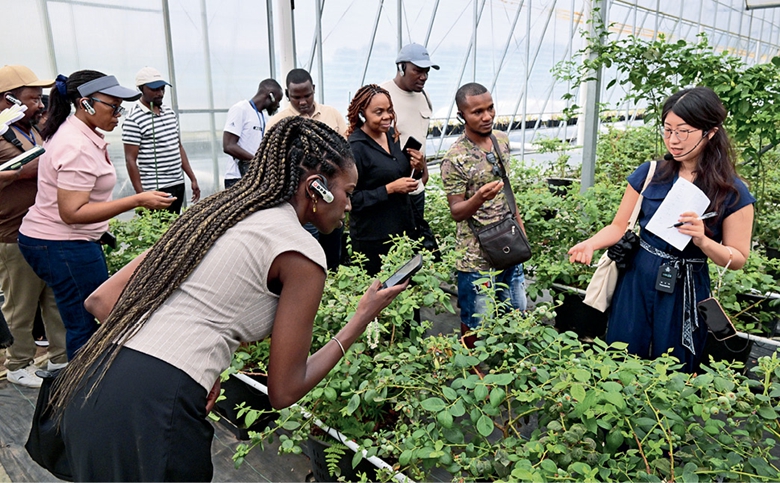
African scholars visit an agricultural technology park in Jinhua, Zhejiang, May 23, 2026.
The issue of human rights has been on the agenda of the international community for decades. However, their definition and interpretation remain contested. Are they truly universal, that is to say valid for all societies at all times? Or do they depend on political, social, economic and cultural realities, as well as historical processes, norms and stages of development specific to each society?
During the China-Europe Seminar on Human Rights, held in Paris last June, several researchers warned against the use of the term “universal”, which, too often, conceals a Western vision seeking to impose its own definition and interpretation of these rights. Although guided by noble intentions, certain United Nations declarations on human rights, starting with the Universal Declaration of Human Rights adopted in 1948, indeed raise questions.
First, most of today’s nation states were unrepresented at the time, as they were still under the yoke of Western colonialism. Second, although Western powers helped shape important systems of global governance – such as in Europe the Peace Treaty of Westphalia in 1648, which first established the principles of national sovereignty, territorial integrity and non-interference – this did not prevent imperialist powers from waging new wars. The United Nations Charter of 1945, drawn up mainly by the victorious great powers of the Second World War to ward off the specter of global conflicts, is today recognized by all countries as the cornerstone of global governance. However, it is regularly undermined by certain great powers who place their strategic interests above international law. The recent conflicts in Gaza are a tragic illustration of this. These findings show that the authority of international rules is not acquired; it is important both to defend them and to make them more inclusive.

The 80th United Nations General Assembly is being held under the theme “Better together: 80 years and beyond for peace, development and human rights”, at UN headquarters in New York, on September 9, 2025.
The right to development
To resolve this dilemma and guarantee peaceful coexistence in a complex world, nations must agree on certain fundamental principles while respecting their social, cultural, historical and economic specificities.
A promising path is to define priorities for humanity, based on the shared conviction that human nature is creative and oriented towards the common good. Universality should thus flow from our deepest human needs. It can also be built gradually: a right accepted by all societies or nations at a given stage of their development can then be considered as a fundamental human right.
The right to development is one of these universal rights. The Declaration on the Right to Development, adopted by the United Nations General Assembly in December 1986, states in its preamble that “development is a global, economic, social, cultural and political process, which aims to continually improve the well-being of the entire population and of all individuals, on the basis of their active, free and meaningful participation in development and the equitable sharing of the benefits resulting from it”. It also calls on the international community to create favorable conditions for the realization of this right.
Indeed, human dignity cannot be preserved without first being freed from hunger, poverty and lack of access to essential services such as sanitation, clean water, electricity, education and health care. This idea is similar to that of American President Franklin D. Roosevelt, who in 1941 established the “freedom to live free from want” in his famous “four freedoms” speech. The Philadelphia Declaration, adopted by the International Labor Organization in 1944, laid the foundations for an ambitious post-war program of social and economic rights, affirming that “all human beings, regardless of race, creed or sex, have the right to pursue their material progress and spiritual development in freedom and dignity, in economic security and with equal opportunity.” This innovative text already called for full employment, improved living standards, fair wages and adequate social protection, through concerted action both nationally and internationally. The United Nations Charter, ratified in 1945, sealed this commitment by including among its four main objectives the need to “use international institutions to promote the economic and social progress of all peoples”.

Scientific approach to Fuzhao Agricultural Park, Zhaojue District (Sichuan), September 11, 2020
China’s exemplary contribution
In 2021, China celebrated a historic victory: the eradication of extreme poverty, fulfilling its first centenary goal. In the space of four decades, 800 million people have been lifted out of poverty, an unprecedented feat in human history. This achievement is not only a triumph for the Chinese people, but also a valuable contribution to the world, and particularly to countries in the Global South. Open and generous, China aspires to share the fruits of its progress in order to build what it calls “a community with a shared future for humanity”.
The preamble to the Declaration on the Right to Development called for “creating a new world economic order.” The Belt and Road Initiative today constitutes the most concrete and advanced platform to achieve this. China is providing this initiative with unprecedented industrial and technological capacity to develop infrastructure, modernize agriculture and industry around the world, while strengthening education and professional training programs with developing countries.
It is crucial to emphasize that these 800 million Chinese, now out of poverty, actively contribute to the development and well-being of billions of other human beings. Human dignity is not limited to the satisfaction of basic needs – food, clothing, shelter. Access to these fundamental rights, inseparable from education, allows each individual to fully develop their creative faculties. It is precisely this creativity that distinguishes us from other living species. Thus, the human being ceases to be a passive receiver to become an active creator, capable of generating new wealth in science, technology, culture, the arts, agriculture or industry.
Beyond a standardized vision of human rights
The development of human rights is a dynamic and constantly evolving process. In the West itself, these rights did not appear as a fixed whole, but were gradually forged over the course of history. In the same way, China has undertaken numerous successive reforms in this area, adapting these rights to the new realities born of its own economic and social development. The inclusion in Article 33 of the Constitution in 2004 of the clause “the State respects and safeguards human rights” marked China’s solemn commitment to international standards and the desire of its institutions to harmonize national laws with the principles of human rights.
The essential lesson of the China-Europe Seminar on Human Rights is clear: there is no ready-made “one-size-fits-all solution”. On the contrary, nations must work together, in dialogue and mutual respect, to bring their visions closer together on issues as crucial as human rights, governance and development.
*HUSSEIN ASKARY is vice-president of the Belt and Road Institute in Sweden.



![[C Finance]Central Bank: The goal of keeping the RMB exchange rate basically stable will not change](https://beijingherald.com/wp-content/uploads/2025/01/C-FinanceCentral-Bank-The-goal-of-keeping-the-RMB-exchange-120x86.jpeg)