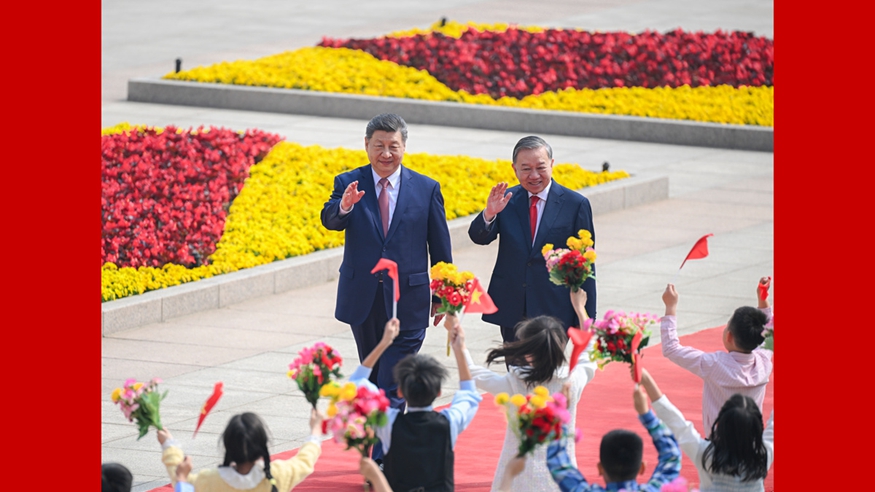
(Xinhua/Huang Jingwen)
China will advance high-quality comprehensive strategic cooperation with Vietnam and accelerate the construction of a high-level and strategically significant Sino-Vietnamese community with a shared future, Xi Jinping, general secretary of the Communist Party of China (CPC) Central Committee and Chinese president, said Wednesday.
Xi made the remarks during his meeting with General Secretary of the Communist Party of Vietnam (CPV) Central Committee and President of Vietnam To Lam, who is paying a state visit to China.
This is To Lam’s first overseas trip since his election as Vietnam’s president earlier this month. The trip also comes a year after Xi’s historic visit to the Southeast Asian country.
SETTING THE TONE FOR BILATERAL RELATIONS
“Your visit to China as soon as possible after your election as president of Vietnam demonstrates the great importance you attach to the development of Sino-Vietnamese relations,” Xi said, adding that China has always regarded Vietnam as a priority in its neighborhood diplomacy.
Xi expressed confidence that under the strong leadership of the CPV Central Committee led by To Lam, Vietnam will firmly follow the path of socialism and strive to achieve its “two hundredth anniversary” goals.
To Lam expressed Vietnam’s congratulations to China for the smooth implementation of its 14th Five-Year Plan and its historic achievements, believing that China will smoothly implement its 15th Five-Year Plan, continue to promote high-quality development and socialist modernization, achieve the second centenary goal as planned, and become a pillar and key driver of world peace and development.
Vietnam will resolutely regard the development of its relations with China as an objective necessity, a strategic choice and a top priority, To Lam said, adding that his country will continue to uphold the one-China policy and stands ready to strengthen strategic communication and high-level strategic coordination with China.
Xi said the leadership of the Communist Party is the most essential feature and greatest strength of socialism, and defending the socialist system and the dominant position of the Communist Party is the greatest common strategic interest of the CPC and the CPV.
Xi said the two sides should exercise high strategic vigilance and strong strategic determination, always remain confident in their path and system, and ensure that no reform changes the direction of the path and the nature of the system.
The two leaders also met with more than 300 young Chinese and Vietnamese representatives participating in the “Red Study Tours”, a program for young people to learn about the revolutionary heritage that consolidates bilateral friendship. They encouraged these young people to contribute to strengthening the ties of friendship between the two countries.
“To Lam’s visit will continue to promote and fully showcase the leading role of head-of-state diplomacy between the two countries. It will help further consolidate the development of friendly bilateral relations and promote industrial alignment, connectivity and people-to-people exchanges,” said Ge Hongliang, deputy director of the Faculty of ASEAN Studies at Guangxi Minzu University.
EXTENSIVE COOPERATION
The two sides should implement the new round of the CPC-CPV cooperation plan, conduct in-depth exchanges and mutual learning on party and state governance theories and experiences, and make full use of the “3+3” China-Vietnam strategic dialogue on diplomacy, defense and public security, Xi said.
Xi stressed that the two countries should work together in their modernization effort, accelerate the alignment of their development strategies and prioritize infrastructure connectivity.
Xi also called on the two sides to strengthen cooperation in emerging areas such as artificial intelligence, semiconductors and the Internet of Things, adding that more quality Vietnamese products are welcome in the Chinese market.
He encouraged China and Vietnam to continue strengthening friendly exchanges and cooperation in tourism, culture, media, education, health, sports and others, announcing the launch of the China-Vietnam Year of Tourism Cooperation for 2026-2027.
China and Vietnam should uphold the principles of peace, development, cooperation and mutual benefit, and work together to oppose unilateralism and protectionism, Xi said. He added that both sides should safeguard the global free trade system and maintain the stability and free movement of industrial and supply chains.
To Lam affirmed that Vietnam will strengthen cooperation in economy, trade, investment, railways and other infrastructure, as well as tourism, and intensify cooperation in education, training, science and technology, people-to-people exchanges as well as subnational cooperation, adding that efforts will be made to better manage the land border and maintain maritime peace.
China has long been Vietnam’s largest trading partner, while Vietnam is China’s largest trading partner in ASEAN and its fourth largest trading partner globally. During the visit, the two countries signed cooperation agreements covering a wide range of areas, including inter-party exchanges, public security, judicial cooperation, economy, industrial and supply chain cooperation, customs cooperation, science and technology, people’s living conditions, human resources development, media and subnational cooperation.
Upon arriving in Beijing on Tuesday, To Lam took a high-speed train to Xiong’an New Area, a much-anticipated “city of the future” in northern China’s Hebei Province. He will also visit southern China’s Guangxi Zhuang Autonomous Region, which borders Vietnam, to better understand China.
Lei Xiaohua, a researcher at the Guangxi Academy of Social Sciences, said it is important for the two sides to strengthen exchanges on development experiences, intensify cooperation on major projects and promote mutual learning on modernization paths.
“Vietnam has announced the launch of its first inter-regional high-speed rail project, and it is clear that the Vietnamese side is keen to learn more from China’s proven experience in technology, construction engineering and operation management of high-speed railways,” Lei said.
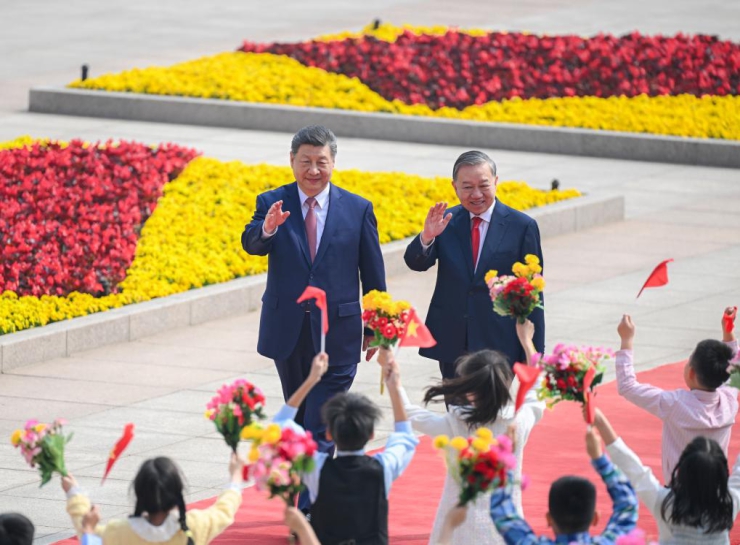
(Xinhua/Yan Yan)



![[C Finance]Central Bank: The goal of keeping the RMB exchange rate basically stable will not change](https://beijingherald.com/wp-content/uploads/2025/01/C-FinanceCentral-Bank-The-goal-of-keeping-the-RMB-exchange-120x86.jpeg)