More agile, more precise and now collaborative, robots are preparing to transform everyday life.
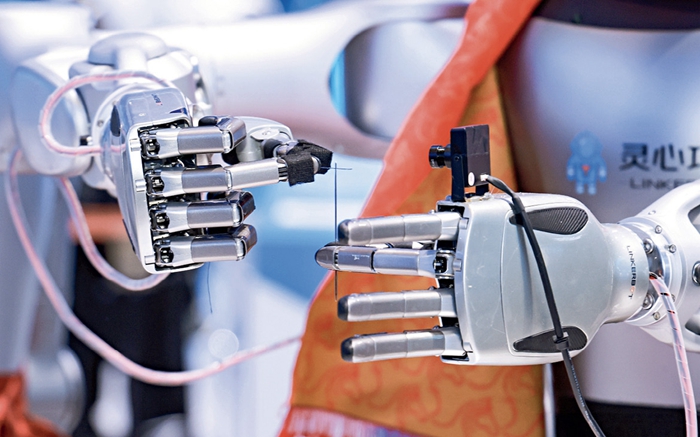
The Linker Hand L20 provides a live needle threading demonstration.
Threading a needle with the precision of a goldsmith, playing a musical instrument, performing the lively gestures of the lion dance or the graceful movements of taijiquan… These are the feats that a host of intelligent robots achieved at the Zhongguancun 2026 Forum at the end of March. Brought together for a demonstration of rare intensity, these technological treasures, with such varied forms and prowess, bear witness to a major evolution of embodied intelligence, a journey where “data” feeds a “brain”, which in turn sets a “body” in motion. Robots are now moving beyond isolated demonstrations to increasingly venture into more concrete and diversified application scenarios.
From individual performance to orchestrated synergy
This year, the Robot Bar has established itself as the star attraction of the event. Unlike the solitary presentations of the previous edition, this space features a fluid collaboration between heterogeneous robots: the Haoyin Technology model prepares coffee with surgical precision; the articulated arm of Robo Space concocts fruity teas; the Mozi robot from Spirit AI sets about dexterously threading skewers of candied cenelles; GALBOT’s humanoid serves pastries with dexterity; and finally, Kuafu, developed by Leju Robot, delivers orders to the pickup point. From ordering by QR code to handing over the dishes, it takes barely two minutes, without the slightest human intervention.
“How to orchestrate several simultaneous commands? How to optimize delivery tasks? It all relies on the coordination capacity of the collective “brain” of the robots,” explains Wang Qiang, director of algorithms at Leju Robot, to China Now. At the heart of this technological ballet is an operating system designed by the Beijing Academy of Artificial Intelligence (BAAI). It is based on a hierarchical collaborative architecture – a “collective brain in the cloud” coupled with “cerebellums” integrated into the structure of the robots – making it possible to break down cooperation barriers between robots from different manufacturers and types.
At the other end of the enclosure, an orchestra made up of robots captivates the audience. Piano, drums, suona (Chinese trumpet)… the instruments come to life to produce interpretations of perfect harmony. This collective, imagined by Linkerbot, already has a repertoire of five to six hundred pieces.
“The key to this harmony is synchronization,” reveals Zuo Jiaping, co-founder of the company. It reveals the three technological pillars of this performance: a robotic hand with sub-millimeter precision, high-precision rhythmic synchronization between all the members of the orchestra, and more surprisingly, an emotional model. The latter allows robots to adjust their fingering, strength and rhythm to produce rich and nuanced musical textures.
The Robot Bar and this orchestra are not simple technical showcases: they foreshadow the future of multi-robot collaboration and mark the accelerated integration of embodied intelligence in the commercial services sector.
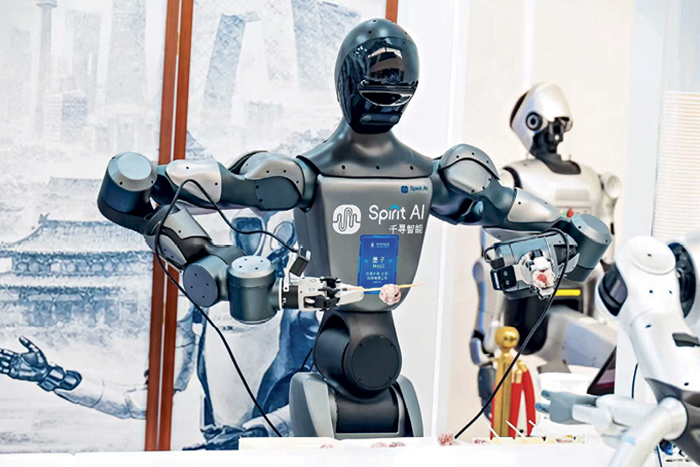
The Mozi robot from the company Spirit AI makes candied hawthorn skewers in the Robot Bar.
From convincing demonstration to real-life application
If collaboration between robots brings embodied intelligence into production and daily life, the bionic hand remains the execution tool of choice. In the exhibition area, the Linker Hand L20, developed by Linkerbot, achieves a feat: threading the eye of a needle. With 21 degrees of freedom, this industrial-class “hand” reproduces with disturbing fidelity the dexterity of the human hand. Alongside it, the Linker Hand 06, the lightest in the world at 370 grams, and the Linker Hand L30, dedicated to research and three times faster than a human hand, demonstrate the meteoric acceleration of this technology.
“In the world of embodied intelligence, the Linker Hand is the robot’s most crucial end effector; it is she who performs the majority of complex tasks and interacts directly with the world,” explains Ms. Zuo. She compares it to the fundamental infrastructure of the sector – “like the battery for electric vehicles or the GPU for artificial intelligence”. And added: “It is only when the “hand” is sufficiently agile that the robot will acquire a quasi-human operational capacity, allowing it to penetrate all sectors of activity. »
Today, Linkerbot dominates 80% of the global market for high-degree-of-freedom robotic hands. Its sales have increased tenfold in one year, including 30% from exports. Its range, which is aimed at the general public as well as industrial and scientific circles, already finds wide applications in manufacturing, everyday services and medical assistance.
Ms. Zuo attributes this success to four strategic pillars: unbeatable value for money – the entry-level model costs just 3,999 yuan thanks to subsidies, compared to nearly a million for some foreign equivalents; the largest R&D team in the world dedicated to bionic hands; world-leading datasets and accumulation of technical expertise; and finally, a strong mass production capacity, supported by factories located in several regions of China. “Our ambition is to further reduce costs so that these hands power robots in every home and sector,” she says.
To adapt to the complexity of the real world, robots must combine “skillful hands” and “agile bodies”. During the forum, Yue Quan Bionics Ltd. has unveiled a humanoid robot on wheels with the most compact chassis in the world (0.2 m2), allowing it to easily fit into tight spaces. Thanks to a unique design of its joints – bendable hip, knee and ankle – it can work at heights ranging from the ground up to 2.2 m. Associated with this robot, the Y-Hand M2 robotic hand, with its 38 degrees of freedom, stands out as the most sophisticated hand on the market, surpassing its competitors in speed, strength, precision, flexibility and agility.
“Whether a robot plays an instrument or threads a needle is not just a technical demonstration. More fluid gestures and better measured force mean that they adapt more and more to our daily lives,” underlines Hu Zheqi, director of the company’s think tank. “In a household, elderly care, health and rehabilitation, seemingly simple tasks – administering a medicine, taking a temperature, pouring a glass of water – require surgical precision and absolute safety. Only great flexibility enables safe human-machine interaction, making these services both accessible and trustworthy. »
“The home is the ultimate testing ground for robots,” adds Mr. Hu. “If embodied intelligence is already flourishing in industry, the domestic environment, with its complexity and unpredictability, requires much greater cognitive and motor skills. » It identifies three major technical challenges to overcome before mass adoption among individuals: flexibility that can still be improved, energy consumption that is too high, and above all, security of human-robot interactions which must be reinforced.
From technical prowess to practical use
Despite persistent challenges, large-scale commercialization of embodied intelligence now appears inevitable. According to the Global Market Analysis of Humanoid Robots report published by IDC (International Data Corporation) last January, these machines have entered their large-scale deployment phase. In 2025, around 18,000 units were delivered worldwide, with China establishing itself as the main source of production.
“If the year 2025 marks the start of mass production of humanoid robots, 2026 will be the year of humanoid robots equipped with operational intelligence,” says Zhang Yufeng, founder and CEO of Boundless Dynamics. “From simple proof of concept (POC) last year to mass production today, we are supporting the sector in its transition – from a purely quantitative change to a truly qualitative one. »
However, between the spectacular demonstration and daily use, a gap remains. What are the obstacles to overcome for widespread adoption? Sector experts deliver their diagnoses.
According to X-Humanoid CTO, Tian Jian, the main obstacle lies in the poor generalization capacity. “As soon as the environment, the process or the manipulated object changes, the success rate of the robot drops suddenly,” he observes. However, he anticipates a radical improvement from 2026, which will allow expanded deployment in the industrial, para-industrial and commercial sectors.
Lian He, vice-president of Lightwheel AI, points to a shortage of data. “Unlike large language models (LLM), fueled by tens or even hundreds of billions of parameters, embodied intelligence models only use one to ten billion. “It’s not a lack of ambition, but a lack of raw data,” he notes. However, collection via teleoperation on physical robots is extremely expensive and difficult to reproduce on a large scale. He believes that generating synthetic data through simulation is the key to the next breakthrough.
Zhao Rui, vice president of embodied intelligence at Honor, emphasizes the maturity of the robot’s “brain”, namely the VLA model. “This model must deeply integrate vision, language and action, and be able to adapt and correct itself in real time in the face of changing scenarios,” he notes. Such agility is highly dependent on the reliability and consistency of the robotic body. “It is not a simple algorithm, but a systemic work, combining hardware, database design and fine optimization of the model. »
Finally, Shen Yujun, scientific director at Robbyant, recalls that embodied intelligence remains an eminently integrated discipline – linking components, bodies, control and intelligence – and that it is still in its infancy. Its complexity requires, according to him, an open and collaborative approach. “It is only by pooling skills and completing usage scenarios that embodied intelligence will move from technological exploration to industrial reality. »