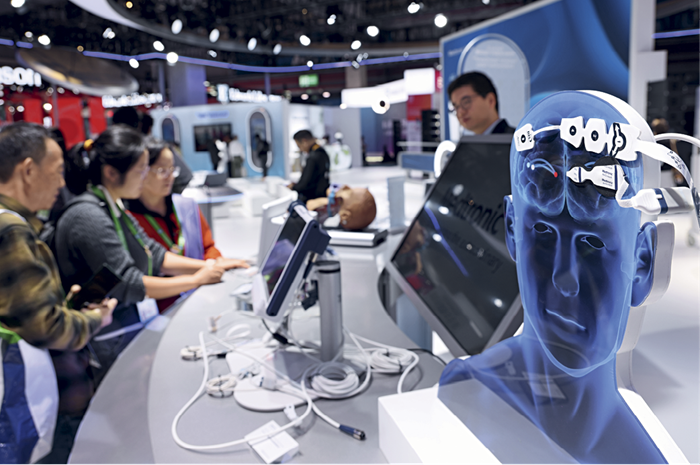
The future of neurology now involves implantable chips.
AI is a must-have in the pharmaceutical and medical equipment sectors at the 8th China International Import Expo in Shanghai on November 9, 2025.
Brain-machine interface (BMI) technology is rapidly moving from science fiction to clinical reality. Recently, the implantable ICM hand function compensation system, jointly developed by a team from Tsinghua University of China and the company
Neuracle, has officially obtained marketing authorization from the National Medical Products Administration. This is China’s first invasive ICM product moving from laboratory to clinical application, which brings unprecedented hope to the millions of patients whose lives are hampered by spinal cord injuries. Identified as one of the key sectors of the future in the 15th Five-Year Plan (2026-2030), ICM is becoming a concrete reality, driving behind it an entire ecosystem of innovation, from technological research to industrialization.
A historic breakthrough
The birth of this system is the result of seven years of research. Since the project’s launch in 2019, the team has started with fundamental technologies to solve a series of problems related to the safe and stable long-term operation of devices implanted in the human body. Its operating principle is both ingenious and human-centered. The system consists of a microchip implanted in the motor area of the cerebral cortex and an external device. No complex wired connections are required and simply attach a small magnetic coil to a precise point on the scalp to wirelessly power the implant, transmit signals and update algorithms in real time. The patient’s brain signals are captured when he emits an intention and decoded by the chip, then the external unit activates a pneumatic glove which allows gripping gestures to be performed.
From the first technical validations to the first successful implantation in October 2023 at Xuanwu Hospital of the Capital Medical University, then to clinical trials carried out in cutting-edge centers such as Tiantan Hospital in Beijing and Huashan Hospital in Shanghai, each step has mobilized the ingenuity of researchers. To ensure its safety and effectiveness, the product has undergone the strictest approval procedures for medical devices in China and, thanks to its innovative nature and high clinical value, has entered a special accelerated review procedure reserved for high-level innovation technologies.
Mao Ying, director of Huashan Hospital affiliated with Fudan University, pointed out that clinical research on ICMs is subject to even stricter ethical requirements than those of conventional medical devices, requiring validations at multiple levels (hospital, municipal scientific management authorities, etc.). Before its approval, the device had already completed, on a global scale and in a world first, a clinical study involving 32 patients with high-level quadriplegia. This valuable data provided the scientific basis for its commercialization and established a new benchmark for neurological rehabilitation research.
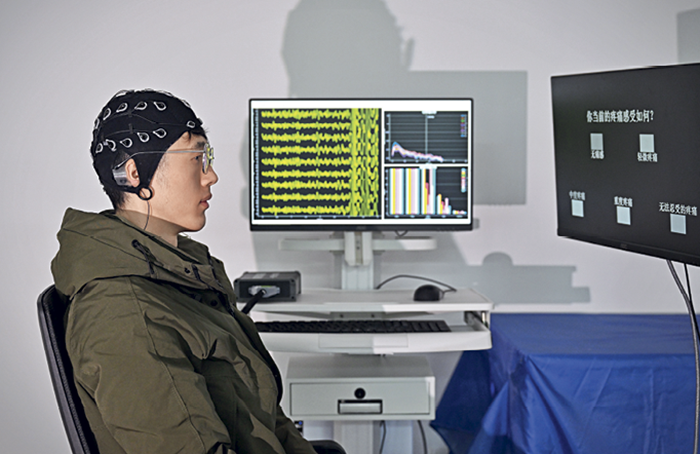
Experiment on Non-Invasive ICM System at Institute of Informatics and Technology of Anhui University, January 8, 2026
Beyond functional compensation
There is nothing magical behind the product, because as Mao Ying points out, it is a complete rehabilitation system requiring active participation from the patient. In clinical studies, participants had to undergo intensive training for six hours a day for over a month to achieve significant results. It is precisely this mode of training, putting the patient and the machine in synergy, which gave unexpected surprises.
The research team observed that some patients showed substantial improvement in their nerve functions after a certain period of time. Some were even able, after removal of the device, to perform certain gripping movements independently. This major discovery challenges the traditional idea that functions enter an almost irreversible plateau phase after four years of spinal cord injury. For the first time, clinical evidence indicates that MCIs not only compensate for lost functions, but could also, through continuous positive feedback, reawaken and reconfigure damaged neural pathways, allowing the brain to repair itself.
The marketing of such a product has repercussions throughout the entire ICM industrial chain. Mao Ying notes that this highly interdisciplinary sector depends on the coordinated advancement of many elements, from high-performance chips and precision algorithms to new biomaterials and advanced medical devices. As part of the clinical research carried out at Huashan Hospital, the requirements of clinicians, particularly in terms of precision of signal acquisition, speed of algorithms, and biocompatibility of implanted materials, have directly stimulated the innovation of upstream companies. This model of innovation driven by clinical demand and supported by industrial collaboration creates a virtuous circle, accelerating the maturation and upscaling of the industrial ecosystem. With the future expansion of applications and improvement of the industrial chain, the cost of devices is expected to gradually decline, allowing this advanced technology to benefit more patients.
A sector of the future
The rapid development of the ICM sector is based on a strategic vision at the highest level of government and continuous political support. From its explicit inclusion in the orientations of the 15th Five-Year Plan to its inclusion, in 2024, in the Chinese Government Activity Report alongside technologies such as quantum science and embodied intelligence, these strategic orientations have instilled strong confidence in the sector. At the same time, Guangdong and Jiangsu have launched action plans to strengthen provincial-level investment, support technological breakthroughs in key links of the industrial chain, and encourage cutting-edge hospitals to develop clinical trial scenarios, creating fertile ground for new breakthroughs to emerge.
The potential of ICM goes far beyond just recovering hand function. Mao Ying thus evokes brain-machine fusion, where the interaction between different devices and the human brain will become more fluid and intelligent. Applications should gradually extend from current functional compensation to more complex areas, such as the recovery of motor functions of the lower limbs or the reconstruction of language. Huashan Hospital has already opened a specialized consultation for screening patients who are candidates for ICM and is exploring new scenarios, particularly in terms of language. Furthermore, therapeutic modalities will become more diversified, in particular with the combination of ICM with gene therapies, biomaterials or electrical stimulation. Fascinating new perspectives are therefore opening up for the treatment of diseases of the nervous system.