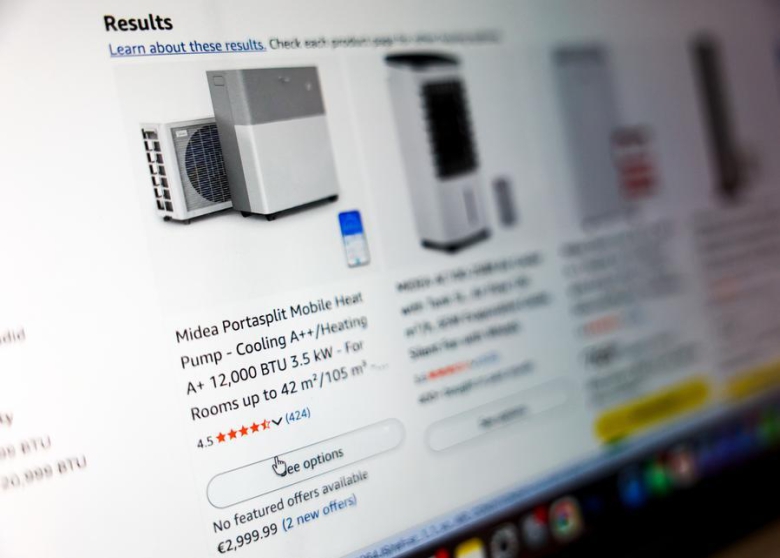
Photo taken on July 6, 2026 shows air conditioners out of stock on an online commerce platform, in Paris, France. (Photo: Wu Huiwo)
The summer of 2026 plunged Europe into a historic heatwave. While European households are faced with soaring electricity prices and the complexities of installing air conditioning equipment, Chinese brands are seeing their air conditioners establish themselves with force on the European market.
In the first half of 2026, exports of air conditioners from China to the European Union reached $3.76 billion according to official Chinese customs figures, an increase of 43.2% in one year, a historic record. From January to May, exports to France, the Netherlands and Belgium more than doubled, while those to Spain and Germany also grew by double digits.
According to data, the rate of air conditioning equipment in Europe does not exceed 20% and local production capacity is limited to 3.2 million units per year, leaving a supply deficit estimated at 6.8 million units. This shortage comes on top of high electricity prices and increasingly stringent environmental requirements for carbon neutrality. Faced with this double challenge, energy efficiency stands out in the eyes of European consumers as the first criterion of choice.
To meet these challenges, Chinese manufacturers, such as Haier and Hisense, have developed solutions that combine cooling performance and energy efficiency.
At Haier, premium products are distinguished by their high energy efficiency combined with intelligent consumption management, which adjusts the power according to the user’s habits and the presence of people, allowing energy savings of up to 52%, said Yu Shipeng, general manager of overseas markets for domestic air conditioners at Haier Smart Home.
Hisense, with its U6 Uni series, achieves SEER A+++ level in cooling and SCOP A++ in heating, offering an energy saving of around 22% compared to entry-level models available on the European market, said Wang Weige, a manager of Hisense’s air conditioning division.
Environmentally, Hisense has adopted an optimized design with low carbon impact refrigerants for its U6 Uni series, thereby reducing carbon emissions and carbon tax costs. Haier, for its part, has taken the lead by integrating refrigerants with low global warming potential (GWP) into its product strategy, while working towards maximum environmental protection.
In Europe, installing an air conditioner is expensive, there is a shortage of qualified technicians and delays are increasing. More than 70% of devices are recommended and installed by the installers themselves. Aware of this specificity, Haier and Hisense have developed devices adapted to different types of European homes, easy to install and maintain, thus considerably reducing installation costs and times.
This logic of adaptation to the local market is also found in mobile air conditioners. With Midea’s PortaSplit model, there is no need to drill into walls or install an outdoor unit: a solution perfectly suited to the constraints of European housing and the expectations of consumers looking for simplicity. The group expects sales of between 200,000 and 300,000 units of this model across the entire European market this year.
The craze for Chinese air conditioners is not just about numbers. Rechard, Haier’s Spanish partner, notes that “Haier is innovative. Our air conditioners, easy to install and energy efficient, are today the most appreciated by our customers.”
The Austrian, Denis Yurchak, traveled 200 kilometers to buy a PortaSplit model from Midea. “It’s my best investment of the year,” he confides.