By moving from the barter of “chicken feathers for sugar” to the status of “supermarket of the world”, Yiwu demonstrates how an industrial model designed for popular well-being has become an essential cog in the global economy.
In the early summer of 2026, as record heatwaves hit Europe, a telling phenomenon occurred. Images of French consumers fighting over fans in supermarkets have made the rounds on social networks and official media. At the same time, the Internet was flooded with fraudulent offers offering overpriced cooling devices with overestimated performance, when they were not simply cashed in without ever being delivered. Faced with a demand that European industries could not satisfy, it was towards China that eyes were turned. From Yiwu, millions of cooling products – portable fans, mobile air conditioners, fan caps, neck coolers, ice machines – have continuously flowed into European homes, providing a concrete response to a vital need. The reason for this success? The same as that which, a few decades earlier, had made Chinese products omnipresent on Mali’s markets.
From Mali to Europe: a continuous thread
In the 1980s, in the markets of Bamako and Ségou, I witnessed firsthand a far-reaching phenomenon: household items made in China had infiltrated the daily lives of the most ordinary families. Enameled iron basins and crockery, plastic kettles with pouring spouts used for ablutions as well as teapots for brewing mint tea… these everyday items had conquered Malian homes. After its independence in 1960, Mali naturally turned towards Europe for its trade, but it is nevertheless these objects from the distant East which have truly become integrated into the daily lives of the inhabitants. Simple, robust and affordable, they were the result of a Chinese presence which was not limited to diplomatic exchanges or major infrastructure projects. This is how bamboo craftsmanship, taught by Chinese experts, made it possible to develop a lucrative and accessible activity in Mali, transforming a modest material into solid and inexpensive furniture. The same was true of enameled basins and plastic kettles – seemingly mundane, they were in reality the prelude to Yiwu’s future economic rise.
Today, the craze for air conditioners and fans on the European market is only an extension of this same logic. As enameled basins were for the Malians, these refreshment products became essential goods for Europeans, which local industry was unable to provide in sufficient quantity. Chinese exports of Midea brand PortaSplit mobile air conditioner jumped dramatically, with shipments to Spain and France up 108% from spring 2025, according to the data.
In Yiwu itself, orders for fan caps have exploded, with factories running at full capacity. A trader at the Yiwu market said candidly: “We have felt the impact of the heatwaves: our exports to Europe have increased significantly this year.”
This almost instantaneous response to a mass need perfectly illustrates the Yiwu philosophy: producing goods useful to the people on a large scale, to meet the daily needs of ordinary families – whether Malian or European.
This ability to provide useful, affordable products adapted to local requirements is not the result of chance. It is rooted in an ancestral commercial tradition as well as a philosophy of governance which has made this city a unique model of development.
From the peddler’s basket to the world’s supermarket
To understand Yiwu, you have to start with the expression “exchanging chicken feathers for sugar”. On the city’s barren lands, peddlers traveled the roads bartering locally made brown sugar for chicken feathers and other organic waste. The most beautiful feathers were resold to make dusters; the less beautiful ones served as natural fertilizer to enrich the soil.
This modest activity already embodied fundamental values: not fearing difficulties, not despising small gains, not fearing dirt, knowing how to use one’s brains to transform waste into useful resources, and accumulating wealth little by little thanks to honest trade. It was this spirit that gave birth to Yiwu’s first free market in 1982. This step, particularly bold at the time, planted the seeds of the historic upheavals that would follow.
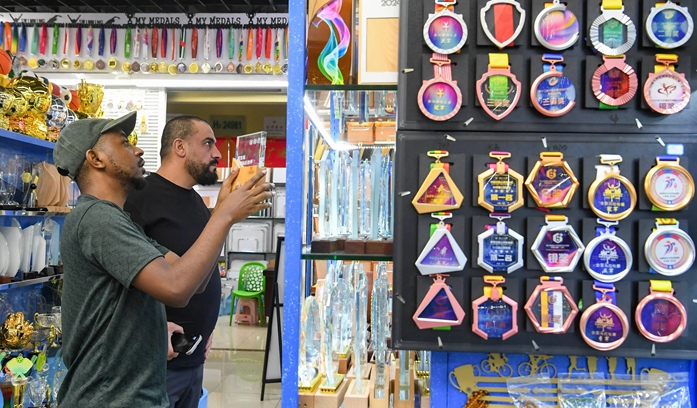
Today, Yiwu is nicknamed the “supermarket of the world”. Yiwu International Commerce City brings together more than 2.1 million product categories, maintains trade relations with more than 230 countries and regions, and attracts nearly 680,000 foreign investors, including 38,000 permanent residents, each year.
In the market aisles, traders are constantly renewing their collections by launching numerous new products every month, tailor-made to the tastes and specificities of the different local markets. This flexibility and creativity are directly linked to the liveliness of the peddlers of yesteryear who roamed the roads.
What fundamentally distinguishes this economic model from the Western liberal approach is this absolute primacy given to the concrete utility and accessibility of mass products over pure financial speculation. The enameled basins, cups and kettles formerly used by Malian households were the distillation of this approach. They weren’t anything fancy, but they made life easier for millions of people. And today, from the fan cap to the ice maker, it is the same pragmatism and the same humanist care that continues.
Chinese governance, the basis of a unique success
This model could not have seen the light of day without specific governance, that of the Chinese Communist Party. The Chinese system, based on a “vertical democratic meritocracy”, is based on an evaluation of the results obtained at each stage of the careers of leaders, with a selection of officials based on their abilities and virtues. This system, heir to Confucian values, is opposed to the model of Western pluralist democracies where competition for power is arbitrated by the electorate to the detriment of continuity and efficiency.
“Asian values” promote harmony through consensus, continuity of government action, and collective interest rather than individual rights. It is within this framework that Yiwu has been able to develop as a true laboratory for commercial innovation, benefiting from constant political support and a long-term vision. The State Council recently approved a comprehensive reform program for Yiwu’s international trade, with 97 reform measures in five areas, demonstrating the state’s ability to support and guide this development.
A governance model for the world
Yiwu’s success offers an alternative to Western economic models. The growth of this city, born from the resourceful spirit of the peddlers of yesteryear, is part of a tradition of meritocracy and service to the people, far from the excesses of economic liberalism.
The development trajectory of contemporary China, set against the backdrop of a centuries-old civilization, has charted a path where Confucian tradition merges with socialist practice, and has already proven its effectiveness in lifting hundreds of millions of Chinese out of poverty.
African traders established in Yiwu for years testify to the continued strengthening of Sino-African trade relations. What they come for is not luxury products or flashy gadgets, but useful, affordable objects that concretely improve the daily life of their communities. This is the living legacy of the spirit of “bartering chicken feathers for sugar” – a value orientation that places the well-being of the population at the heart of business activity.
Thus, from the enameled basins of Malian markets to the most modern international trade reforms, Yiwu embodies a model of development where the Confucian tradition of service, political meritocracy and the spirit of entrepreneurship combine to create shared prosperity. A model which, far from short-term profit logic, places social utility at the heart of the economy.
*JEAN PÉGOURET is a French sinologist and geopolitologist, president of Saphir Eurasia Promotion.