More than 530,000 foreign companies, 3,600 billion dollars in investments: China is seducing.
Schneider Electric booth at the 25th China International Industry Fair (CIIF2025) in Shanghai, September 23, 2025
At a time when the global economy is faltering, multinationals continue to bet on China by elevating it to the rank of strategic priority. They choose the long term.
Over the past three years, the number of foreign-funded enterprises established in China has continued to grow. According to data from the Ministry of Commerce published on May 23, the country now has more than 530,000 foreign companies, for a cumulative amount of foreign direct investment (FDI) exceeding $3.6 trillion.
In the first four months of 2026, 20,113 foreign companies were established in China, an increase of 6.8% year-on-year. More than 3,000 of them have expanded their scope of activity over this same period. Last year, more than 8,000 made additional investments in their core business, up more than 10% from the previous year.
In line with its goal of opening up, China has eased access to its market, lifted restrictions on foreign participation in manufacturing and reduced the number of entries on its negative list, which identifies sectors prohibited to foreign investors, to 29.
Expansion of activities
China continues to consolidate its status as a preferred destination for global investments. According to the 2026 Special Report on the Economic Situation in South China, released on March 10 by the American Chamber of Commerce for South China (AmCham South China), 45 percent of surveyed companies put the country first in their global investment priorities, an average annual increase of six percentage points from 2024.
The survey collected responses from 426 companies. Among them, 37% generate more than 60% of their global revenues in China, an average annual increase of six points since 2024. Furthermore, 95% of respondents affirm their desire to maintain their activities in the country and 75% plan to reinvest there this year. In total, member companies have allocated approximately $13.79 billion of their local profits for reinvestment over the next three to five years.
To adapt to changes in local consumption, many foreign brands are increasing their efforts in terms of cultural anchoring. On April 30, Starbucks China announced a partnership with the hit show, A Tapestry of a Legendary Land, inspired by a masterpiece from the Song Dynasty (960-1279), to integrate traditional Chinese aesthetics into everyday coffee culture.

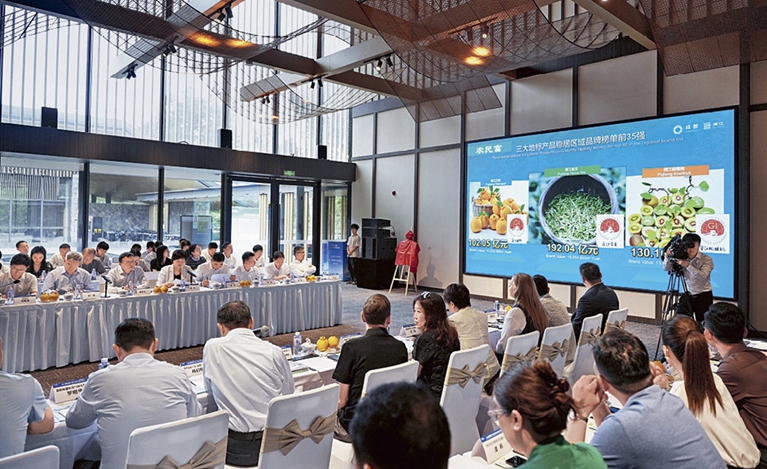
The “Investing in Gaiwan Tea” roundtable attracts German investors to Chengdu, Sichuan, May 27, 2026.
Market recomposition
Data from the Ministry of Commerce also shows that China’s actual FDI used totaled more than 287 billion yuan in the first four months of the year, down 10.3 percent year-on-year.
Zhan Yubo, a researcher at the Institute of Economics of the Shanghai Academy of Social Sciences, explains in an interview with the Yicai news portal that foreign investment in China is going through a restructuring phase. This is characterized by an increase in new registrations alongside a decline in the amounts actually injected.
According to him, many of the new entrants to the Chinese market are small and medium-sized enterprises. As some sectors slow down and local competition increases, established players tend to be more cautious. FDI inflows into China reached a historic peak in 2022, before declining for three consecutive years. The country now captures around 12% of the global total and maintains its rank as the second largest destination in the world.
China no longer attracts only by the size of its market, but increasingly by the vigor of its innovation ecosystem. Figures from the Ministry of Commerce confirm this: over the first four months of 2026, foreign capital injected into high technology jumped 20.3% year-on-year to reach 116.33 billion yuan, representing no less than 40.4% of the national total.
According to the same source, the share of FDI in high technologies increased by 10.3 points over one year. In March alone, German industrial giant Siemens Energy introduced 26 new products in China and announced strengthening cooperation with Alibaba Cloud, a subsidiary of Chinese technology group Alibaba, to integrate its industrial technologies into the latter’s innovation ecosystem.
Siemens specifies that the two groups are expanding their collaboration in industrial infrastructure, automation and AI applications. As part of this partnership, the German company intends to integrate its simulation software with Alibaba’s cloud infrastructure to offer intelligent engineering services for the Chinese market.
Opening of services
With restrictions on foreign investment in the manufacturing sector having been completely lifted, services have become a major focus of the country’s opening. Over the first four months of the year, FDI actually invested in services reached 204.15 billion yuan, or more than 70% of the national total.
Established in 2015 in the Shanghai Pilot Free Trade Zone, the Baker McKenzie FenXun (FTZ) Joint Operation Office is the first joint cooperation structure approved in China between Chinese and foreign law firms. He has participated in numerous STAR Market IPOs and cross-border merger cases, taking advantage of the pilot zone’s policies relating to international legal cooperation.
According to Shi Miao, partner of the firm, the policy carried out in this area has removed barriers in trade in services, allowing closer cooperation between Chinese and international law firms. “We are expanding our services to areas such as artificial intelligence and the digital economy to support the global expansion of Chinese companies. »
In recent years, the Chinese authorities have regularly reduced the negative list of foreign investments, particularly in the services sector, and have introduced a specific list for cross-border trade in services. To date, twenty national pilot zones are expanding the opening of this sector.
An attraction that remains
According to the Ministry of Commerce, in the first four months of the year, investments in the Chinese mainland from Luxembourg, Switzerland, France and the United States increased by 110.3%, 60.8%, 58.3% and 24.5% year-on-year respectively.
Mr. Zhan notes that American investments are oriented towards high technology, new energies, biomedicine and high-end consumer goods, for which demand is strong in the Chinese market. “China’s strengths of a complete industrial chain, a large consumer market and strong policy support for high technology continue to underpin these trends,” he said.
“China will continue to ease its negative list system for cross-border trade in services and expand opening-up in sectors such as telecommunications, Internet, education, culture and health during the 15th Five-Year Plan period (2026-2030),” Yan Dong, vice minister of Commerce, said at a press conference on May 26. “This will attract more multinationals to set up their research, development and production activities here, allowing foreign investment to gain innovation dynamism,” he added.
*LI XIAOYANG is a journalist at Beijing Information.