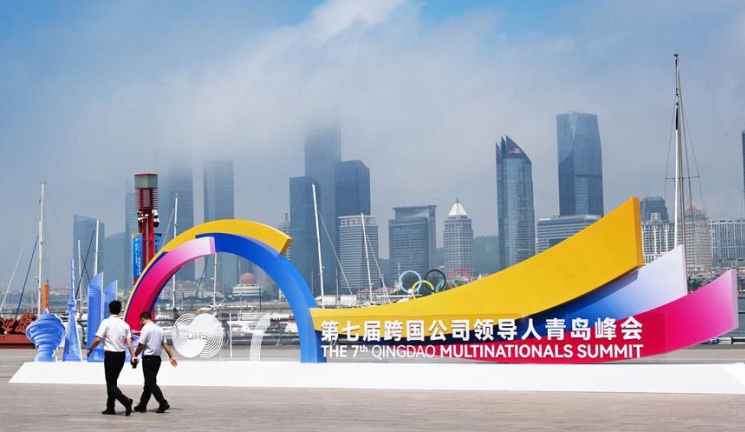
Photo taken on June 16, 2026 shows the emblem of the seventh Qingdao Multinational Business Summit in Qingdao, east China’s Shandong Province. (Photo: Li Ziheng)
Multinational companies involved in the new energy vehicle (NEV) sector highlighted the opportunities created by China’s booming NEV industry at the seventh edition of the three-day Qingdao Multinational Summit, which concluded last Wednesday.
The summit, held in the coastal city of Qingdao in east China’s Shandong Province, brought together more than 700 representatives from government departments, international organizations, multinationals and professional associations.
“China is one of the most important markets for Avanci. It is the world’s largest automaker and the leader in electric and connected vehicles. Without China, our mission to simplify global licensing would be incomplete,” Uta Schneider, vice president for international government affairs at Avanci, said in an interview with Xinhua on the sidelines of the summit.
Furthermore, according to Ms. Schneider, China is a power in terms of innovation in standard essential patents. Many Chinese companies are becoming important patent holders. “China is not just a market for us. It is a critical partner in how we think about connectivity licensing globally,” she added.
Headquartered in the United States, Avanci is a patent licensing company that provides licensing services to smart vehicle manufacturers around the world. In 2018, just two years after its founding, Avanci began offering licensing services to Chinese technology companies and automakers.
Ms. Schneider was particularly impressed by the speed and scale of innovation in China’s automotive sector. “From my office in Brussels, I can observe this transformation with my own eyes. Chinese vehicles are increasingly present on European roads, and confidently compete with their global counterparts in terms of quality, innovation and value for money,” she said.
Regarding the company’s latest developments in China, Schneider said Avanci has opened offices in Beijing and Shenzhen, and its local team continues to strengthen. Several Chinese NEV manufacturers have already joined the licensing platform.
After years of sustained growth, China’s NEV industry has developed a fully integrated supply chain and successfully combined cost competitiveness and rapid innovation. By 2025, the production and sales of Chinese NEVs both exceeded 16 million units, with NEVs accounting for more than 50% of new car sales in the Chinese market.
China’s rapidly expanding NEV industry has created new opportunities for multinational companies. In response, a growing number of international companies have stepped up investment in China’s NEV and automotive components sector.
For example, an electric vehicle project from smart, a brand jointly developed by Mercedes-Benz and the Chinese group Geely Holding, saw the light of day this year in Jinan, capital of Shandong province. Tong Xiangbei, CEO of smart, said at the summit that the brand has successfully established a strong foothold in the Chinese and European markets by relying on comprehensive local supply chains and supporting policies.
A broader shift is underway among multinationals operating in China. Rather than focusing solely on product sales, many are increasingly integrating into the country’s NEV innovation ecosystem, adopting deeply localized strategies that span the entire value chain, from R&D to manufacturing, applications and after-sales services.
This trend is clearly manifested by a series of investments. For example, American automaker Tesla has established the Shanghai Megafactory, a factory dedicated to manufacturing energy storage batteries, in the Lingang Special Zone in Shanghai, eastern China. For their part, Volkswagen and Chinese manufacturer FAW have established an R&D center for NEVs in Hefei, east China’s Anhui province, and continue to expand their range of electric vehicles in China.
Beyond strengthening their presence in China, some multinational companies are also partnering with Chinese companies to expand their global footprint in the NEV industry. Last year, multinational automaker Stellantis and China’s CATL laid the foundation stone for a large lithium-iron-phosphate (LFP) battery factory in Spain.