Video games tend to become one of the new ambassadors of Chinese culture to the whole world.
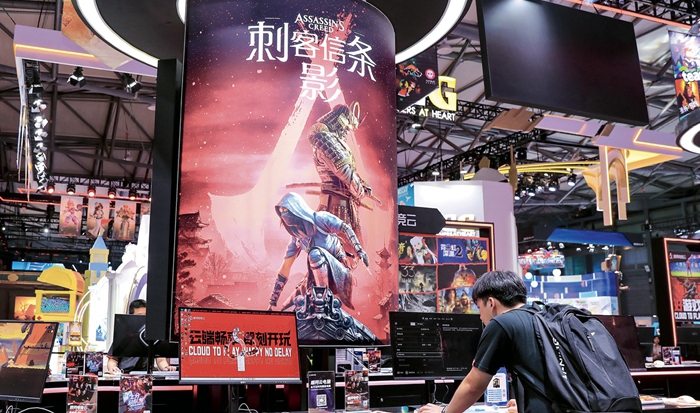
The Assassin’s Creed Shadows video game testing area at the ChinaJoy show in Shanghai on August 2, 2025.
During Chinese New Year 2026, studio Game Science captivated international audiences with a promotional short film for Black Myth: Zhong Kui. This announcement confirms that video games are now establishing themselves, alongside web novels and web series, as the preferred vector of Chinese cultural influence. From the epic of Black Myth: Wukong to the promises of Where Winds Meet, successive waves of this craze allow players around the world to appropriate a cultural aesthetic with universal resonance.
If this irruption into foreign markets looks like a sudden success, the reality is much more difficult. This success is the result of the perseverance of the studios and exploration in deep waters, thus marking a real structural change in the industry.
Exceptional content
The international journey of Where Winds Meet has all the makings of an epic. Initially, the critics were unconvinced; the reference site IGN gave it a harsh 6/10, accusing it of too much content.
“catch-all”. However, the reaction of the players was quite different. Asmongold, a streamer followed by millions of fans, responded directly under IGN’s tweet: “Anything! This game deserves at least an 8 or 9.”
Barely 40 minutes after its launch abroad, Where Winds Meet attracted 500,000 players, before exceeding 15 million in one month. This fervor has transformed traditional Chinese concepts, such as the philosophy of taijiquan or the shichen (Chinese double hours) system, into global topics of conversation.
Sword of Justice is also among the flagship products of the international expansion of Chinese games. The game achieves the feat of resurrecting Along the river during the Qingming Festival, the famous painted scroll from the Northern Song Dynasty (960-1127). The creative team explored historical archives to reconstruct with surgical precision the alleys, pavilions and daily lives of the thousands of inhabitants of Dongjing (the current city of Kaifeng, Henan province).
In the game, players can experience around a hundred vintage professions, such as boatman or fortune teller. This metamorphosis from a static painting to a dynamic world propelled Sword of Justice to the top of the charts, particularly in Japan, Thailand and Malaysia. The fine details, from the rendering of the hair to the texture of the fabrics, offer such total immersion that many users testify on the forums to a unique feeling: that of living less of a gaming experience than of a real time journey through a thousand years.

Visitors play virtual reality games at the Beijing International High-Tech Expo on May 8, 2026.
Political support
The international expansion of online video games produced in Hangzhou began in 2008 with pioneers like Electronic Soul.
Today, the new policy in favor of cultural industries published by the district of Binjiang breathes unprecedented dynamism into the sustainable development of online video game companies. This system is no longer limited to rewarding commercial performance after launch, but supports creators throughout the R&D process. From obtaining publication licenses to investments linked to localization abroad, including the upstream testing phases, each step can benefit from subsidies. For projects with long development cycles and massive investments, this continuous support alleviates financial pressure during long creation periods.
The attractiveness of this policy encourages more companies to choose Hangzhou. Fantang Network Technology, which started its activity in Shanghai, has established its global headquarters within the Hangzhou Games and E-sports Innovation and Development Center. Wang Tao, manager of the company, justifies this decision by two determining factors: on the one hand, the specific assistance with localization, an essential step in attracting a global audience and on the other hand, the “concierge” service offered by the center. The latter frees entrepreneurs from administrative constraints, from registration of the structure to regulatory monitoring.
“Hangzhou has very good university resources, which will make it easier to build a local team in the future. In this city where experts in the sector meet on a daily basis, exchanges make it possible to pool skills and, above all, to reduce the costs linked to strategic errors,” he adds.

Where Winds Meet video game poster
The favorable environment
The service model Wang Tao praises has become the norm in Hangzhou. Since its inauguration in April 2025, the Hangzhou Games and E-sports Innovation and Development Center has brought together nearly a hundred companies. The site managers share an intimate understanding of the challenges of the sector: aware that the R&D cycle of a game often stretches over three to five years, they believe that public authorities must create an environment where companies can devote themselves fully to their work, without worrying about material contingencies.
An enabling environment is not limited to budgetary subsidies. For example, faced with a young team blocked by copyright for an international football game, the center mobilized legal experts to design a tailor-made compliance roadmap.
A true strategic incubation port, the Center builds business loyalty through thematic fairs and unearths creative talent within universities through events such as the Game Developers Competition. The distinguished projects integrate an incubation base to transform their original ideas into finished products at lower cost.
According to data from the Hangzhou Municipal Investment Promotion Bureau, the city currently has two national animation industry bases, three national animation research and education centers, more than 20,000 industry professionals, as well as 274 companies specializing in animation and video games. With an output value exceeding 50 billion yuan, the city has become a center of excellence for digital entrepreneurship. Buoyed by the resounding success of titles such as Black Myth: Wukong, Hangzhou today embodies the new face of “Made in China” video games on the international scene.
*ZHU GUANGHAN, XU JINGJING and HOU HUIHUI are journalists at