Development is not a zero-sum game: it is better to support each other than to blame others.
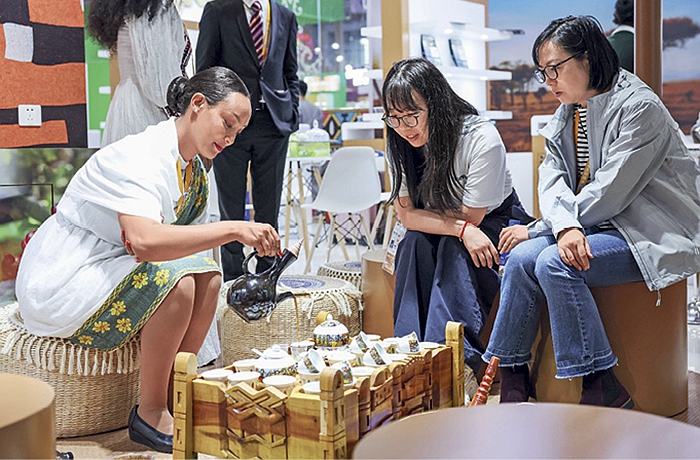
Exploring Ethiopian coffee culture at the National Pavilion of Ethiopia during the 8th China International Import Expo in Shanghai, November 7, 2025
When I received the admission email from Peking University’s Institute of South-South Cooperation and Development (abbreviated “South-South Institute”), I was in my office in Addis Ababa, working on a report about Ethiopia’s industrial parks that I was responsible for promoting. Some time later, I landed in Beijing, 15 years after my first visit in 2008, to participate in a Chinese program inviting officials from different countries of the Global South.
No ready-made answer
Most of the lecturers at the South-South Institute of Peking University have experience in public governance or business management and their courses always start from practice and not from theory alone.
Professor Wang Min spoke to us about the fight against poverty in Yunnan, talking about residents of Lisu Autonomous County in Nujiang selling their honey directly on the Internet. “The first year, many lost money. Logistical costs were exorbitant. The honey crystallized on the way and customers thought it was a counterfeit product. This provoked laughter, but Ms. Wang remained unmoved: “But think about it: if they hadn’t tried, this honey would have reached its expiration date on the mountain.” To develop, you must first proceed by trial and error, then persevere until you succeed. » She didn’t make big phrases, no “prodigious development” or “fundamental transformation”, but the word “persevere” stuck in my memory.
I suddenly remembered the Ethiopian farmers. Due to a lack of roads, their quality coffee can only be sold at low prices to buyers, and a year of work yields little. We often talk about theoretical frameworks, forgetting that perseverance is essential. This form of patience is about holding on despite failure and moving forward through chaos, which is what truly defines development.
This was not a revelation, but I began to doubt development economics textbooks, in which it is always described as a linear path that can be traced with precision.
There were over 30 people in the class, from over 20 countries. I thought the Internet had erased the differences, but I discovered that the Western media narrative had instead imposed a filter on us: Africa was poverty and war, China was cheap manufacturing and a debt trap, and the Middle East was a hotbed of religious extremism. All this transforms a complex reality into simplistic prejudices, locking us into predefined frameworks which generate mutual incomprehension. After having been represented by Western media for too long, we finally had the opportunity to express ourselves thanks to the program: no more labels like “debt trap” or “industrial dumping”. In our discussions, we no longer followed Western frameworks, but started from our respective histories and cultures to look for spaces for cooperation.
Slow logic
The institute organized a tour of a BYD factory and upon entering, I was impressed by the robotic arms that were precisely welding the bodies, the workers just carefully inspecting the work being done. I couldn’t help but ask the accompanying technician: “Wouldn’t it be better to completely automate all these steps?” » He thought for a moment before answering me: “It is technically possible but at too high a cost. Human work proves to be more flexible and makes it possible to quickly manage unforeseen events. We don’t replace overnight. » This logic of “progressive replacement” corresponds precisely to the idea of “persevere”, mentioned by Ms. Wang.
When I returned to Ethiopia, when I worked at the Ministry of Trade and Industry to promote cooperation with Chinese electric vehicle companies, the image of this factory often came to mind. At that time, some people proposed to directly introduce complete production lines, but I insisted on starting with battery assembly. The technical threshold is lower, which would enable local technicians to first understand the characteristics of the components and lay the foundation for subsequent technological improvements.
This proposal was initially the subject of strong opposition. Some said it was a “low-end transfer”, others said we deserved more advanced technologies. But thinking about the coexistence between humans and machines at BYD, I stood my ground. In hindsight, this decision allowed several hundred Ethiopian technicians to acquire real skills, instead of being mere spectators next to imported production lines.
Certainty of South-South cooperation
In today’s world, trust is eroding and geopolitical frictions are increasing. In April 2025, in an interview with Radio China International, I spoke about the impact of high US tariffs on the African Growth and Opportunity Act, indicating that these would hit African exports hard, leading to a slowdown in economic growth. External shocks would force us to accelerate regional economic integration and further diversify our supply chains.
It is in this context that China announced the application of a zero tariff treatment policy to all 53 African countries having diplomatic relations with it from May 1. These are not abstract figures from international trade: batteries from the assembly plant I am responsible for in the Hawassa industrial park will enter the Chinese market duty-free. But this also means that Ethiopian coffee producers will not have to worry about outlets if the American market is closed to them.
While the United States builds walls, China chooses to build bridges; while some question globalization, others continue to insist on the free movement of goods and people.
I now understand what Dean Huang Yiping meant when he said that patience is a quality, because it is also a modality of interaction between nations. We must not turn everything upside down overnight, but gradually lower barriers and build bridges. The Global Development Initiative proposed by China and the zero tariff treatment policy for Africa are examples of this. Instead of seeking immediate results, trust and long-term investments will ultimately connect countries together.
It has already been ten years since the South-South Institute was created and as a participant in the 2021 class, I am among its first “interns”. My takeaway from this program is that poverty is not a permanent condition, but a challenge that can be overcome through deliberate strategies adapted to specific contexts. By identifying and leveraging its own competitive and comparative advantages, a nation can design policies that are both practical and effective.
*TEKA GEBREYESUS ENTEHABU is a former Ethiopian Minister of State for Trade and Industry.