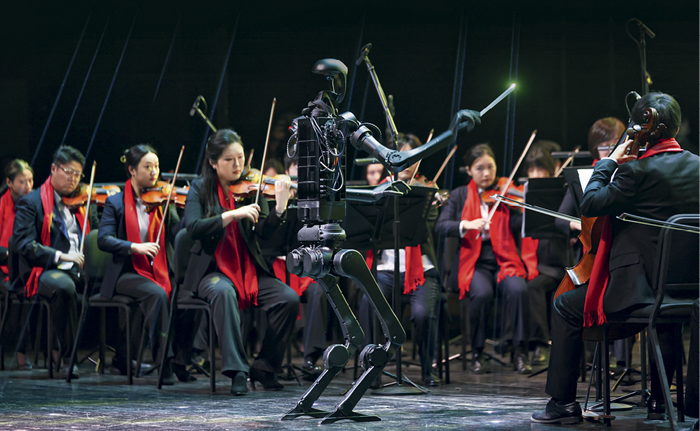
Evolving humanoid robots herald a promising future.
The robot “Zhiyin” leads an orchestra during the New Year’s concert at the Jiangxi Arts Center on December 28, 2025.
At a Wangfujing shopping mall in Beijing, a humanoid robot from Chinese manufacturer Galbot interacts naturally with customers while performing practical tasks, such as grabbing and returning items to shelves autonomously.
In recent years, humanoid robots have emerged as a pillar of global technological innovation. Thanks to artificial intelligence (AI) and advanced robotics, they occupy increasingly varied roles.
China appears to be a key player in this technological race. The country benefits from a unique ecosystem to dominate the sector: rapid innovation, a robust supply chain and rich application scenarios.
Powered by AI
In recent years, embodied AI has represented an innovative approach to research: intelligence is no longer confined to the digital space, but is created through integration into physical systems and active interaction with the real world. The humanoid robot is considered the most advanced form.
In the past, the traditional method of control was based on mathematical and physical models. The robot’s movements were broken down into equations fed into its “brain”, a bit like an instruction manual dictating which foot to put forward, what force to apply or in which direction to lean. Airplanes and automobiles are traditionally controlled this way. The advantage of this approach lies in its predictability: we understand why the machine moves and where the errors come from.
But its limits are just as obvious in the face of a changing real world. No matter how accurate the model is, variables like a slippery floor or an unexpected shock render the robot helpless. Conversely, thanks to a learning capacity based on AI, it is able to adapt its behavior depending on the context.
Rapid growth
Over the past year, start-ups specializing in this industry have multiplied, with large Internet companies, semiconductor manufacturers and new energy vehicle manufacturers entering the market. According to the China Development Report 2025 released by the Development Research Center of the State Council, the market value of embodied AI is expected to exceed 1 trillion yuan by 2035, driving meteoric progress in multiple fields, including logistics, transportation, industrial manufacturing and services.
Technological advances have allowed the emergence of increasingly sophisticated humanoid robots. In April 2025, the first humanoid robot half marathon took place in Beijing, with the participation of around twenty companies.
Tiangong Ultra, developed by the Beijing Humanoid Robot Innovation Center, won the competition with a time of 2:40:42, demonstrating the technical feasibility of bipedal walking, long-distance endurance and adaptation to complex terrain. Last January, Unitree Robotics showed that its Unitree H2 robot is capable of performing complex movements with ease, such as somersaults and punching sandbags, illustrating significant advances in control algorithms.
At the regional level, cities pursue differentiated strategies. The Beijing-Tianjin-Hebei region benefits from its concentration of scientific and technological innovation resources. The Changjiang Delta region emphasizes building data training centers and open source technology platforms. The Pearl River Delta region, relying on its manufacturing strengths and large consumer market, is focusing on the development of robots for the service sector.
Internationally, Chinese companies are establishing themselves in a market previously dominated by the United States and Japan, pioneers in research into humanoid robots. The very first humanoid robot WABOT-1 was invented at Waseda University in 1973 in Japan. US company Tesla has announced that it will commercialize its Optimus Gen 3 humanoid robot by 2027. China has its own advantage: the world’s most comprehensive supply chain, with an increasing rate of local production for key components, such as sensors and chips. Players like Unitree, thanks to their supply chain in the manufacturing of quadruped robots, have a major competitive advantage in humanoid robots.
Ambitious outlook
With a view to mass production, Chinese companies are seeking to broaden the scope of applications of their technologies.
At the end of 2025, Galbot launched an ambitious project planning the deployment of more than 1,000 units. At the same time, UBTech announced the production of its 1,000th industrial humanoid robot, the WALKER S2. The Shenzhen-based company is also setting itself a bold goal of increasing its production capacity to 10,000 units in 2026.
The application of humanoid robots is following a promising trajectory. It started in industrial factories, where they optimize manufacturing processes and improve operational efficiency, before expanding to commercial services, such as hospitality, guided tours or public safety. As such, at the end of 2025, Engine AI Robotics Technology received more than 3,000 orders for patrol robots, illustrating their potential to improve the quality of services offered in varied environments.
Ultimately, humanoid robots are expected to become important players in domestic, hospital and elderly care environments, although this remains in an exploratory phase to date. Obstacles remain numerous, notably the complexity of homes (disorder, presence of children or pets) and the diversity of household tasks, such as cooking or cleaning. Despite ongoing concerns about security and ethics, we can still imagine that one day these machines will transform our interaction with our daily environment, bringing significant benefits for both individuals and businesses.



![[C Finance]Central Bank: The goal of keeping the RMB exchange rate basically stable will not change](https://beijingherald.com/wp-content/uploads/2025/01/C-FinanceCentral-Bank-The-goal-of-keeping-the-RMB-exchange-120x86.jpeg)