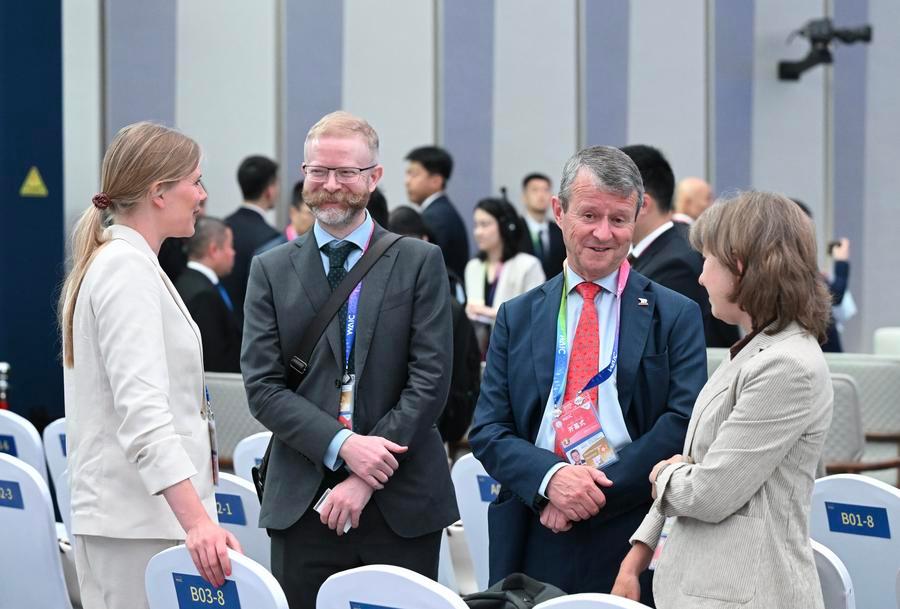
Guests chat before the opening ceremony of the 2026 World Artificial Intelligence Conference (WAIC) and High-level Meeting on Global AI Governance, in Shanghai, east China, July 17, 2026. (Xinhua/Xie Huanchi)
China’s rapid progress in artificial intelligence (AI), supported by open models, a strong industrial base and large-scale application capabilities, could reduce technology costs and allow more countries and people to benefit from technological advances, said Toby Walsh, an Australian AI researcher.
SYDNEY, July 17 (Xinhua) — China’s rapid progress in artificial intelligence (AI), supported by open models, a strong industrial base and large-scale application capabilities, could reduce technology costs and allow more countries and people to benefit from technological advancements, said Toby Walsh, an Australian AI researcher.
He, scientific director of the AI Institute at the University of New South Wales (UNSW), spoke in an exclusive interview with Xinhua as the 2026 World Conference on Artificial Intelligence is being held in Shanghai from July 17 to 20.
Having participated in previous years’ editions, Mr Walsh said the conference highlighted the dynamism of the development of AI and robotics in China, adding that he hoped to see further advances in these fields at this year’s edition.
He said he was impressed by China’s progress in AI over the past 10 to 15 years. In many ways, China has risen to the forefront of global AI development, with some of the world’s largest and most capable models now being developed in the country, he noted.
Regarding DeepSeek and other major Chinese language models, Walsh said China has continued to advance open models, allowing more research institutes, enterprises and countries to participate in the development and application of AI.
“I think it will be very useful to see these models used not only in China, but also around the world,” he said.
Mr. Walsh described AI as a general-purpose technology, comparable to electricity, that should eventually be available to everyone rather than remaining concentrated in the hands of a small number of large technology companies. Smaller, more specialized models, aimed at fields such as agriculture, medicine and education, could run on smartphones or personal computers at lower cost, making them easier to use and share globally.
Another area of particular interest to Mr Walsh is humanoid robots. On a recent visit to Beijing, he saw robots playing ping-pong, serving meals and cleaning rooms, and was impressed by the rapid progress and falling prices in China’s humanoid robotics sector.
“You could have spent hundreds of thousands of dollars to buy a humanoid robot before. Now you’re just spending a few tens of thousands of dollars, and that will definitely expand the market,” he noted.
China’s industrial base, supply chains and large domestic market all play a critical role in reducing production costs and expanding the use of humanoid robots, Walsh said, adding that China is well positioned to make robots not only for its own market and factories, but also for many other countries.